
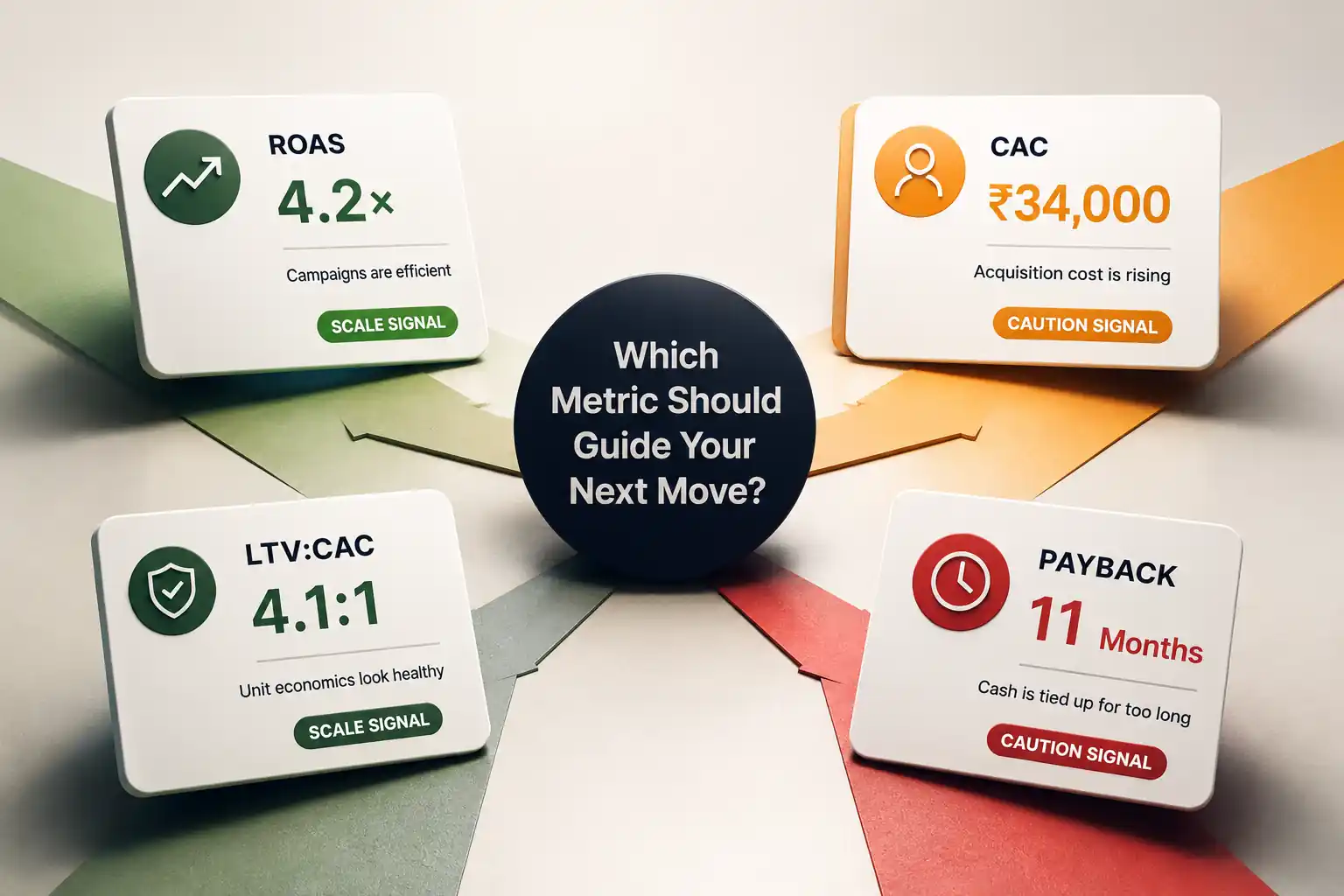
Your ROAS is 4.2 and rising. Your cost per acquisition has crept up 18% this quarter. Your lifetime value to acquisition cost ratio is comfortably above four. And your finance director has just asked why the bank balance keeps falling.
Every one of those numbers is correct. They disagree because they are answering different questions, and nobody told you which one you were supposed to be asking.
The short answer
ROAS measures media efficiency over a period. CAC measures what a customer costs to acquire, including work that is not media. LTV to CAC measures whether the business model works over a customer’s lifetime. Payback period measures how long your money is tied up before it returns. They are not more or less accurate versions of each other — they answer separate questions and are silent on the rest. The one that should govern your decisions is the one matching your actual constraint, and for a business growing on its own cash flow that is usually payback.
Key takeaways
- Four metrics, four questions. Efficiency, cost, viability, velocity.
- They routinely disagree, and that is information rather than a measurement failure.
- The widely quoted thresholds come from funded US businesses — LTV:CAC above 3.5:1, payback under 12 months for SMB. They assume access to capital.
- A business funded from operating cash flow is capped by payback, not by efficiency. Excellent ROAS does not let you grow faster than your money returns.
- Manage the metric that binds you. Optimising a metric that is not your constraint produces improvement you cannot use.
Why the dashboard framing fails
Most guidance on this presents four metrics as a panel — track them all, keep them healthy, act when one moves.
That works when the numbers agree. The difficulty arrives when they do not, which is often, and the panel offers no rule for adjudicating.
A worked disagreement. A campaign returns ₹4.20 for every rupee of media spend. Excellent by any ROAS standard. But when you add the sales team’s time to close those leads, the cost per acquired customer is ₹34,000 against a customer worth ₹1,20,000 over three years. The lifetime ratio looks fine. And the money comes back over eleven months, while the business turns over its working capital every four.
All three readings are true. Only one of them is your problem.
The panel cannot tell you which, because it treats the metrics as complementary views of one thing when they are actually measurements of four different things.
What each metric actually asks
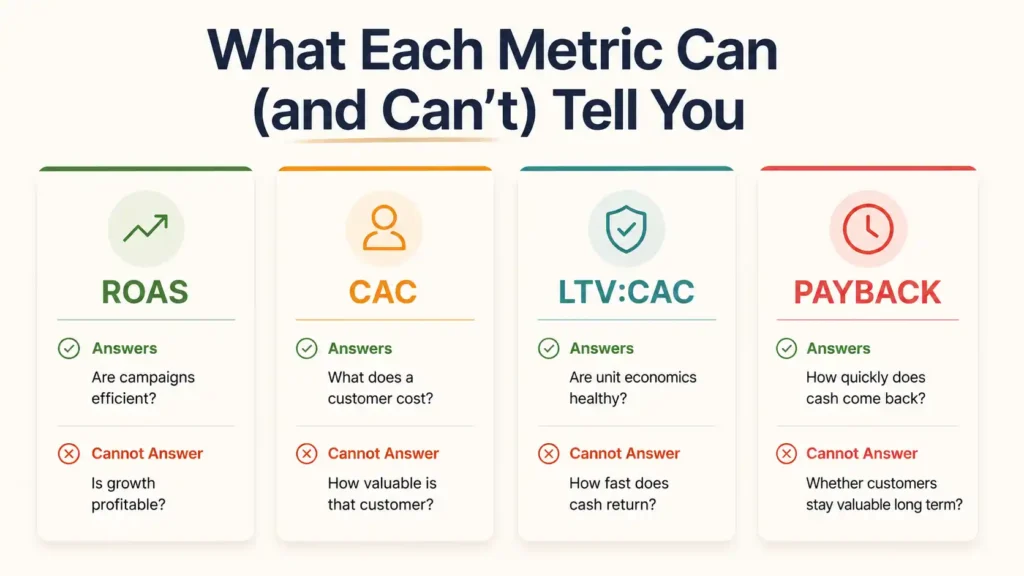
ROAS — is the media efficient?
The question. For every rupee spent on advertising, how much revenue came back within the attribution window?
What it is good for. Comparing campaigns, channels and creatives against each other on the same basis. It is the fastest signal you have and the one that updates daily.
What it is silent on. Everything that is not media. It does not know your gross margin, your sales costs, your delivery costs or whether the revenue was profitable. A 4:1 ROAS at 25% gross margin is break-even; the same figure at 70% margin is excellent — the arithmetic is at how to calculate your break-even ROAS, which is the first thing to establish before reading any ROAS figure at all.
Its other blind spot. It counts revenue that would have arrived anyway. Brand-term campaigns and remarketing routinely post spectacular ROAS by taking credit for demand that already existed.
CAC — what does a customer actually cost?
The question. Across everything you spend to acquire customers, what is the cost per new customer?
What it includes that ROAS does not. Sales salaries, agency fees, tooling, content production, and the proportion of time senior people spend on acquisition. A properly calculated CAC is often two to three times the media-only figure.
Why the fuller version matters. In B2B especially, media is frequently the smaller half of acquisition cost. An account with a ₹6,000 cost per lead and a 20% close rate has a ₹30,000 media CAC — before anyone’s salary.
What it is silent on. Whether that cost is justified. CAC alone is a number without a verdict; it needs lifetime value beside it.
The common error. Calculating CAC on all customers rather than new ones, which flatters it substantially in any business with repeat purchase.
LTV to CAC — does the business model work?
The question. Over a customer’s lifetime, does the value exceed what it cost to acquire them, by enough?
The widely quoted threshold is around 3.5:1 as a signal that a segment is ready to scale, with lower ratios suggesting the economics are too tight to push.
What it is good for. Deciding whether a business or a segment is fundamentally viable, and whether to keep investing in it.
What it is silent on. Time. A 5:1 ratio realised over four years and a 5:1 ratio realised over four months are indistinguishable in the ratio and completely different to run.
Two practical cautions. Use gross profit rather than revenue in the lifetime figure, or the ratio flatters. And be honest about retention assumptions — most LTV calculations assume a customer lifespan the business has never actually observed.
Payback period — how fast can you grow?
The question. How many months until the money you spent acquiring a customer comes back?
The quoted thresholds flag anything above 12 months for SMB-focused businesses and 24 months for enterprise.
What it is good for. Working out your maximum sustainable growth rate, which no other metric here tells you.
Why it is the one most often ignored. It is the least flattering, it does not appear on any advertising dashboard, and it requires talking to finance.
The Binding Metric
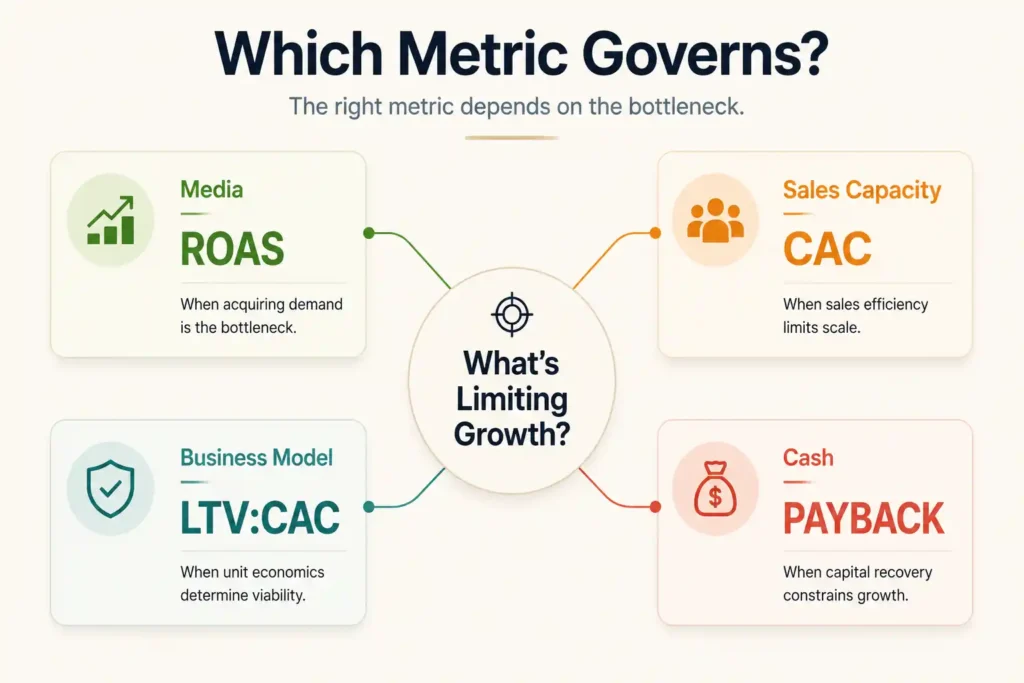
Four metrics, four constraints. The one that should govern your decisions is the one you are actually limited by — and optimising a metric that is not your constraint produces improvement you cannot use.
Identify your constraint and the metric follows.
If media budget is the constraint — you have more demand than money to capture it — manage ROAS. Efficiency is what converts a fixed budget into more customers.
If sales capacity is the constraint — leads arrive faster than anyone can call them — manage CAC, fully loaded. More leads make the problem worse; better leads make it smaller. And speed matters more than volume here: the Harvard Business Review audit of 2,241 companies found an average first response of 42 hours, with 23% never responding at all.
If you are deciding whether to continue — a new segment, a new market, a new product line — manage LTV to CAC. It is the only one of the four that answers whether the thing is worth doing at all.
If cash is the constraint — and for most self-funded businesses it is — manage payback period. This is the case the standard advice handles worst, so it is worth stating carefully.
The case the imported thresholds do not cover
A 12-month payback is unremarkable advice, and it comes from a world where the gap between spending and recovering is bridged by capital.
Take a business growing on its own cash flow. It acquires a customer for ₹30,000. That customer returns ₹30,000 of gross profit over eleven months. The ratio over three years is excellent. Efficiency is fine.
But the business can only acquire as many customers per month as its cash allows, and each one locks up ₹30,000 for the better part of a year. Doubling acquisition means doubling the cash tied up in customers who have not yet paid for themselves.
So growth is capped by cash, not by campaign performance. Improving ROAS from 4:1 to 5:1 does not raise the ceiling — it lowers the cost per customer slightly, which helps at the margin and does not change the structure.
What actually moves the ceiling. Shortening payback: taking payment earlier, adding an upfront component, restructuring the offer so more value is collected in month one. Those are commercial changes, not marketing ones, which is why a marketing team optimising ROAS in this situation can work hard and produce very little.
Why this matters in India particularly. The thresholds circulating in this material come from US SaaS operating practice, where a funded company can comfortably run negative for eighteen months. A self-funded Indian business — the majority of the SME market — cannot, and applying the imported number produces a plan that is arithmetically fine and practically impossible.
When they disagree, what to do
ROAS good, CAC bad. You are counting media only. Recalculate CAC with salaries and fees included, then decide whether the media efficiency was ever the point.
CAC good, LTV:CAC bad. You are acquiring cheaply into a business model that does not retain. That is a product or service problem, and more marketing accelerates the loss.
LTV:CAC good, payback bad. The classic profitable-but-broke position. Nothing in marketing fixes it; the fix is commercial terms.
Everything good, revenue flat. Usually attribution. Platforms overstate collectively when more than one runs — why platforms count the same sale twice covers reconciling reported conversions against actual sales.
Everything good, cost per acquisition rising anyway. You may be exhausting available demand. Around 5% of buyers are in-market at any moment, per Ehrenberg-Bass research for the LinkedIn B2B Institute, and pushing further into a fixed pool raises the price of the marginal customer.
Getting the inputs right
Briefly, because most measurement failures are input failures rather than formula failures.
Use gross profit, not revenue, everywhere it appears. Revenue-based LTV overstates by exactly your cost of goods.
Count new customers, not all customers, in CAC.
Include the non-media costs. Salaries, agency fees, tools, and creative production. If it exists to acquire customers, it belongs in CAC.
Reconcile platform figures against your own records before calculating anything. If the two disagree, the CRM is right.
Observe retention rather than assuming it. Most LTV figures rest on an assumed customer lifespan nobody has measured.
Match the period to the sales cycle. A quarterly ROAS on a six-month cycle is comparing this quarter’s spend against last quarter’s outcomes.
Mistakes that cost real money
Optimising a metric that is not your constraint. Real work, no usable result.
Reporting media-only CAC to the board. It will be challenged the first time someone adds up the salaries.
Treating LTV:CAC as a growth signal without checking payback. The two most common failure modes in this article sit exactly here.
Importing US thresholds into a self-funded business. Arithmetically fine, practically impossible.
Using revenue in lifetime value. Inflates every ratio by your cost of goods.
Judging brand-term campaigns on ROAS. They will always win and they are mostly counting demand that already existed.
When better measurement is not the answer
When the offer is uncompetitive. No metric improves it and every metric will tell you so slowly.
When your data is unreliable. Fix tracking before calculating anything — otherwise you are managing numbers that are not true.
When the constraint is operational. Slow follow-up, capacity limits and delivery bottlenecks show up as marketing problems and are not.
When the business is too new to have a lifetime value. An LTV built on three months of history is a forecast wearing a metric’s clothes.
When measurement itself is the activity. Half your marketing produces effects you cannot attribute at all — why you can only measure half of what works covers what that means for budgets.
The measurement checklist
☐ Gross profit used everywhere, never revenue
☐ CAC calculated on new customers only
☐ Salaries, agency fees, tools and creative costs included in CAC
☐ Break-even ROAS established before reading any ROAS figure
☐ Retention observed rather than assumed in the lifetime value
☐ Payback period calculated and stated in months
☐ Working capital cycle compared against payback period
☐ Constraint identified — media, sales capacity, viability, or cash
☐ Binding metric named and agreed with finance
☐ Platform-reported conversions reconciled against actual sales
☐ Brand-term performance reported separately from acquisition
☐ Reporting period matched to the sales cycle
Questions we get asked
What is a good ROI for performance marketing?
Above your break-even, sustained. The break-even is set by your gross margin, so no universal figure exists and any article offering one has not seen your accounts.
What is the difference between ROAS and CAC?
ROAS measures revenue against media spend. CAC measures total acquisition cost per new customer, including sales and overheads. A campaign can look efficient on the first and expensive on the second.
What is a good LTV to CAC ratio?
Commonly quoted around 3.5:1 as a scaling signal. Worth treating as a starting reference rather than a target, and worth nothing at all without a payback period beside it.
How do I calculate customer acquisition cost?
Total acquisition spend — media, salaries, agency, tools — divided by new customers acquired in the same period. Most published CACs omit at least two of those four.
Which marketing metric matters most?
The one measuring your constraint. If you are cash-limited, payback. If budget-limited, ROAS. If capacity-limited, fully loaded CAC.
Why do my metrics contradict each other?
Because they measure different things over different periods. Contradiction is usually information about where your constraint actually sits.
The question to settle first
Before improving any number, work out what is actually stopping you growing.
If you could spend more tomorrow and confidently acquire more customers, your constraint is budget and ROAS is your metric.
If the leads are already arriving faster than anyone can answer them, your constraint is capacity and fully loaded CAC is your metric.
And if the honest answer is that you could sell more but cannot afford to wait for the money to come back, your constraint is cash — and no amount of campaign optimisation will move it. That one is settled in your payment terms, not in your ad account.
If you would like the four numbers calculated properly against your accounts, and an honest view of which one is holding you back, you can reach out to us on whatsapp at +91 7738844851.
More in Blog
Keep reading
All articles →


Ready to talk about your growth?
Tell us what's stuck and we'll tell you what we'd do first. Free, 30 minutes, no pitch.