
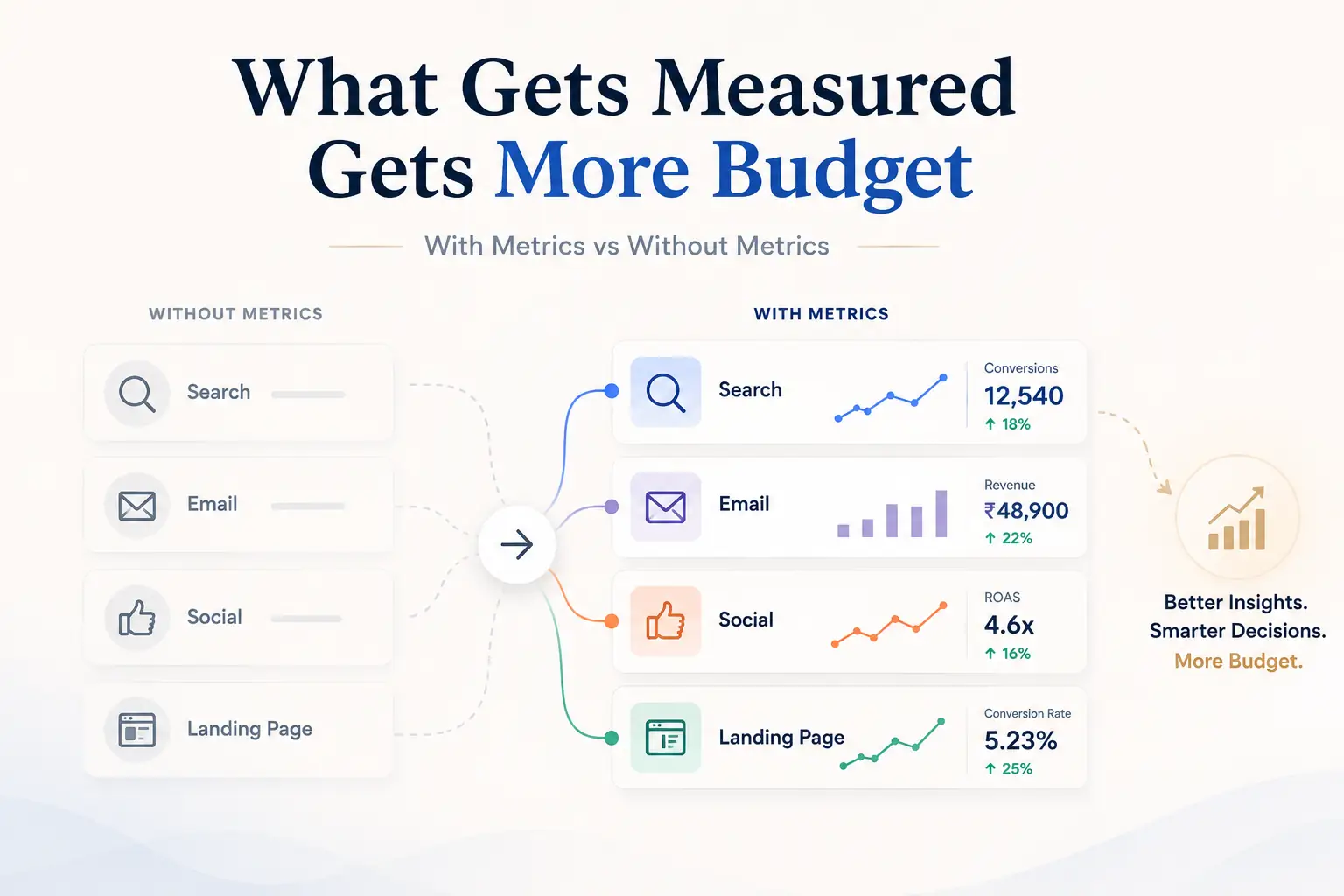
The answer everyone gives is correct and takes one sentence. Performance marketing is the accountable subset of digital marketing — the channels where spend maps to a measurable outcome.
The more useful question is why anyone drew the line there, and what happens to a business that takes the categories seriously.
Because the split is not between things that work and things that do not. It is between things you can prove and things you cannot — and budgets follow proof.
The short answer
Digital marketing is everything you do online. Performance marketing is the part where a rupee spent connects to a countable action — paid search, paid social, affiliate, retargeting. The distinction is real, and it is a distinction about measurability rather than about effectiveness. That matters because organisations fund what they can demonstrate, so the unmeasurable half loses budget first regardless of what it contributes. And since roughly 5% of buyers are in-market at any moment, the measurable half only ever reaches a small fraction of your future customers.
Key takeaways
- Performance marketing is a subset defined by measurability, not by results.
- Budgets follow what can be proven, which is why brand and demand creation are cut first in a downturn.
- Around 5% of buyers are in-market at any time. Measurable channels reach that 5%.
- Attribution decides the split in practice, and last-click systematically credits the harvest rather than the sowing.
- The useful question is not which to choose but what proportion of your results you are willing to be unable to prove.
What each term actually covers
Briefly, because this part is not contested.
Digital marketing is the whole set — search advertising, paid social, SEO, content, email, organic social, PR, community, partnerships, everything done through a screen.
Performance marketing is the subset where you can attribute an outcome to a spend with reasonable confidence. Paid search and paid social with conversion tracking. Affiliate and partner arrangements paid on result. Retargeting. App install campaigns.
The boundary is not tidy. SEO produces measurable outcomes but no per-rupee attribution. Email is measurable and usually not paid per action. Organic social produces revenue nobody can trace. Each sits somewhere on a spectrum rather than in one box, and the categories are conventions rather than laws.
Where they genuinely differ is speed and provability. Performance channels produce a number this month. The rest produce an effect you infer.
The Measurable Half
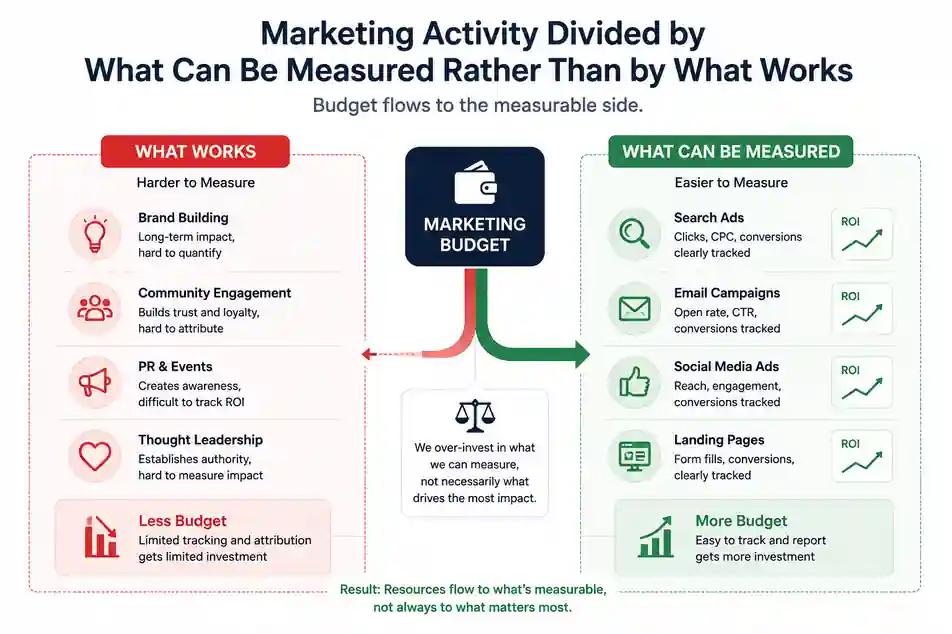
The line between performance marketing and everything else is drawn by what can be attributed, not by what works. Organisations fund what they can demonstrate — so the half that cannot be proven loses budget first, whatever it contributes. That is a measurement problem being solved as though it were a strategy decision.
Follow what happens inside a business that takes the categories at face value.
A quarterly review arrives. The paid search campaign shows 240 conversions at a stated cost per acquisition. The content programme shows traffic and time on page. The brand work shows impressions.
Only one of those survives a hostile question. So budget moves toward paid search, because paid search can answer.
The move looks rational and is partly circular. Paid search captures demand — people already searching for what you sell. It converts efficiently precisely because the buyer arrived pre-qualified. What it does not do is create the intention that produced the search.
Meanwhile the activity that created that intention has been defunded, because it could not produce a comparable number.
The result is a business that harvests demand it has stopped creating. Efficiency metrics look excellent for two or three quarters. Then the volume of available demand stops growing, cost per acquisition rises as you push further into a fixed pool, and nobody can identify what changed — because the thing that changed was defunded eighteen months earlier and never appeared in a report.
Why the small in-market share matters here
The distinction becomes consequential because of a fact about buyers.
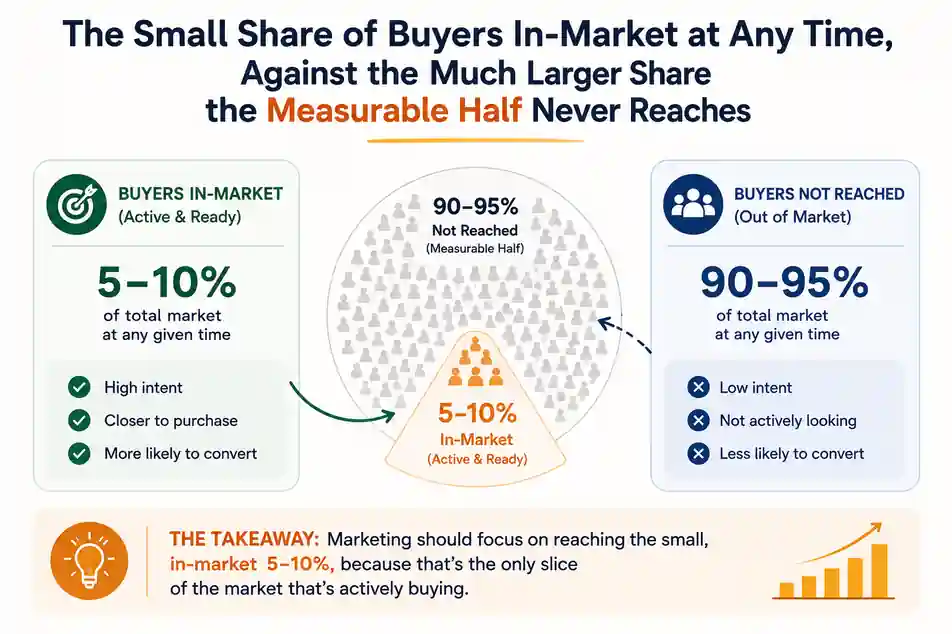
Research by Professor John Dawes at the Ehrenberg-Bass Institute, published through the LinkedIn B2B Institute, put the proportion of B2B buyers in-market at any given time at approximately 5%.
Measurable channels reach the 5%. Search captures people who are looking now. Retargeting reaches people who have already engaged. Both work on demand that exists.
The other 95% are reachable only through activity that cannot be attributed cleanly — content they read, a post they saw, a name they half-remember. That work pays off on a timescale that outlasts any quarterly review, which is exactly why it is vulnerable.
This is not an argument against performance marketing. Capturing existing demand is the cheapest revenue available and should be funded first. It is an argument against mistaking the measurable half for the whole, which is what the vocabulary encourages.
Attribution is what actually decides the split
The mechanism is worth naming, because it is fixable in a way the philosophy is not.
Last-click attribution credits the final touch. Someone reads three of your articles over six months, sees a social post, then searches your brand name and clicks a paid ad. Last-click gives all of it to the paid ad.
So the channel closest to the purchase always looks best, and the channels that made the purchase possible always look worst. The measurement method produces the conclusion, and the conclusion produces the budget.
Two practical corrections.
Reconcile platform-reported results against your own records. Platforms overstate collectively — the same buyer often appears in two dashboards at once, covered in why platforms count the same sale twice.
Track branded search volume as a standing metric. It is the cleanest available proxy for demand you created and cannot attribute. If it rises while your unmeasurable spend rises, that relationship is worth more than any single-channel report.
Underneath both, know what a conversion is worth before judging any channel — working out what a lead is actually worth has the arithmetic.
What this means for how you buy
If you are hiring an agency, the label tells you what they measure rather than what they can do. A performance marketing agency will produce numbers. Ask what it does about the part that does not produce numbers, and listen for whether the answer is “nothing” or “we measure it differently.”
If you are setting a budget, decide the split deliberately rather than letting the reporting decide it. The default outcome of a measurement-led review is a steadily shrinking demand-creation budget, and nobody ever votes for that explicitly.
If you are choosing a career direction, performance marketing skills are more legible and more portable. The broader discipline is harder to demonstrate and harder to automate.
If you are early and small, fund the measurable half first. Capturing existing demand is the right first move, and how to allocate a budget across stages covers when the second half becomes affordable.
Mistakes that cost real money
Treating unmeasurable as ineffective. The two words are not synonyms and the vocabulary encourages the confusion.
Judging every channel on last-click. It rewards the harvest and punishes the sowing, every time.
Cutting demand creation because it cannot answer a quarterly question. The cost appears four quarters later, unattributed.
Adding platform-reported conversions together. They overstate collectively.
Believing the categories are natural. They are conventions that suit reporting, and SEO, email and organic social sit awkwardly across the boundary.
Ignoring response speed while optimising media. The Harvard Business Review audit of 2,241 companies found an average first response of 42 hours and 23% never responding — no channel survives that, measurable or otherwise.
When the distinction does not help you
When your budget only funds one thing. Then it is not a split, it is a choice, and the choice is usually to capture existing demand first.
When nobody in the business knows what a customer is worth. Every argument above depends on it.
When your market is small enough to reach directly. Categories designed for auction-based media do not describe a market of two hundred accounts.
When the offer or the follow-up is the constraint. Neither half fixes that, and both make it more expensive.
Questions we get asked
Is performance marketing part of digital marketing?
Yes — the subset where spend maps to a countable outcome.
Which is better?
Neither. One is a category and the other is a subset of it. The real question is what proportion of your results you can accept being unable to prove.
Is SEO performance marketing?
It sits across the line. Outcomes are measurable; per-rupee attribution is not. Most classifications place it outside performance marketing for that reason rather than because it performs less well.
Which pays better as a career?
Performance skills are easier to evidence and command clearer premiums early. Broader marketing judgement is harder to demonstrate and harder to replace later.
Do I need both?
Eventually. Early on, fund the measurable half — but decide that deliberately rather than by default, because the default never reverses on its own.
Why do agencies use the word “performance”?
Because it signals accountability, which is a reasonable thing to signal. It also quietly implies everything else is unaccountable, which is where the trouble starts.
The question to ask at your next review
When a channel comes up for cutting, ask one thing before deciding: is this underperforming, or is it unmeasurable?
They produce identical-looking reports and require opposite responses.
Most businesses have never separated the two, and the ones that do usually find that the activity they were about to cut is the reason the measurable half still has anything to harvest.
If you would like help working out which half of your marketing is which — and what your reporting is currently hiding — you can reach out to us on whatsapp at +91 7738844851 .
More in Blog
Keep reading
All articles →


Ready to talk about your growth?
Tell us what's stuck and we'll tell you what we'd do first. Free, 30 minutes, no pitch.