
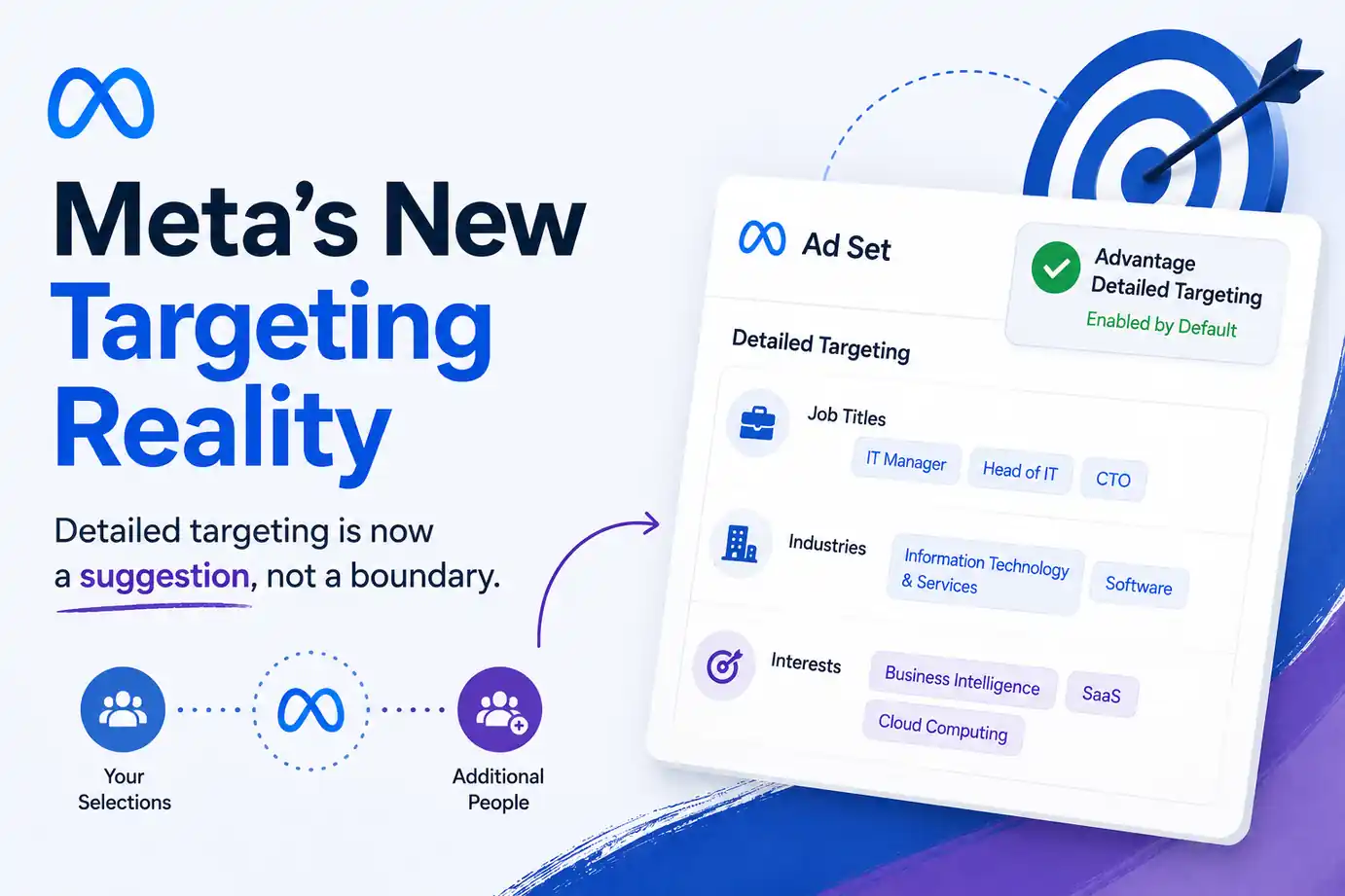
Open any guide to B2B advertising on Meta and it will tell you to select the business decision-maker audiences, layer a custom audience from your CRM, and build lookalikes.
The first instruction stopped constraining anything in January.
That change matters more for B2B than for anyone else, because B2B advertisers were relying on targeting to compensate for something else they do not have: enough conversions to teach the algorithm what a good customer looks like.
The short answer
Meta’s detailed targeting selections now function as suggestions rather than constraints, and Advantage Detailed Targeting cannot be switched off for conversion and link click objectives. Delivery is decided by what the system predicts will convert. That makes your conversion event the only meaningful steering input — and B2B businesses rarely produce enough qualified leads to feed one. Meta’s learning phase needs roughly 50 optimisation events per ad set within a rolling seven days. Twenty qualified leads a month cannot get near it.
Key takeaways
- Detailed targeting is now a suggestion. Reported changes from 15 January 2026 deprecated interest-stacking and made Advantage Detailed Targeting non-optional on conversion objectives.
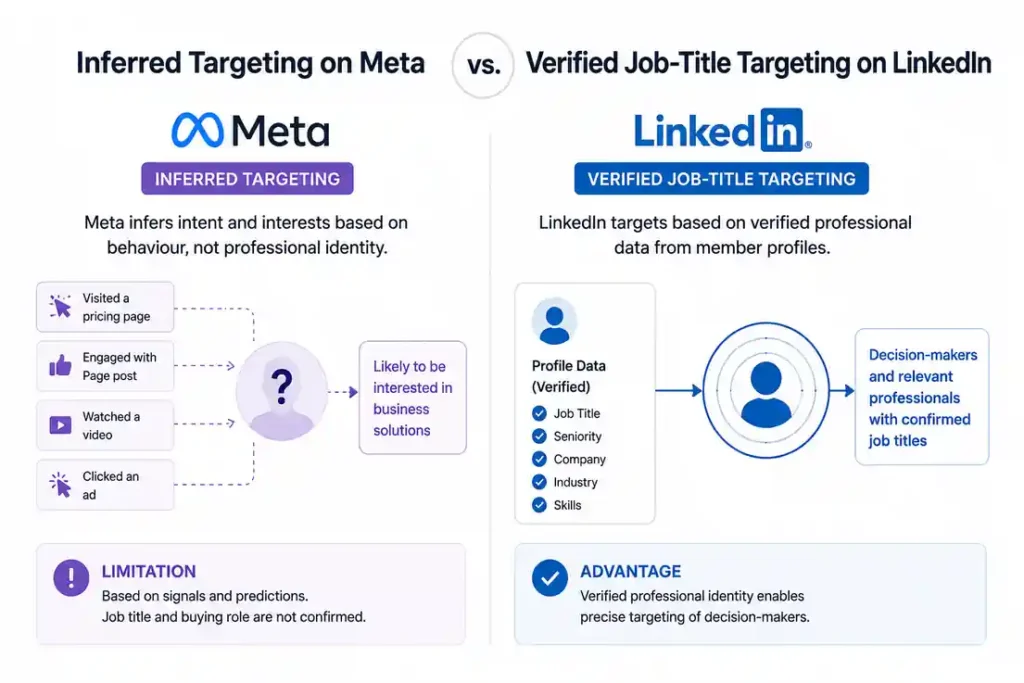
- Meta’s decision-maker segments were always inferred, never verified. LinkedIn knows a job title because someone typed it in public. Meta guesses from behaviour.
- Your conversion event now steers delivery. It is the main input you still control.
- Meta needs about 50 optimisation events per ad set per week — roughly 200 a month, per ad set. Most B2B pipelines cannot produce that at any useful depth.
- This is why B2B Meta accounts produce junk leads, and why the budget gets cut before anyone diagnoses it properly.
What changed, and why it hits B2B hardest
Reported platform changes indicate that on 15 January 2026 Meta stopped delivering ads from ad sets relying on deprecated detailed targeting interests, following a consolidation of behaviour and interest segments running from June 2025. Detailed targeting still appears in the interface. Your selections are now treated as suggestions the system may exceed, and Advantage Detailed Targeting is enabled by default and cannot be turned off for conversion and link click campaigns.
For a consumer advertiser this is mostly fine. The system is often better than manual selection at finding people who will buy a ₹2,000 product, and there are plenty of them.
For B2B it removes the one lever that was holding the campaign together.
A B2B advertiser’s problem has always been that their buyer is rare. Perhaps a few thousand people in India can sign off on what you sell. Targeting was the crude instrument that kept delivery somewhere near them. Take it away and the system optimises toward whoever looks likely to complete your conversion event — and if your conversion event is a form fill, it will find people who fill in forms.
Meta’s B2B segments were never LinkedIn’s
Worth being precise about, because the guides treat these as equivalent and they never were.
LinkedIn’s targeting is declared and socially verified. A user types their job title, employer and function, and their colleagues can see it. Lying is possible and awkward. The data is imperfect but it is a statement of fact by the person themselves.
Meta’s is inferred. “IT decision-maker” is a prediction derived from behaviour — pages engaged with, content consumed, apps used, signals correlated across a graph. Nobody told Meta they run an IT department. The system concluded it.
That difference matters at the margins where B2B lives. An inference that is 70% accurate is useful for a consumer category with millions of buyers. For a category with four thousand qualified buyers in India, a 30% error rate against a population you cannot verify is a different proposition entirely.
Which is not an argument against Meta for B2B. Whether Meta belongs in your B2B mix at all covers that question properly. It is an argument against expecting Meta’s segments to do LinkedIn’s job — and after January, an argument against expecting them to do much at all.
The Signal Ceiling
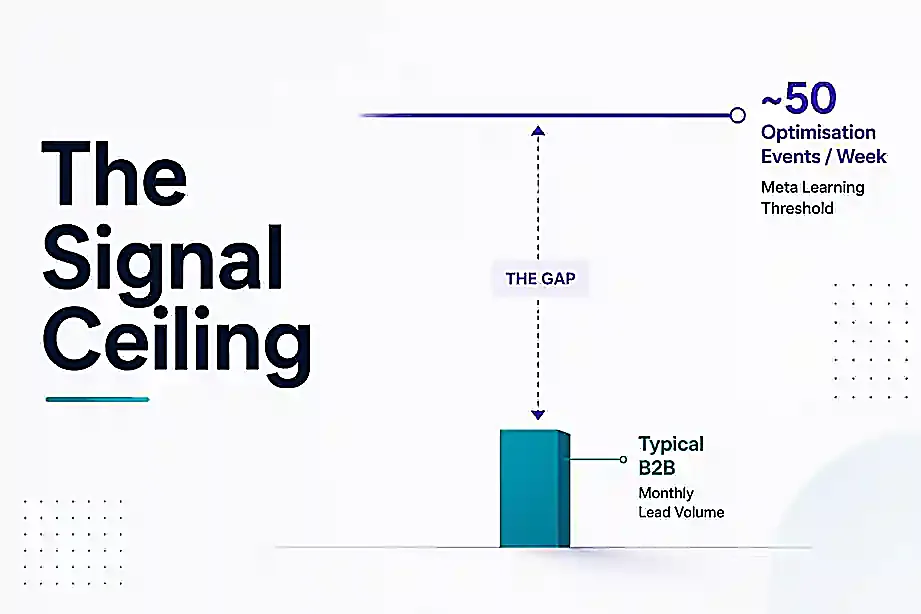
How deep into your funnel you can optimise is capped by how many events you produce, not by how much you spend. Meta needs roughly 50 optimisation events per ad set each week. Below that, the system stops learning — so the more qualified your conversion event, the less able Meta is to find more of it.
The arithmetic is short and unpleasant.
Meta’s learning phase requires approximately 50 optimisation events per ad set within a rolling seven-day window. That is about 200 a month, from a single ad set.
Now take a typical Indian B2B business. Sixty form fills a month, of which perhaps twenty are worth a sales conversation, of which three or four become opportunities.
Optimise toward closed deals — four a month against a 200 requirement. The system learns nothing.
Optimise toward qualified leads — twenty a month. Still a tenth of what one ad set needs.
Optimise toward form fills — sixty. Closer, still short, and now you are instructing Meta to find people who fill in forms rather than people who buy.
The ceiling is set by your pipeline. No budget increase fixes it, because the constraint is the number of qualified people who exist, not the number of impressions you can buy.
And this is the mechanism behind the complaint. B2B advertisers optimise toward the only event with enough volume, the system obliges, and the leads are poor — not because Meta is bad at B2B but because it was told to find form-fillers and did so efficiently.
Three ways through the ceiling
None is perfect. Pick deliberately rather than by default.
Optimise shallow, qualify hard
Accept a shallow conversion event, then do the filtering yourself — before the form and inside it. Higher-intent form settings, a qualifying question, price stated up front. Why frictionless forms produce unqualified leads sets out the mechanics.
Works when you have sales capacity to qualify and a fast follow-up process.
Fails when nobody calls for two days.
Feed the outcome back
Use offline conversion imports so closed deals return from your CRM. Even below the learning threshold, quality signal shapes the model over time, and it stops you optimising toward the wrong thing.
Works when your CRM is disciplined and the sales cycle is under a quarter.
Fails when deals take nine months — the feedback arrives after the campaign has changed.
Stop optimising for conversions entirely
Run reach or traffic objectives, treat Meta as a demand channel, and measure elsewhere — branded search volume, direct traffic, enquiries that mention seeing you.
This sounds like giving up. It is the honest response to a pipeline that cannot feed a conversion model, and it aligns with what Meta is actually good at for B2B: reaching the roughly 95% of buyers not currently in-market, per Ehrenberg-Bass research for the LinkedIn B2B Institute. How B2B demand generation actually works covers measuring that properly.
Works when you have patience and a way to observe demand.
Fails when the business needs attributable pipeline this quarter.
Why the budget gets cut anyway
Even when Meta is working, it loses the argument internally. Three reasons compound.
The buyer did not search. There is no query to credit, so the ad has no obvious causal link to the enquiry.
The gap is long. Someone exposed for six months who then searches your brand name arrives as branded search or direct. Meta gets nothing.
The comparison is unfair. Google captures demand that already exists and reports a clean cost per lead. Meta creates familiarity and reports a bad one. Set side by side in a last-click dashboard, Meta always loses — including in the quarters where it is doing the work that fills Google’s pipeline.
What to do instead of arguing. Report branded search volume from Search Console monthly. Add “where did you first hear of us” to enquiry calls. Track direct traffic. None is perfect and all three beat defending a last-click number you know is wrong. If you need the arithmetic for what a qualified lead is worth before any of this means anything, working out what a qualified lead is actually worth covers it.
What actually works now
Your own data, above everything. Customer lists, CRM contacts, high-value segments. First-party audiences were always the strongest input on Meta and after January they are close to the only reliable one.
Lookalikes from good customers, not from all leads. A lookalike built on everyone who filled a form models form-fillers. Build from closed customers, ideally your best ones.
Retargeting. Consistently Meta’s strongest B2B performer, because the audience is defined by behaviour you observed rather than by an inference.
Creative that disqualifies. With targeting weakened, your ad is doing the filtering. Name the buyer, name the price band, name the problem in language only a real prospect would recognise.
Fewer ad sets. Fifty events a week is per ad set. Splitting a thin B2B pipeline across five ad sets guarantees none of them learns.
Mistakes that cost real money
Still building on detailed targeting. The interface implies it works. It suggests.
Optimising toward form fills and complaining about lead quality. You specified the outcome precisely.
Lookalikes seeded from unqualified leads. Garbage in, at scale.
Running many ad sets on a thin pipeline. The most common structural error in B2B Meta accounts.
Judging it on last-click. It will always lose, including when it is working.
Expecting Meta to replace LinkedIn. Different instruments. One reaches people in work mode with declared titles; the other reaches the same people far more cheaply with no idea who they are.
When Meta is the wrong channel for your B2B
When your buyer universe is very small. A few hundred target accounts in India means account-based outreach, not broadcast.
When you cannot produce or qualify volume. If sixty form fills a month would overwhelm you, and twenty qualified leads cannot feed the algorithm, you are squeezed from both ends.
When your sales cycle exceeds a year. Feedback loops that long make optimisation nearly meaningless and attribution entirely so.
When you need attributable pipeline this quarter. Search captures existing demand and reports it cleanly. Whether your budget can fund more than one platform covers choosing between them.
The B2B Meta checklist
☐ Monthly volume counted at three depths — form fills, qualified leads, closed deals
☐ Each compared against roughly 200 events per ad set per month
☐ Conversion event chosen deliberately from what your pipeline can actually feed
☐ Ad set count minimised to concentrate the data
☐ Customer list uploaded as a custom audience
☐ Lookalikes built from closed customers, not from all leads
☐ Retargeting audiences live and separated from prospecting
☐ Offline conversion import configured if the sales cycle allows
☐ Creative written to disqualify as well as attract
☐ Baseline branded search volume recorded in Search Console
☐ “Where did you first hear of us” added to enquiry calls
☐ Review interval matched to the sales cycle, not to the reporting cycle
Questions we get asked
Do Facebook Ads work for B2B?
For retargeting and demand creation, consistently. For cold prospecting toward qualified leads at volume, rarely — and the reason is arithmetic rather than platform quality.
How do you target decision-makers on Meta now?
Mostly you do not, in the sense the guides mean. You upload people you already know, build lookalikes from good customers, and write creative that only the right reader responds to.
Is LinkedIn better than Meta for B2B?
For reaching a declared job title with intent, yes, and it costs accordingly. Meta reaches the same people much more cheaply with no verification. Most B2B programmes that work use both for different jobs.
Why are my B2B Facebook leads unqualified?
Almost always because the campaign is optimising toward form fills — the only event with enough volume to feed the system. The fix is upstream of the form.
What should a B2B company optimise for on Meta?
The deepest event your pipeline can supply at roughly 200 a month per ad set. For most Indian B2B businesses that is shallower than they would like, which is the point of this article.
Has Advantage+ made this better or worse?
Better at finding people likely to complete your chosen event. Worse if that event is a poor proxy for a customer — the system is now more efficient at delivering exactly what you asked for.
Two numbers, then decide
Count your monthly volume at three depths: form fills, qualified leads, closed deals. Then set each against 200 a month per ad set.
Wherever the number falls short — which for most B2B businesses is everywhere except form fills — you have found the ceiling. What you do about it is a choice between qualifying harder, feeding outcomes back, or accepting that Meta’s job here is demand rather than pipeline.
What you should not do is keep optimising toward form fills and treating the resulting lead quality as a targeting problem. Targeting is not the problem any more. It is barely a lever.
If you would like the arithmetic run against your pipeline before you spend another quarter on it, you can reach out to us on whatsapp at +91 7738844851 — or see our Meta advertising services.
More in Blog
Keep reading
All articles →
Ready to talk about your growth?
Tell us what's stuck and we'll tell you what we'd do first. Free, 30 minutes, no pitch.