
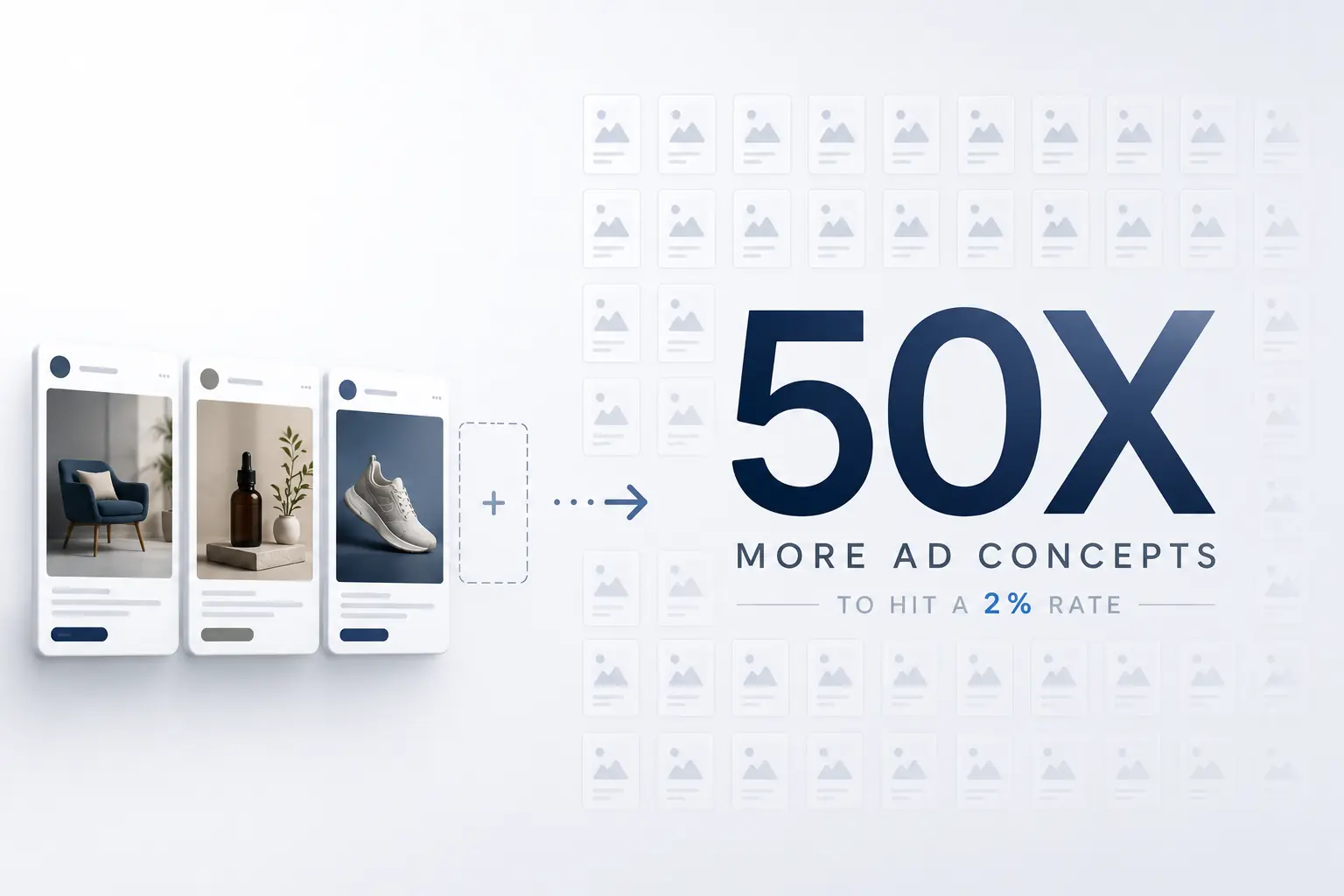
Search this question and the best-written answer confirms that Meta concentrates spend rather than splitting it evenly, names the three variables that decide your number, and then asks for your email address before it will tell you the number.
Here it is without the form.
The short answer
Three to four concepts per ad set, and roughly four new concepts a month, for a Meta account spending under about ₹3 lakh a month. Not because more would be worse in principle, but because your ad set cannot deliver enough for a fifth concept to mean anything before the fatigue clock replaces it. The instruction to run eight to twelve was written for accounts spending ₹26 lakh and above. And since a small account cannot find winners by volume, the number that actually matters is not how many concepts you make — it is how often they work.
Key takeaways
- Three to four concepts per ad set under roughly ₹3 lakh monthly spend; about four new concepts a month.
- The published hit rate is around 2%. At that rate you would need 34 concepts for a coin-flip chance of one winner.
- A ₹2 lakh account can properly feed three or four. The brute-force route is arithmetically closed.
- So raise the hit rate instead. At 20%, three concepts give you the same odds 34 do at 2%.
- Budget 15–20% of media spend for production — on ₹2 lakh that is ₹30,000 to ₹40,000 a month.
- More concepts becomes the right answer above roughly ₹5 lakh, where several ad sets can be fed at once.
The two answers you will be given
Both are well argued. They point in opposite directions, and almost nobody publishes them together.
“Test more.” brkfst.io, analysing Meta accounts across industries, reports that only about 2% of creatives become winners — ads that scale efficiently. If nineteen in twenty fail, you clearly need a lot of attempts.
“Test fewer.” Meta’s ad set needs roughly 50 optimisation events a week to deliver stably. Divide that between many ads and each receives too little to judge — and delivery is not divided evenly anyway, because Meta concentrates spend on whichever ad leads early. The mechanism is set out at why your concept count is set by delivery.
Before going further, be clear about where the 2% comes from. brkfst.io publishes it from “hundreds of Meta ad accounts” without stating a sample size or a methodology, and the company sells UGC creative — a business that benefits when advertisers conclude they need more creative. It is the only published figure on creative hit rates, so we use it. Treat it as directional and note who is telling you.
The arithmetic of the trap
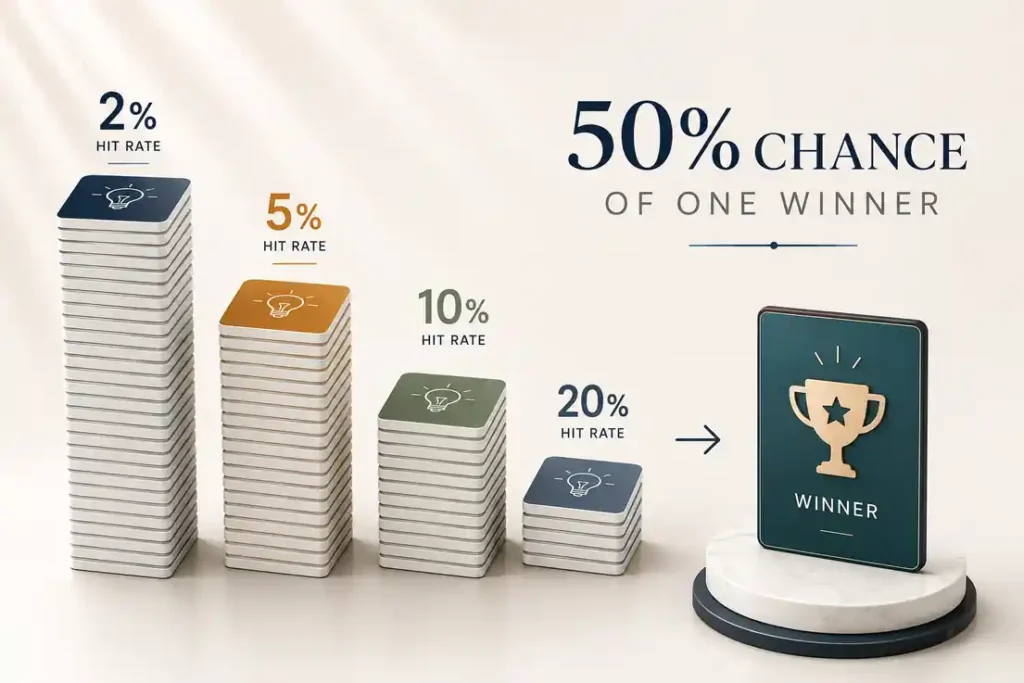
Take the 2% figure at face value and ask how many concepts you would need for a reasonable chance of one winner.
At a 2% hit rate, you need about 34 concepts for a fifty-fifty chance of at least one winning.
At 5%, about 14.
At 10%, about 7.
At 20%, about 3.
Now set that against what a real account can deliver. A Meta account spending ₹2 lakh a month on leads costing ₹700 each can properly feed roughly one ad set. At three to four concepts per ad set, that is three or four concepts running at a time, and about the same number replaced each month.
Four against thirty-four. A small account playing the volume game is not playing a long game — it is playing an unwinnable one.
This is why so many Indian businesses conclude that Meta does not work for them. They were given a strategy that requires ten times their budget, ran it faithfully, and produced twelve underfunded ads that told them nothing.
The Hit Rate Escape
You cannot buy volume, so buy odds. Every rupee that would have gone into a fourth mediocre concept goes instead into making the three you can afford more likely to work.
The arithmetic is unforgiving in one direction and generous in the other. Moving from a 2% hit rate to 20% cuts the concepts you need from thirty-four to three — which is exactly the number your account can carry.
Nothing about a 2% hit rate is inevitable. It is the average across accounts producing concepts without evidence behind them. Here is what raises it.
Use the customer’s own words. Sales call notes, WhatsApp enquiries, review text, the phrase people actually type into the search bar. Copy written from the buyer’s language outperforms copy written from a brand deck, and it costs nothing but attention.
Study what has already survived. Meta’s Ad Library shows every competitor ad currently running and how long it has been live. An ad running for four months is a winner someone else paid to find. You are not copying the execution — you are reading which argument survived a market you both sell into.
Start from the objection, not the feature. The concepts that work usually answer the thing that stops people buying: price, trust, switching cost, whether it works in Indian conditions. List the five real objections and you have five concepts with a reason to exist.
Give each concept one job. A concept trying to establish credibility, explain the product and drive urgency does none of them. One argument per concept, stated in one sentence before production begins.
Kill duplicates before you make them. If two concepts would persuade the same person for the same reason, they are one concept wearing two outfits, and you have just halved your effective count while paying for both.
What your budget actually supports
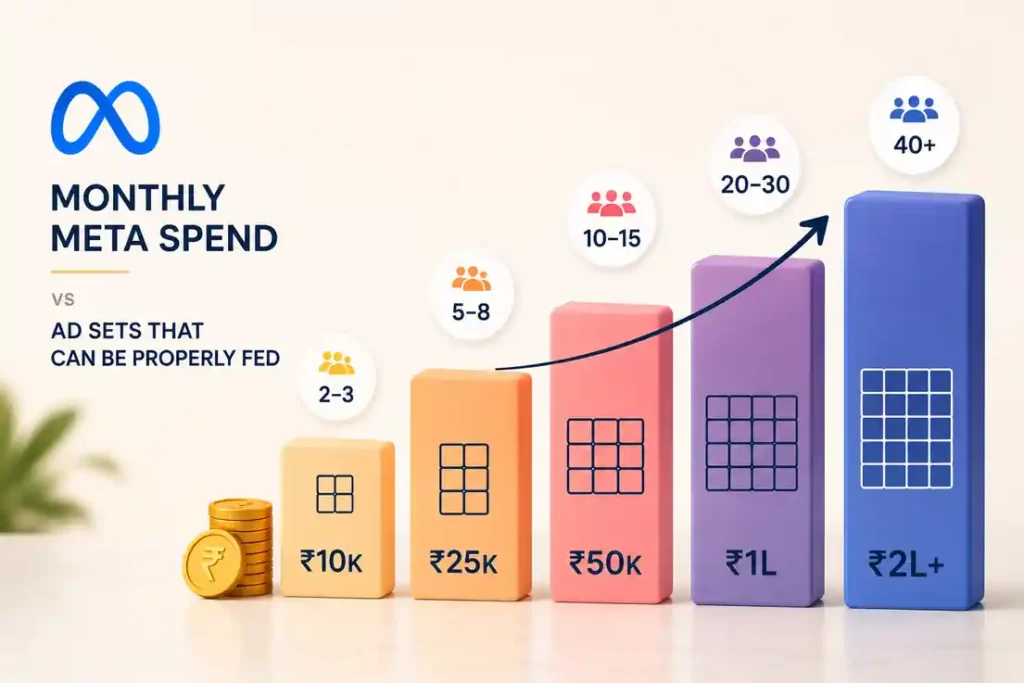
Rough bands for Meta, assuming an optimisation event costing ₹700 — a qualified lead in a competitive category. Cheap events change these substantially, which is why the event you optimise for matters as much as the budget: what each stage costs to run properly covers that choice.
Under ₹1 lakh a month. You cannot fully feed a single ad set on expensive events. Run two concepts, optimise for something cheaper than a qualified lead, and accept that you are gathering signal rather than testing. Adding concepts here actively harms delivery.
₹1 to ₹3 lakh. Roughly one ad set properly fed. Three to four concepts, replaced on a two-to-three week cycle — about four new a month. Most Findise clients sit in this band, and it is where the eight-to-twelve advice does the most damage.
₹3 to ₹5 lakh. Two ad sets. Six to eight concepts live, six or so new a month. Genuine comparison between concepts becomes possible for the first time.
₹5 to ₹10 lakh. Three or more ad sets. Eight to twelve concepts, and now the standard advice starts to apply. Volume begins to work as a strategy because you can afford enough attempts for a low hit rate to still produce winners.
Above ₹10 lakh. The international guidance applies as written. Ten to fifteen new concepts a fortnight is achievable and sensible.
Read your own numbers rather than these. Divide monthly spend by your actual cost per optimisation event, then by 217 — Meta’s roughly fifty events a week over a month. That is how many ad sets you can genuinely feed.
What to spend on making them
The published rule is 15–20% of media spend on creative production, and it converts usefully.
At ₹1 lakh monthly media, that is ₹15,000 to ₹20,000 for creative. At ₹2 lakh, ₹30,000 to ₹40,000. At ₹5 lakh, ₹75,000 to ₹1 lakh.
Four concepts a month on a ₹35,000 production budget is roughly ₹8,750 each. That is achievable in India with a mix of founder-to-camera video, customer footage and well-made statics. It is not achievable with a full production shoot per concept, which is why accounts that insist on polish end up with one concept a quarter and an account that has been fatigued since March.
As spend grows, production should fall as a share — the absolute number rises fast enough on its own.
Mistakes this question usually causes
Running twelve ads because an article said so. Correct at ₹26 lakh. Actively harmful at ₹2 lakh.
Counting variations as concepts. Four headlines on one argument is one attempt at the 2% lottery, not four.
Adding concepts to fix poor performance. If the current concepts are failing, more of the same reasoning fails too. Change the argument, not the count.
Cutting production budget to fund media. Below roughly 10% of spend, the account starves creatively and the media budget buys decreasingly effective impressions.
Judging concepts against each other inside one ad set. Delivery was never equal, so the comparison was never fair — how many visitors a real test needs covers when a controlled comparison is even possible.
When more genuinely is the answer
Above roughly ₹5 lakh a month on Meta, where several ad sets can be fed at once.
When your hit rate is already good and the constraint is simply how many winners you can find.
When you are scaling a proven concept and need variations to delay fatigue on something that works.
When production is genuinely cheap — an in-house team or a creator arrangement producing at low marginal cost changes the arithmetic in your favour.
The volume checklist
☐ Cost per optimisation event read from your own account
☐ Ad sets you can fully feed calculated — spend ÷ (cost per event × 217)
☐ Concept count set at three to four per fed ad set
☐ Monthly replacement rate set to match a two-to-three week cycle
☐ Every concept’s argument written in one sentence before production
☐ Duplicate arguments merged and the budget redirected
☐ Five real objections listed and used as concept starting points
☐ Competitor ads checked in Meta’s Ad Library for long-running survivors
☐ Customer language collected from calls, enquiries and reviews
☐ Production budget set at 15–20% of media spend
☐ Cost per concept calculated and checked against what your team can actually make
☐ Ad count reviewed monthly against changes in spend
Questions we get asked
How many ads should I run per ad set?
Three to four for most Indian SME accounts. More only once the ad set is clearing its learning threshold comfortably with room to spare.
How many creatives should I test per month?
About four new concepts a month under ₹3 lakh spend, which matches a two-to-three week replacement cycle on a single fed ad set.
What percentage of ad creatives actually work?
The only published figure is around 2%, from a company that sells creative. Accounts that research before producing do considerably better, which is the entire argument of this page.
How much should I spend on ad creative production?
15–20% of media spend. On ₹2 lakh a month that is ₹30,000 to ₹40,000, or roughly ₹8,750 per concept at four a month.
Is it better to test more ads or fewer?
Fewer, below about ₹5 lakh a month. More, above it. The crossover is where you can feed several ad sets at once.
Should I pause losing ads quickly?
Not before they have had a fair share of delivery. On a small account that can take two weeks, and pausing early usually means pausing the ad that started slowly rather than the ad that was worse.
Do this before your next production brief
Open the account. Find the cost of one optimisation event and the monthly spend. Divide spend by that cost, then by 217.
That is how many ad sets you can feed. Multiply by four and you have your concept count — usually a smaller number than whatever was in the plan.
Then take the money that was going to fund the concepts you just cut, and spend it on finding out what your buyers actually object to. That is the only route to a better hit rate, and on a small budget it is the only route that exists.
If you want the calculation run against your own account and a concept plan built from it, you can reach out to us on whatsapp at +91 7738844851.
More in Blog
Keep reading
All articles →
Ready to talk about your growth?
Tell us what's stuck and we'll tell you what we'd do first. Free, 30 minutes, no pitch.