
The standard advice on this subject is to keep eight to twelve ads live, refresh them every two to three weeks, and produce ten to fifteen new concepts a fortnight.
That advice is correct. It was written for accounts spending thirty to fifty thousand dollars a month — ₹26 to ₹44 lakh — and it is repeated, unconverted, to businesses spending two lakh.
At that budget the same instruction produces twelve concepts that nobody can assess, replaced before any of them delivered enough to say anything.
The short answer
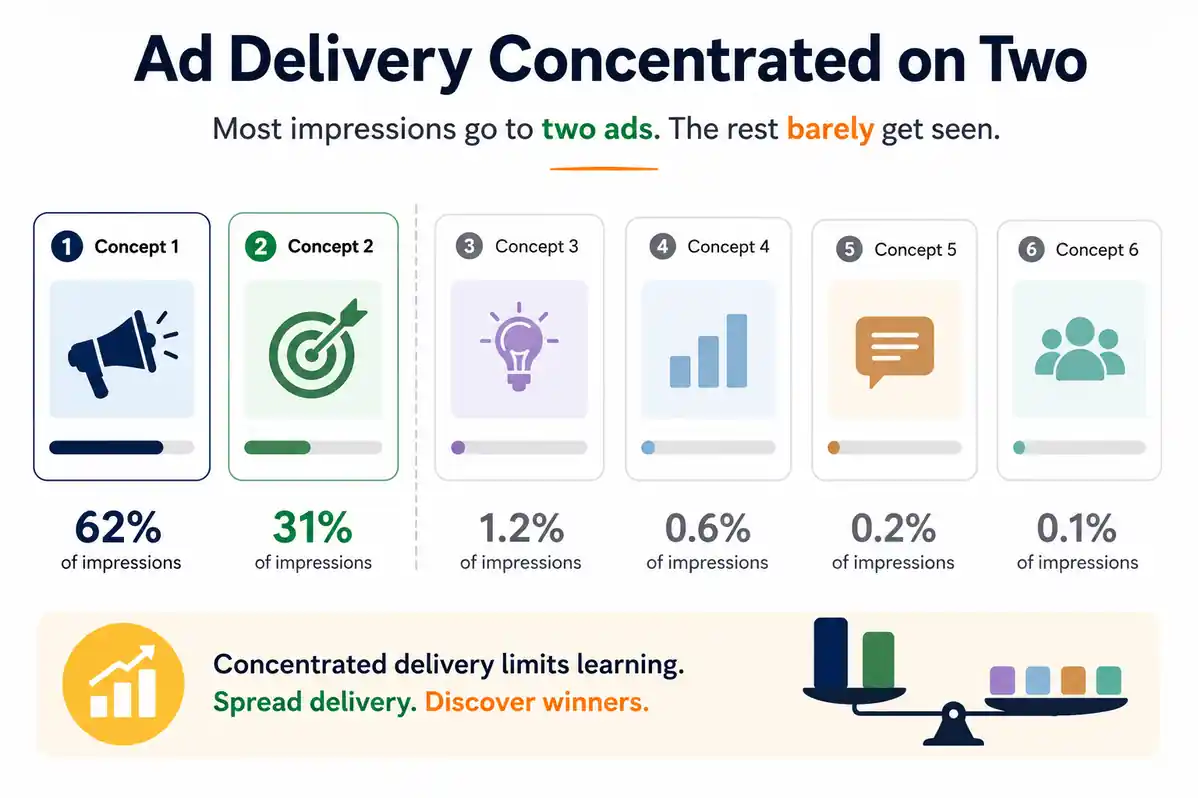
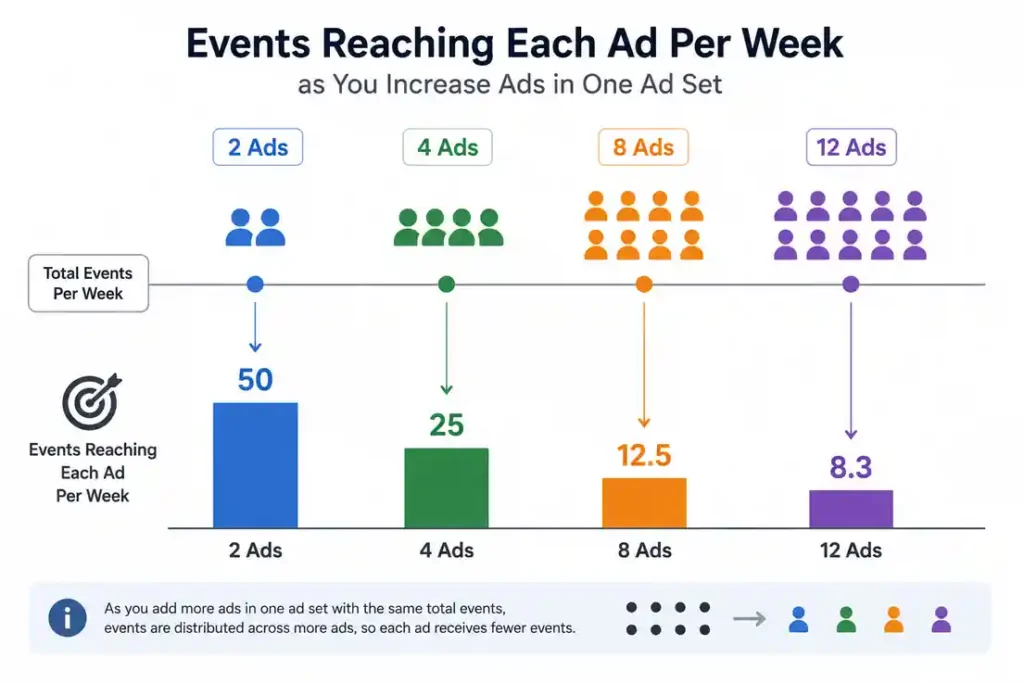
Ad creative strategy is deciding what to make, how many concepts to keep live, and how fast to replace them. The number you can usefully run is bounded by your optimisation event volume, not by a published best practice. Meta’s ad set needs roughly fifty events a week to deliver stably; split evenly across twelve ads that is four a week each, and delivery is not split evenly — Meta concentrates spend on whichever ad leads early. So a small account should run fewer concepts, judge them on the share of delivery they earn rather than on statistical comparison, and spend the saved production effort on making the surviving concepts genuinely different from each other.
Key takeaways
- Concept count is a function of event volume. At roughly 50 optimisation events per ad set per week, four ads is a working number and twelve is not.
- Meta does not split delivery evenly. It reallocates toward the early leader, which means an in-ad-set comparison is not a controlled test and never was.
- So read delivery share, not significance. Which ad the algorithm chose to spend on is the signal you actually get.
- The fatigue clock sets the floor. Cold audiences generally need refreshing every two to three weeks; Meta flags fatigue when cost per result reaches roughly twice that of past ads.
- Production capacity is the real constraint in most Indian accounts, and almost no guidance is written about it.
- Difference beats volume. Four genuinely distinct concepts outperform twelve variations of one.
Why creative matters more than it used to
Targeting used to be the lever. You built audiences, layered interests, excluded segments, and the account got better.
Most of that control has been withdrawn. Broad targeting with Advantage+ audience expansion now beats hand-built segments in a large share of accounts, and the platform decides who sees what. What you still control is the material it has to work with.
Which makes creative the main input rather than the finishing touch — and makes the question of how much creative you need a budgeting question rather than a taste question.
The thing nobody tells you about testing
Here is the misunderstanding that costs the most money.
A landing page split test holds a fixed allocation. Fifty percent of visitors see A, fifty percent see B, held steady until the test concludes. That is what makes it a test, and the arithmetic of how much traffic it needs is set out at how many visitors a test actually needs.
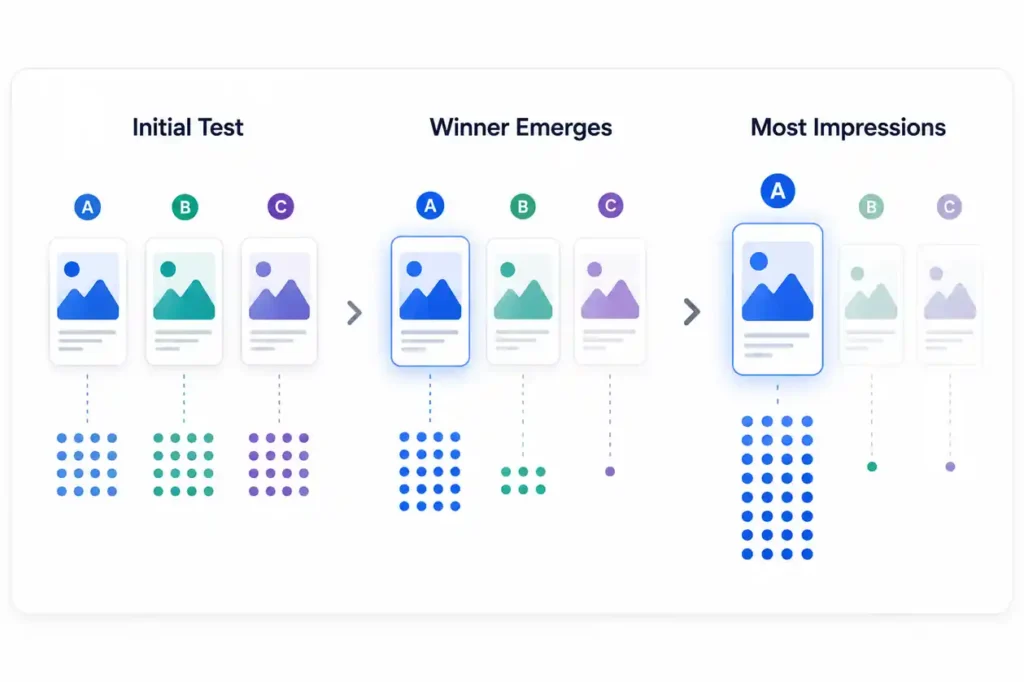
Meta does none of that. Within an ad set, delivery is decided by the auction. An ad that performs well in its first hundred impressions receives more of the next thousand. An ad that starts slowly — because of the hour it launched, the placement it landed in, or ordinary noise — may never recover, and can end the week with a few dozen impressions against a leader with thousands.
So the comparison is contaminated by design. Not by sample size. By the mechanism.
This is why “I tested six creatives and this one won” is usually a description of what the algorithm decided early rather than a finding about what your audience prefers.
Two consequences follow, and they are practical.
First, stop calling it testing. You are stocking the auction with options. The useful measure is which concepts earned delivery and held it, over a period long enough to matter.
Second, if you genuinely need a controlled comparison — a price, a positioning, a claim you are going to build a business around — run it as a proper split test with fixed allocation, or run it on a landing page where you control the split. Do not run it as four ads in an ad set and read the result as evidence.
The Concept Portfolio
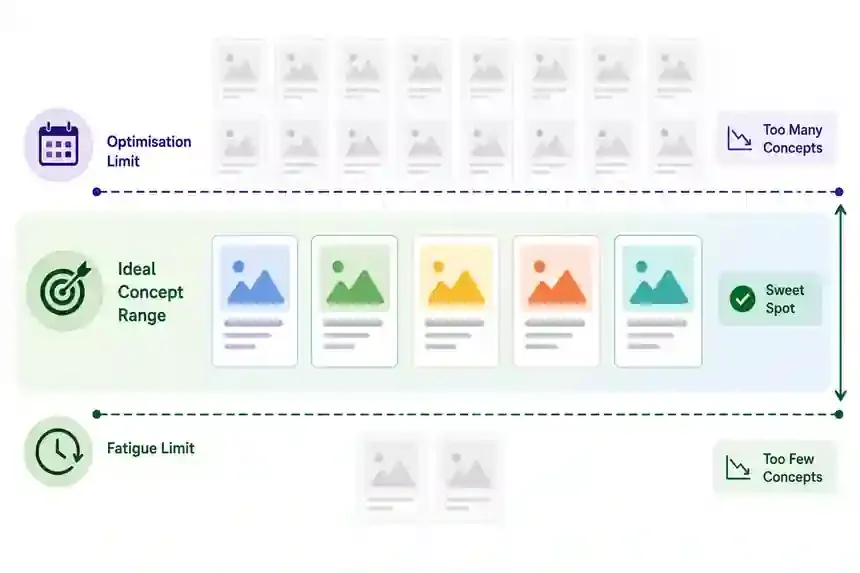
The number of concepts you can usefully run is bounded above by your optimisation event volume and below by the fatigue clock. Fill the space between those two limits with concepts that are genuinely different from each other, and replace them on a schedule rather than when performance collapses.
Both bounds are calculable.
The upper bound — how many concepts your delivery supports
Meta’s ad set needs approximately 50 optimisation events per week to exit the learning phase and deliver stably. Divide that between the ads inside it.
- 2 ads — 25 events each per week, 75 over a three-week window
- 3 ads — about 17 each per week, 50 over three weeks
- 4 ads — about 12 each per week, 38 over three weeks
- 6 ads — about 8 each per week, 25 over three weeks
- 8 ads — about 6 each per week, 19 over three weeks
- 12 ads — about 4 each per week, 13 over three weeks
Those are the even-split figures, and delivery is not even. Meta concentrates spend on its early pick, so in practice the top one or two ads take most of the events and the bottom half take almost none. The real numbers for the lower-ranked ads are worse than the table above, often by a lot.
Read the twelve-ad row honestly. Thirteen events over three weeks, before concentration. That is not a creative you can judge. It is a creative you can only replace.
A working rule. At one ad set clearing the learning threshold, three to four concepts is the practical maximum. If you want to run eight, you need roughly twice the event volume — which means roughly twice the budget, or a cheaper optimisation event. The arithmetic on what an ad set costs to feed is at what each stage costs to run properly.
The lower bound — how fast fatigue forces replacement
Cold prospecting audiences generally need new material every two to three weeks. Performance risk rises noticeably once seven-day frequency passes roughly 2 to 2.5, and Meta assigns an official creative fatigue status when an ad’s cost per result reaches about twice that of your past ads.
Which produces a replacement rate rather than a test plan. Running four concepts on a three-week cycle means roughly four new concepts a month — not the ten to fifteen a fortnight the American guidance suggests, and a number a small team can actually produce.
Below that rate, the account decays regardless of how good the current creative is. Above it, you are producing material the account cannot deliver.
What “genuinely different” means
Four concepts beat twelve variations, but only if the four differ in ways the audience can perceive.
A different concept changes the argument. Price against outcome. Problem against aspiration. Founder to camera against customer testimonial. Demonstration against social proof.
A variation changes the execution. A new headline on the same argument. Another colourway. A different model reading the same script.
Most accounts run variations and call them concepts, which is why the results all look the same. If two ads would persuade the same person for the same reason, they are one concept.
A practical test before production. Write the one-sentence argument for each concept. If two sentences could be swapped without anyone noticing, cut one and use the budget to make something actually different.
Reading results when you cannot run a test
Since the comparison is not controlled, judge on signals that survive uneven delivery.
Delivery share. Which ads the algorithm chose to spend on, and whether it held that choice for more than a few days. An ad that took 60% of spend for three weeks has told you something, even without significance.
Hook rate on video. The share of impressions that reach three seconds. It is measured early, needs far less volume than a conversion, and it isolates the opening rather than the whole ad.
Cost per result against the account average, not against the other ads in its set. Meta’s own fatigue signal works this way for a reason.
Frequency trend. Rising frequency with flat results means the audience is saturating and the concept is finished, whatever the cost per result currently says.
What to ignore. Click-through rate in isolation, which rewards curiosity rather than intent. And any comparison between two ads with wildly different impression counts — that is not a result, it is a delivery decision.
Production capacity — the constraint nobody writes about
Every guide tells you how much creative to run. Almost none asks whether you can make it.
Work out your real monthly capacity before setting any cadence. Not what you managed in launch month with everyone’s attention on it — what you can sustain in month seven alongside everything else.
Then design the account around that number, rather than designing an ideal account and failing to feed it.
Where the volume actually comes from. One properly planned shoot produces far more than most teams extract from it — different edits, different opening seconds, stills pulled from video, captions in more than one language. The teams producing genuine volume are rarely shooting more often; they are cutting more from each session.
When capacity is the binding constraint, the honest answer is fewer ad sets and fewer concepts, run properly, rather than a structure the team cannot supply.
Mistakes worth the money they cost
Running twelve ads in one ad set. Correct advice at ₹26 lakh a month. Wasteful at ₹2 lakh.
Calling in-ad-set comparison a test. It shapes decisions that were never evidenced.
Replacing creative only when performance collapses. By then you have paid for two or three weeks of decline. Replace on a schedule.
Producing variations instead of concepts. Twelve versions of one argument is one argument.
Judging a video ad on conversions before checking hook rate. If nobody reaches three seconds, nothing after three seconds is the problem.
Copying a competitor’s ad. You are copying the execution of an argument that fits their business, their price and their proof. The ad is the visible part of a thing you cannot see.
Restarting the account to launch new creative. Every structural change resets learning. Add creative into a stable structure instead.
When creative is not your problem
When tracking is unreliable. You will optimise toward numbers that are not real, and conclude the wrong concept won.
When the offer is uncompetitive. Better creative sells an uncompetitive offer to more people who then do not buy.
When you are below the learning threshold entirely. Fix volume first — what each channel requires before budget matters covers which channels you can actually run.
When the landing page is the failure. High hook rate, high click-through, no conversions is a page problem wearing a creative costume.
When the audience is exhausted rather than bored. Rising frequency across every concept means you have saturated a small pool. New creative will not enlarge it.
The creative operating checklist
☐ Weekly optimisation events per ad set measured, not assumed
☐ Concept count set from that number — typically three to four per ad set at Indian SME volumes
☐ Every live concept able to state its argument in one sentence
☐ Any two concepts sharing an argument merged, and the saved effort spent on difference
☐ Replacement schedule set at two to three weeks for cold audiences
☐ Monthly production capacity stated honestly as a sustainable rate
☐ Account structure designed around that capacity rather than an ideal
☐ Hook rate tracked separately from conversion rate on all video
☐ Frequency monitored weekly against a stated threshold
☐ Delivery share recorded per concept, not just cost per result
☐ Controlled comparisons run on landing pages, never inside an ad set
☐ Assets from every shoot catalogued so one session yields many cuts
Questions we get asked
How many ad creatives should I test?
As many as your event volume supports. At one ad set clearing roughly 50 optimisation events a week, that is three to four concepts. Twelve is correct advice for an account with ten times the volume.
How often should I refresh ad creative?
Every two to three weeks for cold audiences, on a schedule rather than in response to a decline. Warm and retargeting audiences saturate faster because the pool is smaller.
What is creative fatigue?
Declining performance from repeated exposure to the same material. Meta flags it formally when an ad’s cost per result reaches about twice that of your past ads, but the useful early signal is rising frequency with flat or falling results.
How do you know which ad creative is working?
On a small account, by which one earned and held delivery share, supported by hook rate on video. Not by comparing cost per result between ads that received very different impression volumes.
How much creative do I need for Meta ads?
Roughly four new concepts a month sustains a single-ad-set account on a three-week cycle. Scale that with the number of ad sets you can genuinely feed, not with ambition.
Can I use AI to generate ad creative?
For iteration and volume, increasingly yes. Both Meta and Google have disclosure requirements for synthetic media and both revise them, so check current policy before running anything photoreal. The concept still has to come from understanding the buyer.
Where to go next
This page is the survey. The detail sits in the articles below.
On volume — how many ad creatives to test, answered in rupees rather than dollars.
On fatigue — detection thresholds and a refresh routine.
On capacity — planning creative production a small team can actually sustain.
On video — hook rate and why most ads fail in the first three seconds.
On repurposing — getting thirty assets out of one shoot.
Start by counting events
Before changing anything, open your Meta account and find the weekly optimisation events for each ad set.
Divide by the number of ads live inside it. That number — usually smaller than people expect — is the honest answer to how many concepts your account can currently carry.
Most media buyers who do this cut their ad count the same afternoon, and their cost per result improves within a fortnight for no other reason.
If you would like your creative capacity and concept count worked out against your own account, you can reach out to us on whatsapp at +91 7738844851 .
☐
More in Blog
Keep reading
All articles →
Ready to talk about your growth?
Tell us what's stuck and we'll tell you what we'd do first. Free, 30 minutes, no pitch.