
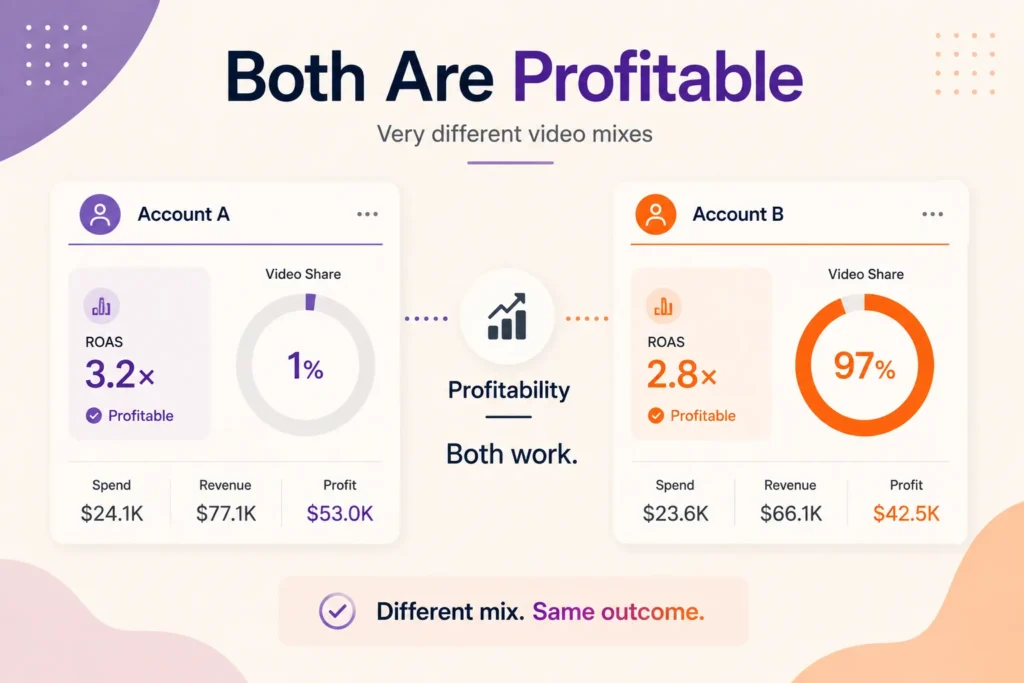
SHEIN runs 1% video. Shapellx runs 97%. Both are scaled, profitable Meta advertisers.
That comes from an analysis of 67,000 Facebook ads across more than a hundred top-performing accounts, and it should end the argument about which format wins. It does not, because the argument is comfortable and the answer is not.
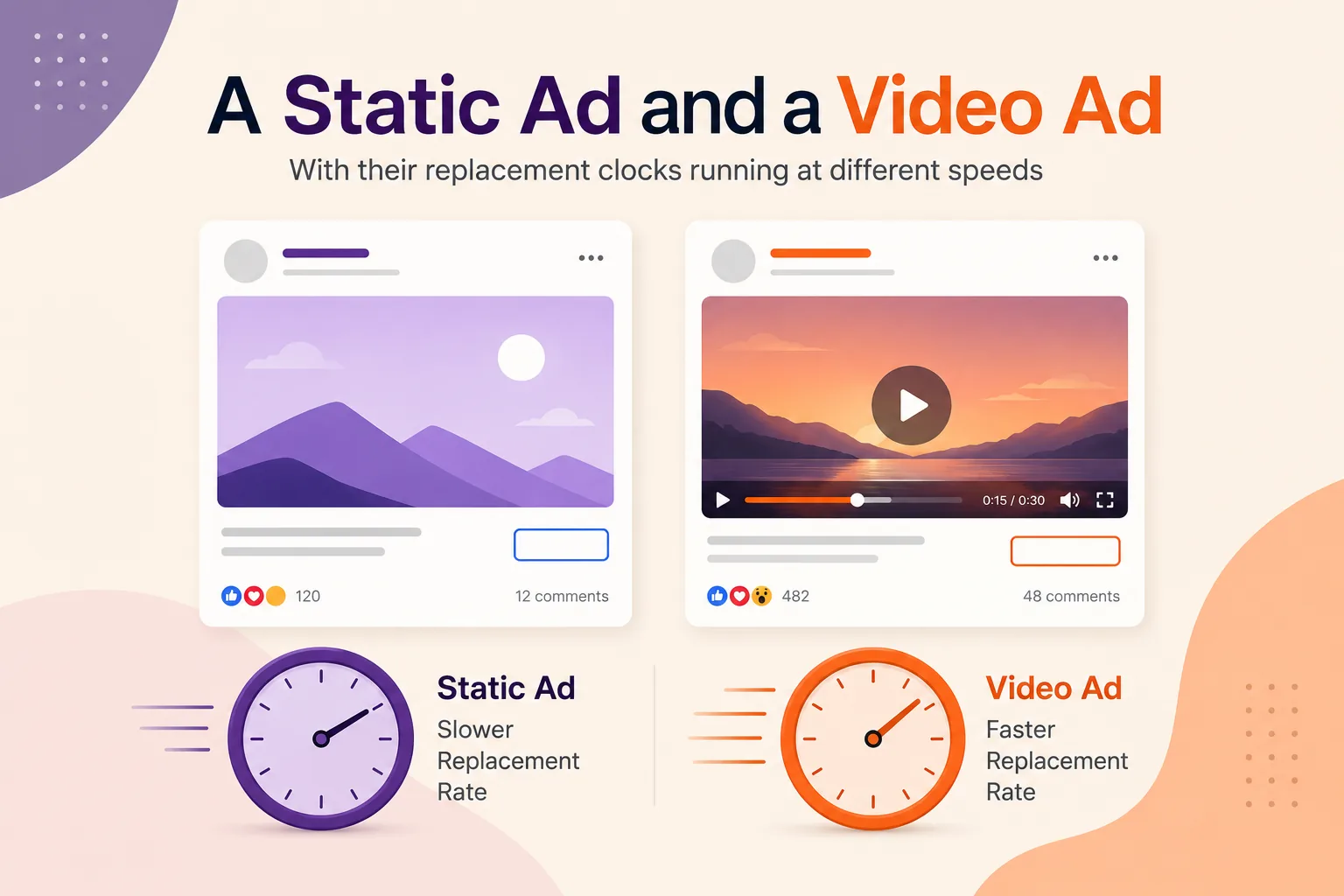
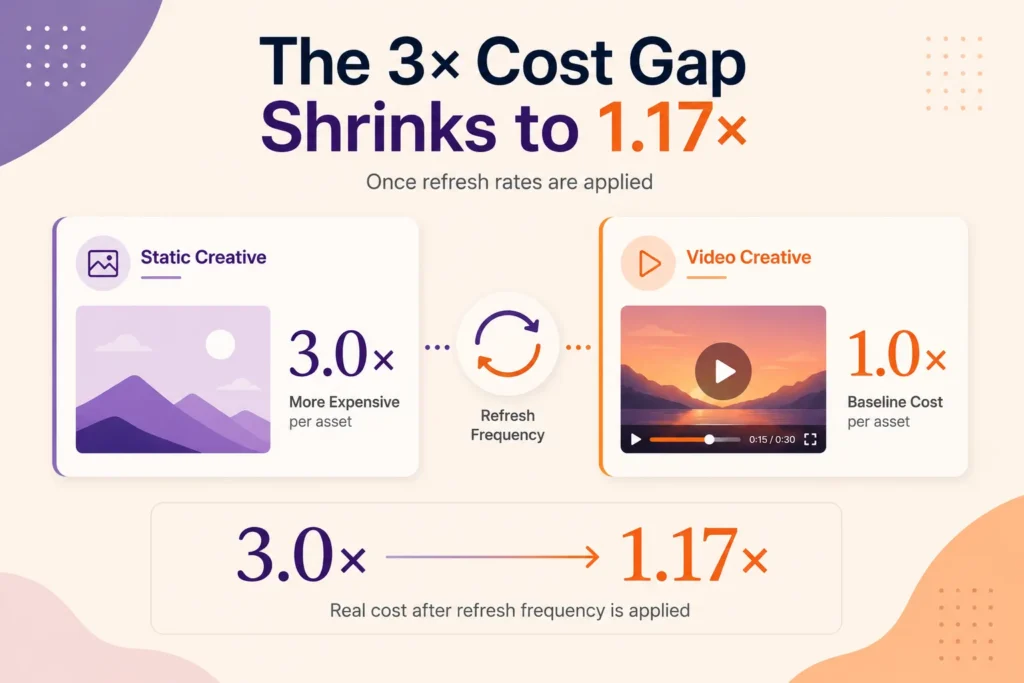
Here is the answer, and it is arithmetic rather than opinion: static costs roughly a third of video per asset in India, and it fatigues about twice as fast. Which means the price gap you are choosing on mostly disappears the moment you look at a month instead of an invoice.
The short answer
Neither format wins in general. The median Meta account runs about 61% static and 39% video, and profitable accounts exist at both extremes. What decides your mix is product type, funnel stage and production capacity — and, critically, refresh-adjusted cost. Static is around a third the price per asset but needs replacing every 20–30 days against video’s 40–60, so a three-times price advantage narrows to roughly 1.17 times per month. At Indian SME budgets the published guidance still points static-heavy, because every recommendation above 50% video was written for accounts spending more than ₹17 lakh a month.
Key takeaways
- Median mix is 61% static / 39% video across 67,000 ads and 100+ top accounts. The range runs 1% to 97%, profitably.
- Static fatigues 30–50% faster. Replace every 20–30 days; video holds 40–60.
- The refresh-adjusted gap is 1.17x, not 3x. Cheap per asset, barely cheaper per month.
- Under ₹17.6 lakh a month, the data says lead with static — and that covers almost every Indian SME advertiser.
- The published format benchmarks contradict each other, because format never varies alone.
- Carousels are the most under-used format on Meta. Only 40% of top accounts ran even one.
Why the comparison keeps failing
Look at what gets published about this, side by side.
Video CPM is 28% higher than static in one analysis and 5 to 15 times higher in another. Video CPA is $48.20 against static’s $34.50 in one set of benchmarks; elsewhere video produces a cost per lead of $2.75 against static’s $14.22 — eighty percent cheaper, in the same campaign.
These are not lies and they are not sloppiness. They are what happens when you average a variable that never moves alone.
A video ad and a static ad in the same account differ in production budget, in the effort that went into the concept, in the placements they land in, in the objective they run against, and in the kind of product that suited each in the first place. Comparing format across accounts compares everything except format.
Which is why the honest version of this question is not “which is better” but “what does each one do, and what does holding a mix of them cost me every month.”
What each format is actually for
Video explains. It is the format for anything a person has to see in use, in motion, or over time. Transformation, application, assembly, before and after, a process with steps. Beauty, skincare and shapewear brands run 80%+ video for exactly this reason — Shapellx at 97% is not a stylistic choice, it is a product requirement.
Static reminds and asserts. It is the format for a product the viewer already understands. A clean shot, a price, an offer, a deadline. SHEIN at 1% video works because nobody needs a film explaining what a dress is.
The heuristic that survives contact with reality: if a first-time viewer could understand your product’s value from a single image, static can carry the work. If they need to see it used, you need video.
Then funnel stage adjusts it. Cold audiences respond better to video — higher engagement, and the reach signal Meta’s system uses to find the next buyer. Retargeting converts better on static, where benchmarks put static CPA at $34.50 against video’s $48.20, because a warm audience needs an offer rather than an explanation.
And carousels sit almost unused. Only 40% of top-performing accounts ran a single one, despite carousels being well suited to the consideration stage and to any business with more than one thing to sell. If you have a range, that is free ground.
The Refresh-Adjusted Cost
Compare formats by what they cost per month, not per asset. Static is roughly a third of video’s price in India and needs replacing about twice as often — which means the gap you are choosing on is far smaller than the invoice suggests.
Work it through with real numbers.
Take an account that can serve four concepts at a time — typical for a Meta account under about ₹3 lakh a month; the arithmetic behind that ceiling is at how many ad creatives your account can carry, and it is independently corroborated by Meta’s own recommendation of three to five active ads per ad set.
Apply the refresh windows. Static every 25 days, video every 50 — the midpoints of the published ranges.
A 70% static mix holds about 2.8 static and 1.2 video concepts live. Because static turns over faster, that produces roughly 3.4 new statics and 0.7 new videos each month — about 4.1 assets.
A 30% static mix holds 1.2 static and 2.8 video. That produces about 1.4 new statics and 1.7 new videos — about 3.1 assets.
Now price them. At illustrative Indian rates of ₹1,000 for a static and ₹3,000 for a video: the static-heavy mix costs about ₹5,520 a month. The video-heavy mix costs about ₹6,480.
A three-times per-asset price difference has become a 1.17-times monthly difference.
Which changes the decision entirely. If you were choosing static because it is cheap, the saving is roughly 17%, not 67% — and you are buying two and a half times as many assets to get it, which costs briefing time, review time and attention that nobody prices.
And it cuts the other way too. If your product needs video, the monthly premium for running video-heavy is far smaller than the sticker price implies. That is usually the more useful direction for a brand that has been avoiding video on cost grounds.
Read the spend bands in rupees
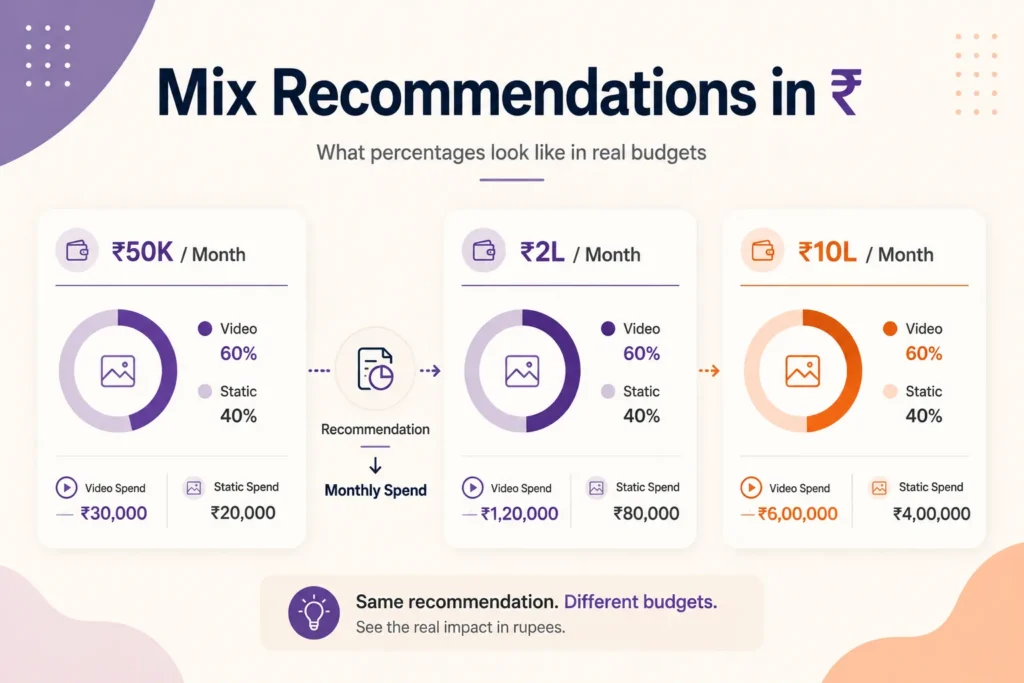
Every published mix recommendation is denominated in dollars, and the conversion changes who the advice is for.
Under $20,000 a month — under ₹17.6 lakh. Recommendation: roughly 70% static, 30% video. Prioritise testing velocity; find the messages that work before committing to video production.
$20,000 to $100,000 — ₹17.6 lakh to ₹88 lakh. Move to 50/50, then 60% video. Video takes cold prospecting; static handles retargeting and offers.
Above $100,000 — above ₹88 lakh. 65–70% video. At this scale Meta’s system rewards video at the top of funnel and static does targeted conversion work underneath.
Now place your account. A ₹2 lakh a month Indian advertiser is not in the middle band. They are at the bottom of the bottom band, at roughly a ninth of its upper limit.
So the honest recommendation for most Indian SMEs is static-led, which is the opposite of what the ambient advice says. Video-first is correct guidance for an advertiser spending more in a month than most Findise clients spend in a year.
That is not an argument against video. It is an argument against paying video’s production and attention cost before you know which message works — and static is simply the faster instrument for finding that out.
What actually changed in video’s favour
Worth being fair, because the case for video has genuinely strengthened.
Bandwidth. Faster mobile networks removed the load-time penalty video used to carry, which matters more in India than in most markets.
Compression. Modern codecs cut file size without visible quality loss.
The auction. As Meta competes for time on platform, video generates watch-time and engagement signals its system rewards with better delivery. Reels and Stories are near-exclusively video environments, and they carry a large and growing share of Indian impressions.
And production collapsed in price. Phone-shot creator video now performs comparably to studio work, sometimes better, because it matches the feed. The old assumption that video means a production budget is simply out of date — what UGC costs in India, and what the rights cost covers what that actually runs to.
Setting your own mix, in order
Start with the product. Can a single image communicate the value to someone seeing it for the first time? If no, you need video regardless of budget.
Then the funnel. Video for cold, static for retargeting, as a default you adjust from.
Then capacity — honestly. Not what you could produce in a good month. What you will still be producing in month seven. The mix has to be sustainable or it is not a mix, it is a launch.
Then the monthly cost, refresh-adjusted, using the arithmetic above rather than the per-asset price.
Then let your own data override all of it. These are starting positions. An account with six months of history has better information than any benchmark, including this one.
And shoot for both at once. A single well-planned session yields video and the stills that become statics — getting more than one ad out of a shoot covers how to capture for both rather than choosing.
Mistakes worth the money they cost
Choosing on per-asset price. The mistake this whole article exists to correct.
Going video-first at ₹2 lakh a month. Correct advice, wrong budget by a factor of nine.
Refreshing both formats on the same calendar. Static needs replacing roughly twice as often. A single refresh cycle either starves one or wastes the other.
Treating benchmark CPAs as your CPAs. They compare accounts that differ in everything.
Ignoring carousels. Under-used by 60% of top accounts, and well matched to any business with a range.
Producing video to satisfy a trend. If a still image communicates your value, video is spending three times as much to say the same thing more slowly.
Assuming static means cheap. It means cheap per asset and demanding per month.
When the format question is not your problem
When you have one concept and it is not working. No format saves a weak argument.
When the account is below its learning threshold. Format is a refinement; delivery volume is a prerequisite.
When your placements are already decided for you. A Reels-dominant delivery mix has answered the question.
When production capacity is one asset a month. Make it whatever you can make well, and fix capacity first.
When you have never separated the formats in reporting. You cannot choose a mix you have never measured — split the columns before the debate.
The format checklist
☐ Product tested against the single-image question
☐ Cold and retargeting audiences separated in reporting before comparing formats
☐ Static and video performance read separately, never blended
☐ Refresh windows set separately — 20–30 days static, 40–60 video
☐ Monthly asset requirement calculated per format, not per asset
☐ Refresh-adjusted monthly cost compared, not sticker price
☐ Spend band located in rupees, not dollars
☐ Production capacity stated as a sustainable monthly rate
☐ Carousel tested at least once if you sell more than one thing
☐ Shoots planned to yield both video and stills
☐ Placement mix checked before assuming a format is optional
☐ Own account data used to override benchmarks after three months
Questions we get asked
Are video ads better than image ads?
Not in general. Video wins on engagement and cold-audience reach; static wins on cost per acquisition in retargeting. The median top account runs more static than video.
What is the best static to video ratio for Meta ads?
The median is about 61% static to 39% video, but profitable accounts run everything from 1% to 97% video. Under ₹17.6 lakh a month, the published guidance points to roughly 70% static.
Do static ads still work in 2026?
They are the majority of creative in the median top-performing account. SHEIN runs almost nothing else.
Which format is cheaper, static or video?
Static is about a third the price per asset in India and roughly 17% cheaper per month once you account for it fatiguing twice as fast. Per-asset price is the wrong comparison.
When should you use a carousel?
When you have a range, or when the consideration stage needs several proof points in one unit. It is the most under-used format on the platform.
How do I know which format my product needs?
Show a stranger one still image of it. If they understand what it does and why it is worth the money, static can carry your account.
The number to work out first
Before allocating another rupee between formats, calculate one thing: what each format costs you per month, not per asset.
Take the concepts your account can hold. Split them by your current mix. Divide each side by its refresh window. Multiply by what each asset actually costs you.
Most people who do this discover two things at once — that static is far less of a bargain than they assumed, and that video is far less of a luxury.
If you want that calculation run against your own account, with a format mix set from your product and your capacity rather than from a benchmark, you can reach out to us on whatsapp at +91 7738844851 .
Rupee conversions at approximately ₹88 to the dollar. Asset costs are illustrative — use your own quotes.
B
More in Blog
Keep reading
All articles →


Ready to talk about your growth?
Tell us what's stuck and we'll tell you what we'd do first. Free, 30 minutes, no pitch.