
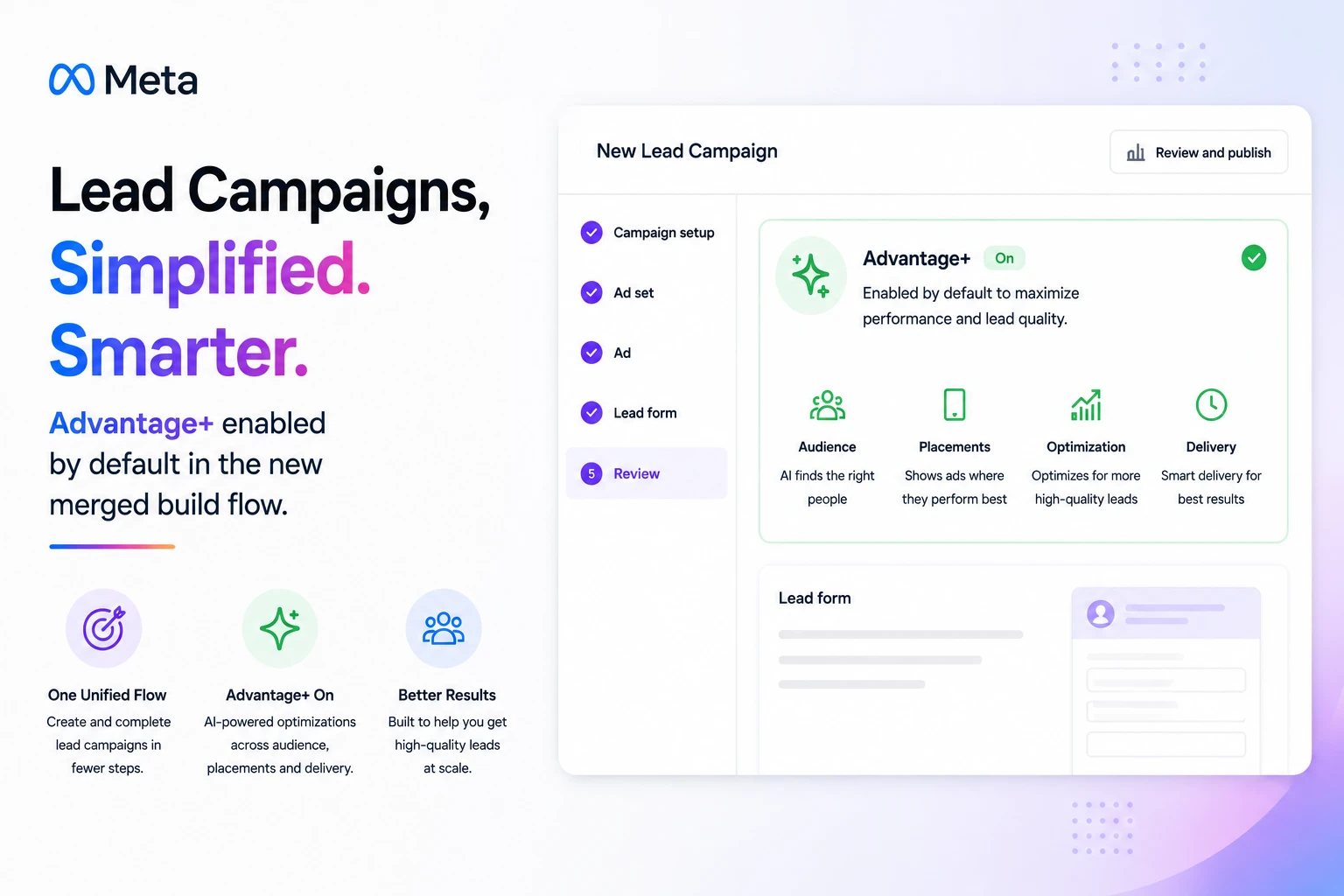
Build a lead campaign in Ads Manager today and Advantage+ is already on. You did not choose it. The build flow chose it for you.
Most of the advice available treats this as a binary — surrender to the automation, or fight it back to manual. That framing is wrong, and it is wrong in a way that costs money, because Advantage+ is not one setting. It is four, they are independent, and for lead generation they do not all have the same right answer.
The short answer
Reported changes indicate Meta merged its manual and Advantage+ build flows in February 2026, making the automated path the default for new Sales, Leads and App Promotion campaigns. Lead generation now runs through the same engine as sales. You can still toggle automation separately for audience, placement, budget and creative — so you might accept automated audience while keeping manual placement control. Value Rules let you bid more for chosen segments without switching automation off. The automation optimises efficiently toward whatever conversion event you selected, which makes that selection the most consequential thing on the screen.
Key takeaways
- Advantage+ is four independent controls, not one switch: audience, placement, budget, creative.
- Targeting is advisory now. Interests, custom audiences and lookalikes are treated as suggestions the system may spend outside of.
- Value Rules are the underused lever — bid more for a defined segment while leaving automation running.
- Automation amplifies your conversion event. Choose a shallow one and you will get efficient delivery of shallow outcomes.
- Meta’s defaults are calibrated for high-volume advertisers. Most Indian mid-market accounts are not, and the settings should reflect that.
What actually changed
Meta has been consolidating campaign creation for two years, and the reported February 2026 change completed it for lead generation. Manual and Advantage+ build flows merged into a single path, with automation on by default.
The more meaningful shift sits underneath. Lead generation is no longer treated as a separate, top-of-funnel activity. It now runs through the same automated engine Meta uses for sales campaigns, which means the system is applying purchase-optimisation logic to lead events.
For a business whose leads convert quickly and predictably, that is an improvement. For a business whose “conversion” is a form fill that converts to revenue three months later at a rate nobody has measured, it means the system is optimising confidently toward something it has been told matters and cannot verify.
Meta’s own early testing is reported to show a 10% reduction in cost per qualified lead from Advantage+ leads campaigns. That is Meta’s figure about Meta’s product, and should be read accordingly — but the direction is plausible, because the automation genuinely is better at finding people who complete the event you specified.
The Four Switches
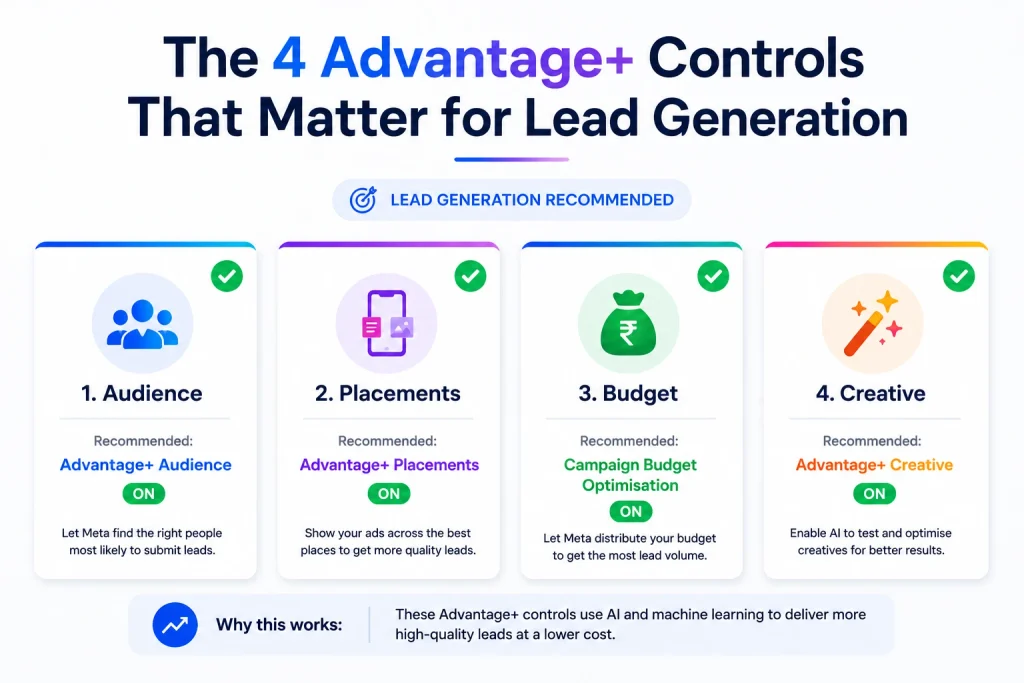
Advantage+ is not on or off. Audience, placement, budget and creative each automate independently, and for lead generation the right setting differs for each. Treating it as one decision means accepting three defaults you never considered.
Audience — usually leave automated, with your data loaded
Your interests, custom audiences and lookalikes are treated as suggestions rather than boundaries. The system may spend outside them when it predicts a better result.
Fighting this is mostly futile, and the automation is genuinely good at finding people who complete your event. But two things still matter enormously.
Load your first-party data anyway. Customer lists and CRM contacts are the strongest signal available, and they inform the model even when they do not constrain it.
Build lookalikes from closed customers, not from all leads. A lookalike seeded on everyone who filled a form models form-fillers. This is the single most common seeding error and it compounds under automation.
The full picture on how targeting changed sits in why your pipeline caps what you can optimise toward — worth reading if your lead volume is thin.
Placement — automate, with exclusions
Automated placement is usually correct. Meta finds cheap inventory you would not have selected, and for lead generation cheap qualified reach beats expensive prestigious reach.
Two exceptions. Exclude placements where your creative genuinely does not work — a text-heavy static asset in Reels, for instance. And check the placement breakdown monthly, because a placement delivering volume at poor quality will not surface on its own.
Budget — automate across ad sets, but watch the concentration
Campaign-level budget optimisation moves money toward whatever is performing. Sensible in principle.
The risk for lead generation is that it concentrates spend into one ad set quickly, which is fine if that ad set is genuinely better and a problem if it simply started faster.
The real constraint is the learning threshold. Meta needs roughly 50 optimisation events per ad set within a rolling seven days. Automated budget allocation across five thin ad sets produces five ad sets that never learn. Keep the count low enough that concentration is not needed to reach the threshold. Our guide to what Meta Ads cost in India covers the budget floor arithmetic.
Creative — automate cautiously
This is the switch to think hardest about.
Automated creative enhancements adjust and combine your assets — cropping, text overlays, generated variants. Sometimes this improves performance. Sometimes it produces an ad you would not have approved.
For lead generation specifically, creative is doing qualification work. If your ad states a price band or names who the offer is not for, automated enhancement that crops or rewrites can remove precisely the filter you built in.
Test it rather than assuming. Run enhancements on, measure lead quality rather than lead volume, and switch off the specific enhancements that hurt. Meta allows this at a granular level and most advertisers never look.
Value Rules — steering without switching off
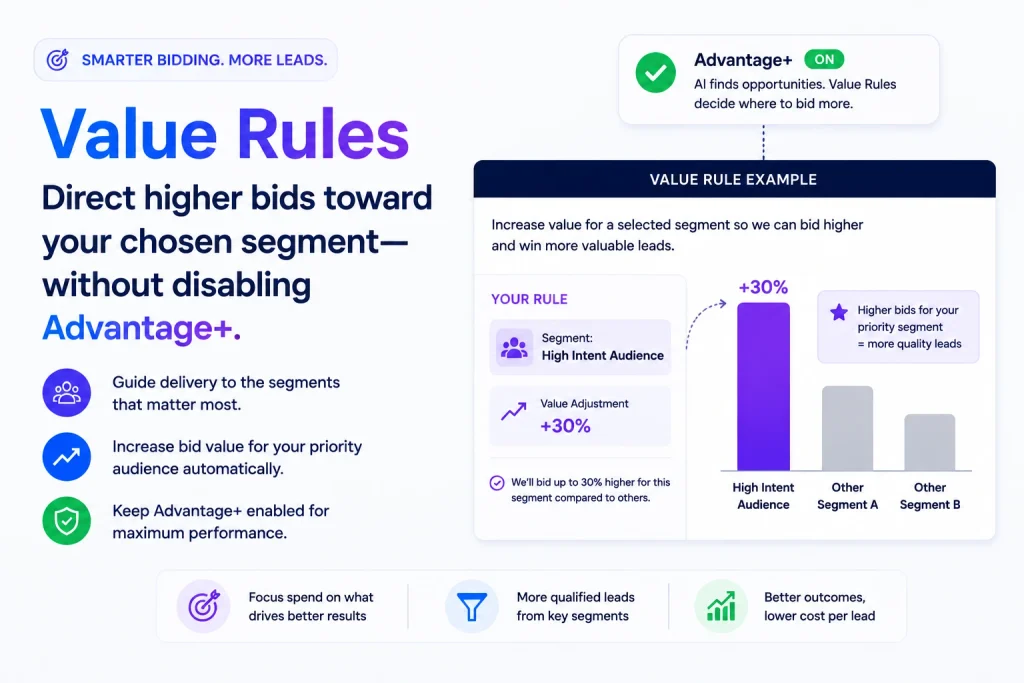
Barely covered anywhere, and genuinely useful.
Value Rules let you tell Meta that certain segments are worth more to you, so the system bids more aggressively for them — without disabling Advantage+ or reverting to manual targeting.
Why this matters for lead generation. If your best customers are, say, women aged 25–44 in Mumbai and Pune, you can express that as a bidding preference rather than a targeting restriction. The automation keeps its reach; your money tilts toward the people who convert.
How to build one properly. Do not guess the segments. Pull the demographic and geographic breakdown of your closed customers from your CRM, find where value concentrates, and encode that. A Value Rule built on assumptions is a way of imposing your bias on a system that was doing better without it.
Review quarterly. Segment value shifts, and a rule set in January can be steering budget toward last year’s best customer by June.
The amplification problem
Which brings us to the thing that matters more than any switch.
Advantage+ makes Meta more efficient at delivering the conversion event you specified. That is the whole product. It is also the risk.
If your conversion event is a form fill, the automation will get progressively better at finding people who fill forms. Not people who buy. People who fill forms. And it will do so at a falling cost per form fill, which will look like success on every dashboard you own.
The fix is upstream of every setting in this article. Send qualified leads or closed deals back through the Conversions API so the system optimises toward something worth having. Where volume permits, optimise toward the deepest event you can actually feed.
Where volume does not permit — and for most Indian B2B and considered-purchase businesses it does not — accept a shallower event and do the qualifying yourself, at the form. Why frictionless forms produce unqualified leads covers that layer, and the two work together: the campaign settings decide who sees the ad, the form decides who gets through.
Mistakes that cost real money
Treating Advantage+ as one decision. Accepting all four defaults because you agreed with one.
Seeding lookalikes from unqualified leads. Under automation this error scales faster than it used to.
Leaving creative enhancements on without checking lead quality. Volume rises, quality falls, cost per form fill improves, and the report looks excellent.
Running five ad sets on a budget that can feed one. Automated budget allocation cannot manufacture events that do not exist.
Building Value Rules on assumptions. You are overriding a model with a guess.
Judging within the learning period. Every meaningful change restarts it, and early figures describe instability rather than performance.
When to keep manual control
When creative carries legal or regulatory language. Financial services, healthcare, education claims — anything where wording is not yours to vary.
When placement genuinely matters. A format that only works in feed should not be discovered in Reels.
When you are testing something specific. Automation optimises for outcomes, not for clean experiments. If you are trying to learn whether a segment or message works, constrain the variables.
When your volume is far below the thresholds. Automation with insufficient data is not intelligence; it is expensive guessing. Whether your budget can fund Meta properly covers where that line sits.
The Advantage+ Leads checklist
☐ Each of the four switches reviewed and set deliberately
☐ Customer list uploaded as a custom audience
☐ Lookalikes built from closed customers, not all leads
☐ Placement exclusions set where creative genuinely fails
☐ Placement breakdown reviewed monthly for quality, not just volume
☐ Ad set count reduced to what the budget can feed past the learning threshold
☐ Creative enhancements tested against lead quality, not lead volume
☐ Qualifying language checked as intact after any automated enhancement
☐ Value Rules built from actual customer data, not assumptions
☐ Conversion event chosen from what your pipeline can supply
☐ Qualified or closed-deal events returning via the Conversions API
☐ Value Rules and conversion event reviewed quarterly
Questions we get asked
What is Advantage+ Leads?
Meta’s automated campaign type for lead generation, now the default in the merged build flow. It automates audience, placement, budget and creative delivery, each of which can be adjusted separately.
Should I use Advantage+ or manual?
Both, per component. Automated audience and placement suit most lead campaigns; creative deserves more scrutiny, particularly where your ad copy is doing qualification work.
Can I turn Advantage+ off?
You can toggle individual components. Detailed targeting cannot be restored as a hard constraint on conversion objectives — it functions as a suggestion regardless.
Does Advantage+ work for lead generation?
It works efficiently toward whatever event you nominate. Whether that helps depends entirely on whether the event is a good proxy for a customer.
What are Value Rules?
Instructions to bid more for defined segments while leaving automation running. The most useful control most advertisers have never opened.
Will this fix my lead quality problem?
No. Automation improves delivery efficiency; lead quality is set by your conversion event, your form design and your qualifying copy. Better delivery of the wrong leads is a faster problem, not a smaller one.
Before your next campaign build
Open the four switches and set each one on purpose. Ten minutes, and most advertisers have never done it — they accepted a default flow that made all four decisions at once.
Then look at the conversion event sitting above all of them. That single selection determines what the automation spends the next quarter getting better at, and no combination of settings compensates for choosing it badly.
If you would like someone to review what your campaigns are currently optimising toward, and whether your settings match your volume, you can reach out to us on whatsapp at +91 7738844851 .
More in Blog
Keep reading
All articles →

Ready to talk about your growth?
Tell us what's stuck and we'll tell you what we'd do first. Free, 30 minutes, no pitch.