

Every festive guide written in India tells you to spend more to win. None of them mentions that you have to spend more to stay level.
Indian CPMs run 40 to 80% above January through the Diwali period, and at the sharpest moments — Navratri, the marketplace sale days, Diwali week itself — reported costs triple. Meanwhile the platform requirement that governs whether your account works at all does not move an inch.
So an advertiser who holds budget flat through October is not just paying more per result. They have quietly dropped below the volume their account needs to keep learning, in the eight weeks that matter most.
The short answer
Festive advertising in India runs roughly from Ganesh Chaturthi through to Diwali, with a second peak in wedding season. Costs rise sharply — 40 to 80% above baseline, more at the peaks — because every advertiser arrives at once. The critical consequence is mechanical rather than financial: platform learning requirements are fixed in events, not rupees, so higher costs mean fewer events for the same money and an account that stops optimising properly. Budget must rise roughly 1.4 to 1.8 times just to hold position. Anything above that is growth; anything below it is decline dressed as a flat budget.
Key takeaways
- Diwali CPMs run 40–80% above January, and can triple at the sharpest points.
- Learning requirements are fixed in events, not money. Costs rise; the requirement does not.
- A flat budget at +60% costs delivers about 62% of the events you need. The account stops learning.
- Holding position costs 1.4 to 1.8 times your September budget.
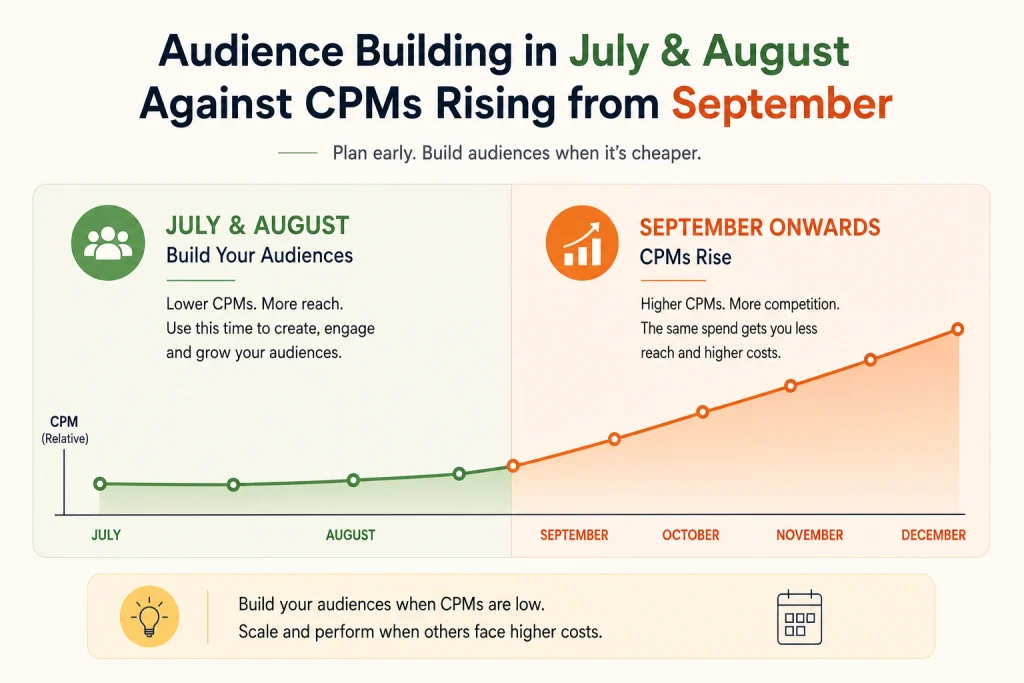
- Build audiences in July and August, before the auction fills.
- Festive digital spend is projected up 25% year on year, taking over half of Indian media budgets.
What actually happens to the auction
The mechanism is simple and it is not about consumer behaviour.
Every advertiser arrives at the same time. National brands, marketplaces, D2C, local retail, and the ones who advertise twice a year. Inventory does not expand to match, so the price of an impression rises.
Reported Indian figures put October CPMs around ₹80–150, against a considerably lower baseline for most of the year, with the sharpest inflation clustered around Navratri, the big marketplace sale events and the ten days before Diwali. What sets your CPM in the first place is a separate subject — what drives your CPM in India covers the chain.
And the money is real. Festive digital advertising in India is projected to grow around 25% year on year and to take over half of media budget allocations, up from roughly 45%. Total festive advertising is estimated at ₹55,000 to ₹60,000 crore, with about ₹5,400 crore of that incremental.
Which is the point. You are not bidding against last month’s competitors. You are bidding against everyone, including businesses with budgets that dwarf yours and a once-a-year willingness to spend them.
The Festive Floor
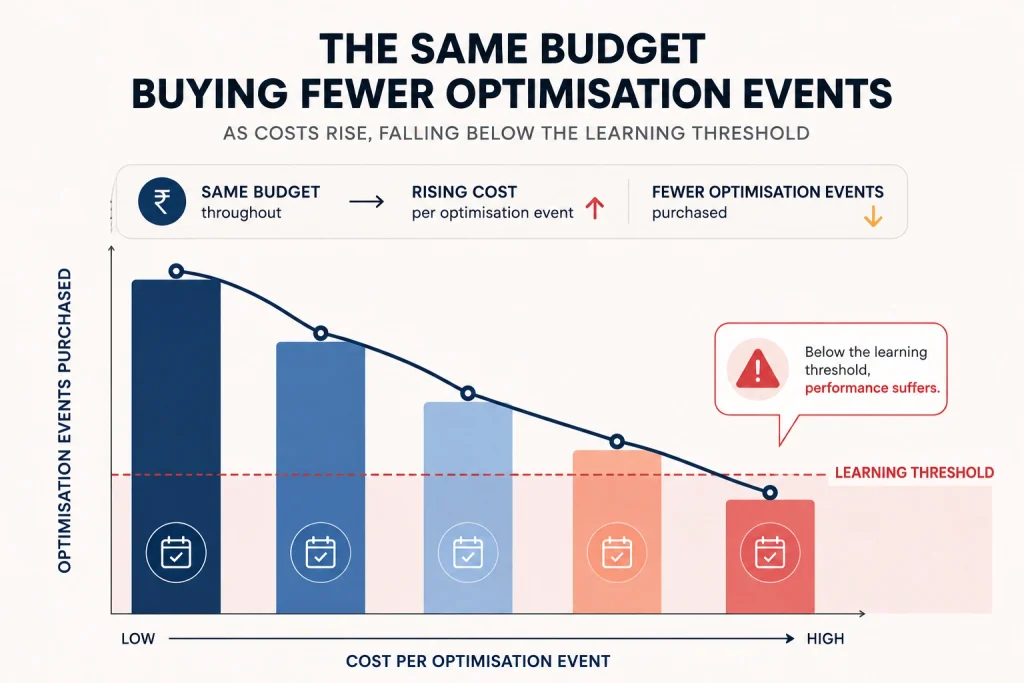
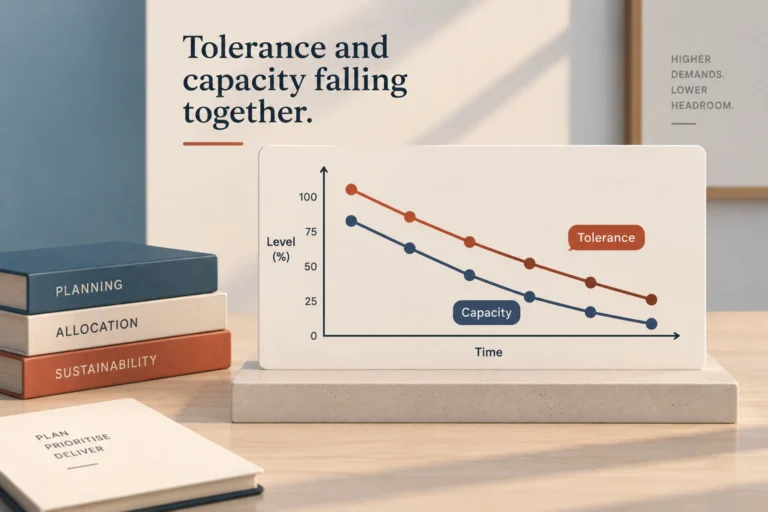
Platform learning requirements are denominated in events, not rupees. When costs rise 60% and your budget does not, you do not simply get fewer results — you drop below the volume your account needs to optimise, and the results you do get stop being reliable.
Here is the arithmetic, and it is the reason this page exists.
A Meta ad set needs roughly 50 optimisation events a week to deliver stably — about 217 a month. That requirement is set by the platform and it does not care what month it is. The full derivation sits at what each stage costs to run properly.
Take an account at ₹700 per optimisation event. Its ad set floor is about ₹1,51,900 a month. In September it clears comfortably.
Now apply festive inflation and hold the budget flat.
- At +40% costs, that budget buys about 155 events against 217 needed — 71% of threshold
- At +60%, about 136 events — 62%
- At +80%, about 121 events — 56%
The account has not become expensive. It has become unstable. Delivery fluctuates, cost per result swings, and every number you look at in October is a poor guide to anything — which is precisely when people start making changes, compounding the problem.
What holding position actually costs
To keep the same ad set at threshold:
- At +40%: about ₹2,12,700 a month — 1.4 times September
- At +60%: about ₹2,43,000 — 1.6 times
- At +80%: about ₹2,73,400 — 1.8 times
None of that is growth. That is the cost of the account continuing to work as well as it did in September.
So the first festive budget conversation is not about opportunity. It is: what does standing still cost, can we afford it, and if not, what do we switch off so that what remains still clears its floor?
That last question is the useful one, and almost nobody asks it. Two ad sets funded below threshold perform worse than one funded above it — and festive is exactly when accounts get wider rather than narrower.
The calendar, as advertising windows
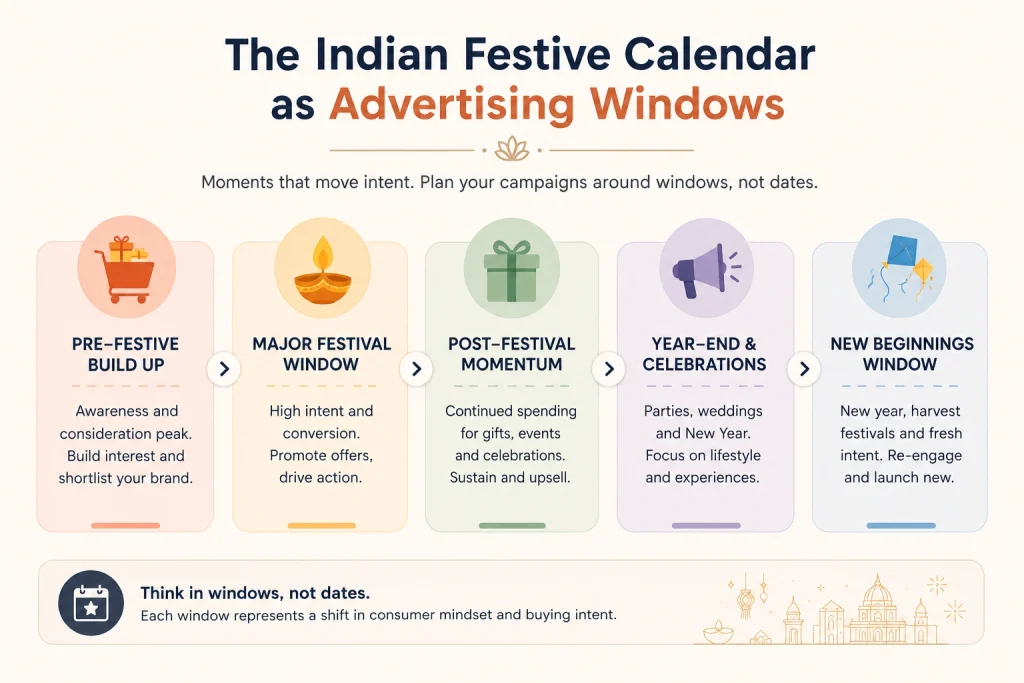
Dates matter less than what each window is for.
July and August — the build. The cheapest audience you will buy all year. Awareness and traffic campaigns now create the retargeting pools you convert in October at a fraction of what cold reach will cost then. This advice is well established and it is correct; the mistake is treating it as optional.
September — Ganesh Chaturthi and Navratri begin. Costs start climbing. Categories with early gifting and home-improvement demand move first.
Early to mid October — Navratri, Dussehra and the marketplace sale events. The steepest inflation of the year. Marketplaces buy enormous reach, and everybody else pays for it.
The ten days before Diwali — peak. Highest costs, highest intent, shortest consideration. Retargeting earns its keep here more than in any other window.
Diwali week itself. Attention fragments. Many categories see conversion hold while costs stay high.
Late November into December — wedding season. A second peak that gets almost no planning attention, and a genuine opportunity for jewellery, apparel, travel, catering, photography, venues and financial services.
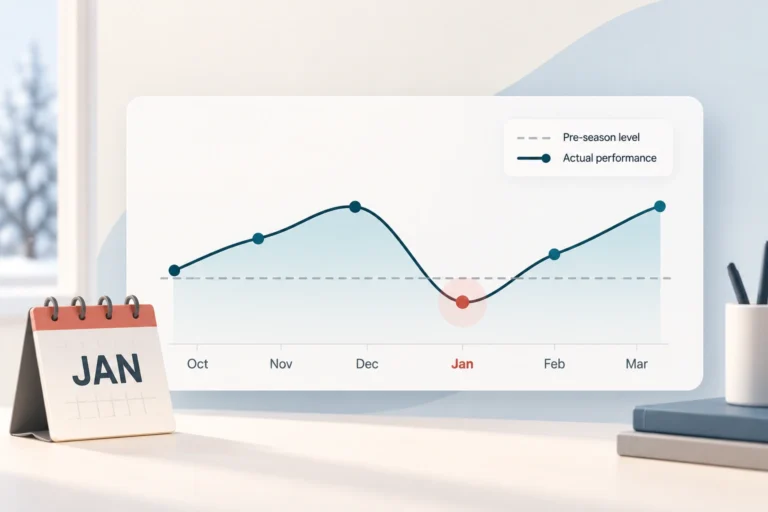
January — the reset. Costs fall sharply. The best month of the year to buy audiences and to test, and the month most teams spend recovering.
Where festive money is moving
Worth knowing, because the mix is shifting faster than the total.
Digital is taking over half of festive media budgets, up from roughly 45% — which is itself part of why digital costs rise so sharply in the window.
Affiliate is forecast to take a further 15 to 20% share of festive digital spend, which matters if you have margin to share and clean attribution.
Connected TV and creator collaborations are the fastest-growing lines. Creator work in particular front-loads: rates and availability tighten well before the season, which is a booking problem rather than a budgeting one. We have covered that separately — planning a creator campaign around a launch and what influencers actually cost in India.
The mistakes that recur every year
Holding budget flat and expecting September performance. The whole argument above, and by far the most common.
Widening the account in October. More campaigns, more ad sets, more audiences, each below threshold. Festive rewards concentration.
Starting the build in September. By then you are paying festive prices for audiences you could have bought in July.
Restructuring mid-season. Every structural change resets learning, and the recovery window is measured in days you do not have — what campaign management involves week to week covers which changes cost what.
Reading October numbers as if they were normal. They are not, and the changes people make in response are usually wrong.
Discounting to a margin you have not calculated. Festive volume at a loss is still a loss.
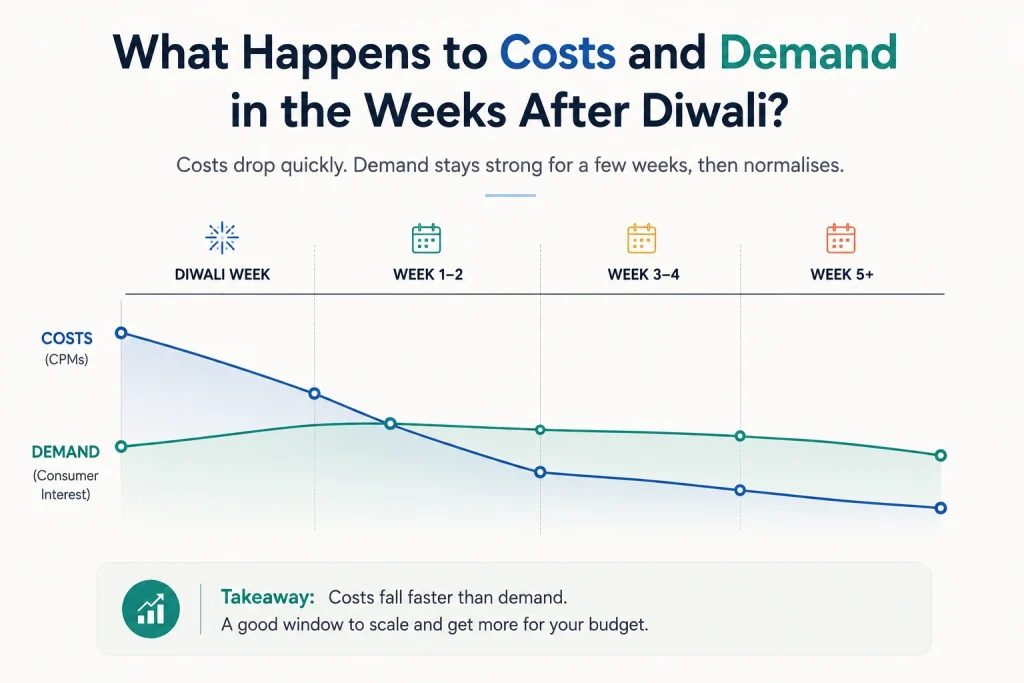
Switching everything off on the day after Diwali. Demand does not stop; the auction empties, which makes the following weeks unusually cheap.
Measuring festive honestly
Compare like periods. October against September tells you nothing except that October is expensive. Compare October against last October, and only if the account was structurally similar.
Expect ROAS to fall and contribution to rise. Higher costs compress efficiency while volume lifts absolute profit. Judging festive on ROAS alone produces the wrong decision every year — which metric should govern your decisions sets out how to choose.
Separate incremental from harvested. A large share of festive conversions would have happened anyway, from people who had already decided. Brand-term and retargeting performance looks spectacular in October for reasons that have nothing to do with your campaigns.
Watch frequency, not just cost. Compressed timelines and concentrated budgets exhaust audiences faster than usual — how to tell whether creative is actually fatigued covers the mechanism.
When to sit festive out
When your category has no festive demand. Most B2B, most professional services, most industrial supply. Bidding into the most expensive auction of the year for the same buyers you could reach cheaply in January is a straightforward way to waste a quarter’s budget.
When you cannot fund a single ad set above its floor. Concentrate on what you can afford to run properly, or wait.
When you cannot service the demand. Festive enquiries you answer in December are worse than no festive enquiries.
When margin cannot carry the discount your competitors are offering. Competing on discount depth against a marketplace is not a strategy.
When your tracking is unreliable. Every decision you make in the most expensive eight weeks of the year will be based on numbers you cannot trust.
The festive checklist
☐ Cost per optimisation event recorded from a normal month as a baseline
☐ Ad set floor calculated at baseline costs
☐ Floor recalculated at +40%, +60% and +80%
☐ Budget required to hold position established before any growth discussion
☐ Decision taken on what to switch off if the full floor is unaffordable
☐ Audience building started in July or August, not September
☐ Retargeting pools sized and checked before October
☐ Creative and creator bookings confirmed early, when rates and availability allow
☐ Structural changes frozen from late September
☐ Offer margin calculated before any discount is published
☐ Comparison periods agreed in advance — like for like, year on year
☐ Contribution tracked alongside ROAS, not instead of it
☐ Post-festive plan written before Diwali, not after
☐ January booked as the year’s cheapest testing window
Questions we get asked
When should you start festive campaign planning in India?
Audience building in July or August. Budget planning in June, because the answer determines whether the plan is affordable at all.
How much do CPMs rise during Diwali?
Reported figures put Indian CPMs 40–80% above January through the period, with the sharpest windows considerably higher.
What is the best time to advertise during the festive season?
For conversion, the ten days before Diwali. For value, July and August — you are buying the audience you will convert later at a fraction of the price.
How much should you increase ad budget for Diwali?
Roughly 1.4 to 1.8 times your normal monthly budget simply to keep each ad set at its learning threshold. Growth ambitions sit on top of that.
What happens to ad performance after Diwali?
Costs fall sharply and demand softens but does not vanish. The weeks after are among the cheapest of the year, and most advertisers leave them empty.
Is festive worth it for B2B?
Usually not. Decision-makers are on leave, procurement slows, and you are paying consumer-season prices for business buyers.
Where to go next
This page is the survey. The detail sits in the articles below.
On budget — the festive floor calculation at full depth, with worked examples by spend band.
On the build — what to run in July and August, and how large a retargeting pool you need.
On the sub-seasons — Navratri, Dussehra and Diwali as separate windows with separate jobs.
On pacing — how to distribute an eight-week budget across windows that are not equal.
On the aftermath — trading November to January, when everyone else has stopped.
The number to work out in June
Find your cost per optimisation event in a normal month. Multiply by 217. That is what one ad set costs to keep learning today.
Multiply that by 1.6. That is roughly what the same ad set costs in October to do exactly as well as it does now.
If that number is affordable, you have a festive plan to build. If it is not, you have a different and more useful decision to make — which parts of the account to fund properly and which to switch off — and making it in June is worth considerably more than making it in October.
If you want that calculation run against your own account and a festive plan built from it, you can reach out to us on whatsapp at +91 7738844851 .
More in Blog
Keep reading
All articles →
Ready to talk about your growth?
Tell us what's stuck and we'll tell you what we'd do first. Free, 30 minutes, no pitch.