
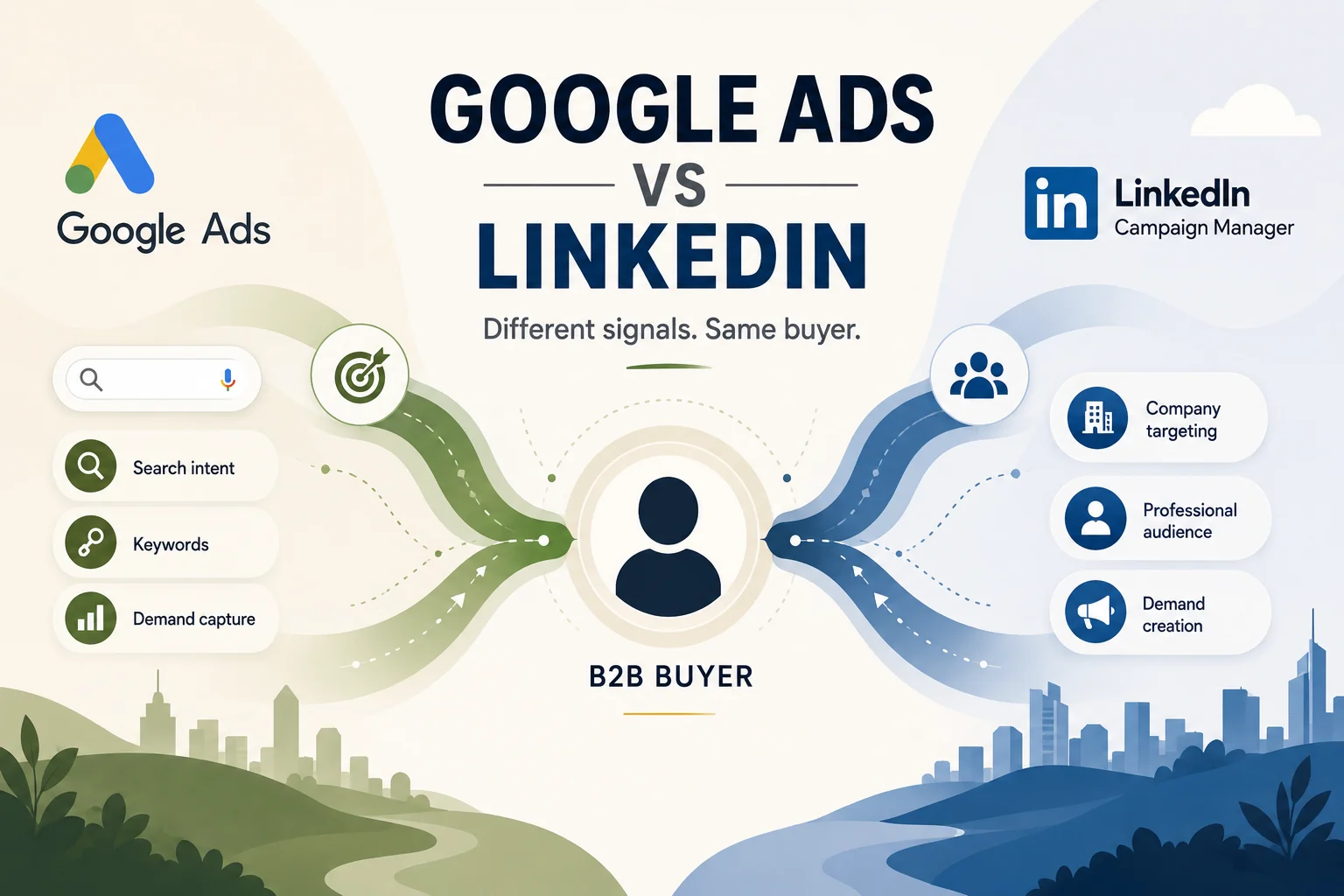
Someone searches “inventory management software for pharma distributors.” Google will show them your ad. Google has no idea whether they are a purchasing head with a budget, an intern doing research, or a competitor checking your positioning.
Someone else is a purchasing head at a pharma distributor with 200 staff. LinkedIn will show them your ad. LinkedIn has no idea whether they are looking for inventory software, or have any intention of doing so this year.
Both platforms are working correctly. Each can see exactly half of what you need to know.
The short answer
Google captures intent without identity — you know what someone wants and nothing reliable about who they are. LinkedIn offers identity without intent — you know their job title, employer and seniority, and nothing about whether they are in market. That difference determines where each platform wastes your money: Google on the wrong people asking the right question, LinkedIn on the right people at the wrong moment. Which waste you can absorb depends almost entirely on what a customer is worth.
Key takeaways
- Google wastes on identity, LinkedIn wastes on timing. Neither platform lets you filter both.
- Indian LinkedIn CPCs run several times Google’s, because you are buying declared professional data rather than a query.
- The circulating allocation rule is stated in dollars. Converted, its thresholds are roughly ₹13 lakh and ₹43 lakh in annual contract value — far above most Indian B2B deals.
- That points most Indian businesses toward Google, not toward the universal “run both” advice.
- Around 5% of B2B buyers are in-market at any time. LinkedIn reaches the other 95%, which is valuable and slow.
What each platform actually knows
The comparison usually stops at “Google has intent, LinkedIn has targeting.” Worth going one step further, because the consequence is where the money goes.
Google knows the question, not the questioner. Someone typed a query. That query is strong evidence of a need and almost no evidence of authority, budget or fit. In B2B this matters more than in consumer categories, because the person researching is frequently not the person deciding, and the person deciding often never searches at all.
LinkedIn knows the person, not the moment. Job title, seniority, company size, industry, all declared by the user in public where colleagues can see it. What LinkedIn cannot tell you is whether that person has a problem today.
Neither platform can give you both, and no amount of skill closes the gap. You are choosing which half to be blind to.
The Blind Half
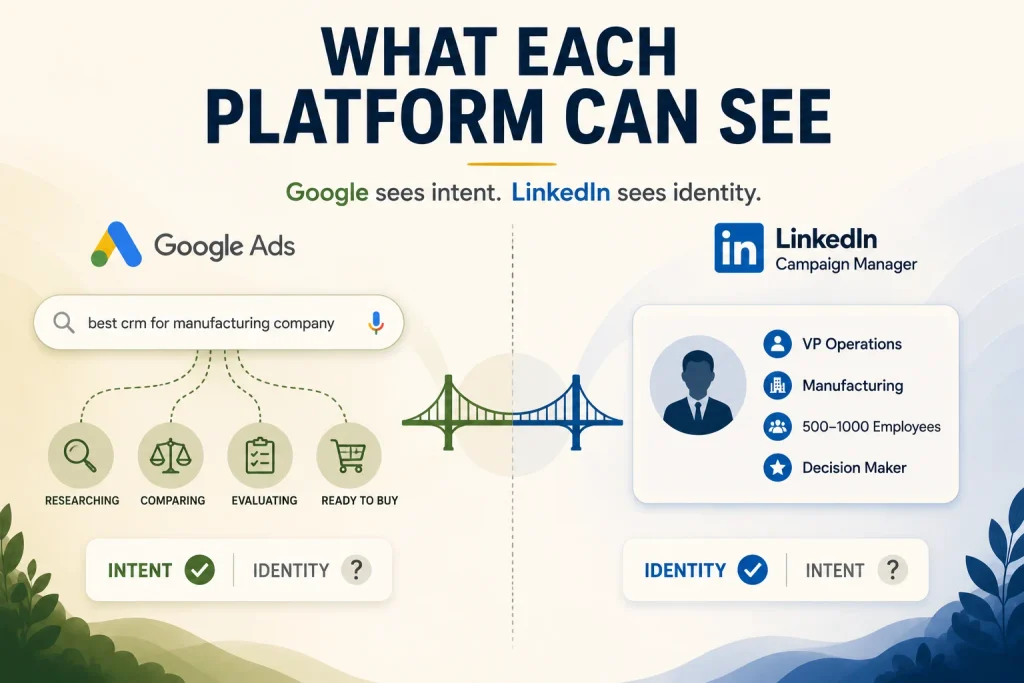
Google shows you intent without identity. LinkedIn shows you identity without intent. Each wastes money on what it cannot see — Google on the wrong people asking the right question, LinkedIn on the right people at the wrong time. The platform that suits you is the one whose waste your deal values can absorb.
Work through what each waste looks like in practice.
Google’s waste: the wrong people
Your ad appears for a relevant query. The click costs you money regardless of who clicked.
Students and researchers. Particularly costly in technical B2B categories, where academic and journalistic interest overlaps with commercial search terms.
Competitors and agencies. Checking your positioning, your landing page, your offer.
Juniors without authority. Someone tasked with “finding options” who will produce a shortlist and no decision for eight months.
Adjacent needs. Someone whose query matched but whose actual requirement is a different product entirely.
What reduces it. Negative keywords, stated price bands, copy that names the buyer explicitly, and qualifying questions on the form. None of it filters by identity, because Google does not have identity to filter on. You are approximating.
LinkedIn’s waste: the wrong moment
Your ad reaches exactly the right person. They have no current need.
This is not failure, which is what makes it hard to manage. Reaching a qualified buyer who is not in market is genuinely valuable — around 5% of B2B buyers are in market at any moment, per Ehrenberg-Bass research for the LinkedIn B2B Institute, so 95% of correct targeting lands on people who will buy eventually or never.
The cost is patience and money. You pay a premium per impression to reach a rare person, then wait. If your sales cycle is short and your budget is quarterly, that wait is not an investment, it is a shortfall.
What reduces it. Retargeting people who have shown behavioural interest, and using Lead Gen Forms only on audiences who already recognise you. Both narrow toward intent that LinkedIn cannot see natively.
The cost gap, and what it buys
Reported Indian LinkedIn CPCs run roughly ₹150 to ₹650, with a median near ₹320. Google’s Indian search CPCs sit far below that across most categories.
The premium is not arbitrary. It buys declared professional data — typed by the user, visible to their network, awkward to falsify. Google’s equivalent signal is a search string.
Whether it is worth paying is a question about deal value rather than about platform quality, and the mechanism behind LinkedIn’s pricing is worth understanding separately — why LinkedIn Ads cost what they do covers how audience scarcity drives the price, including the counter-intuitive point that narrowing your targeting raises it.
One figure worth treating carefully. A comparative claim circulates across this topic putting LinkedIn at 121% ROAS against Google Search at 67%. It appears on multiple pages with no stated sample, period or methodology, and we could not trace it to a primary source. A cross-platform ROAS comparison with no methodology is the least reliable kind of statistic available, because it depends entirely on whose accounts were measured and how conversions were attributed. Treat it as a claim rather than evidence.
The allocation rule, converted for India
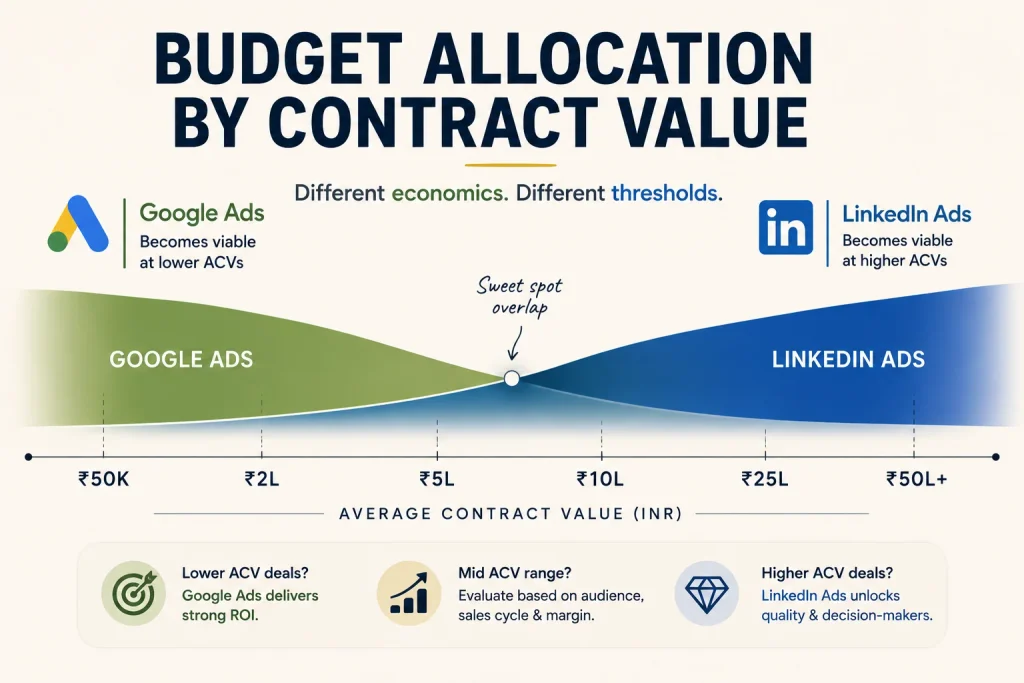
The most useful thing on this topic circulates as a dollar-denominated rule: businesses with annual contract value under $15,000 and short sales cycles should put roughly 80% into Google; those above $50,000 with long cycles should put roughly 70% into LinkedIn.
Convert it. Those thresholds are approximately ₹13 lakh and ₹43 lakh in annual contract value.
Now hold that against Indian B2B reality. A large share of Indian B2B — services firms, component suppliers, regional distributors, SME software — operates well below ₹13 lakh per contract.
Which means the rule, applied honestly, points most Indian B2B businesses toward Google, not toward the balanced split that almost every article recommends.
Why the standard advice differs. Most of the material on this topic is written for B2B SaaS in North America, where six-figure contract values are common and LinkedIn’s premium is easily absorbed. Repeating that advice into an Indian market with different deal sizes is where the recommendation stops being useful.
The arithmetic to run yourself. Gross profit per customer, multiplied by your close rate on qualified leads, gives your maximum acceptable cost per lead. Compare it against each platform’s realistic cost per lead in your category. Working out what a lead is actually worth has the method and a calculator.
When each one is clearly right
Google, when people are searching for what you sell. If Keyword Planner shows meaningful volume for the phrases your buyers use, that demand exists now and capturing it is cheaper than creating it.
Google, when deal values are modest. Below roughly ₹13 lakh in contract value, LinkedIn’s cost per lead is difficult to justify at Indian rates.
Google, when you need pipeline this quarter. Intent converts faster than identity.
LinkedIn, when nobody searches for your category. New propositions, emerging categories, and products buyers do not yet know exist.
LinkedIn, when the buyer is specific and rare. If you sell to compliance heads at NBFCs, Google cannot find them and LinkedIn can.
LinkedIn, when contract values are large and cycles are long. The premium is absorbed and the patience is affordable.
LinkedIn, for account-based work. A defined target list is exactly what its targeting was built for, and nothing on Google approximates it.
Running both, honestly
Most articles conclude here and most conclude too quickly.
Both platforms require enough conversion volume to optimise. Google recommends at least 30 conversions in 30 days for Target CPA bidding. LinkedIn needs audiences large enough to deliver — its recommended minimum for Sponsored Content is 50,000 members against a technical floor of 300.
A budget that cannot feed either properly does not become adequate by being split across both. The general version of that argument sits in whether you can afford more than one platform, and it applies here unchanged.
If you do run both, expect your reporting to overstate results. Someone who saw a LinkedIn ad, remembered you, then searched your name and clicked a Google ad will often appear in both platforms’ conversion counts. Why platforms count the same conversion twice covers how to measure the overlap.
The sequence that usually works. Fund Google to the point where additional spend stops finding qualified searches — visible as impression share rising while conversion rate falls. Then, if deal values justify it, add LinkedIn for the buyers who never search.
Mistakes that cost real money
Comparing cost per click across the two platforms. Different products at different prices. Compare cost per qualified lead or do not compare.
Applying North American allocation advice to Indian deal sizes. The thresholds do not survive the currency conversion.
Expecting LinkedIn to produce this quarter’s pipeline. It reaches people who are not looking yet, which is the point and also the delay.
Judging Google leads on volume without checking who they were. Google’s blindness to identity is exactly where its waste sits.
Splitting a small budget to hedge. Neither platform clears its threshold and both underperform.
Running LinkedIn on a sub-10,000 audience. You pay a scarcity premium you probably did not intend to buy.
When neither is the answer
When your buyer is not searching and not professionally active on LinkedIn. Many Indian B2B buyers — traders, small manufacturers, regional retailers — are reachable through trade platforms, referral and direct contact far more cheaply.
When gross profit per customer is small. Both platforms carry costs that modest deal values cannot absorb.
When your follow-up is slow. Neither platform survives a two-day response time, and the HBR audit of 2,241 companies found an average first response of 42 hours.
When you have no way to tell a qualified lead from an unqualified one. Both platforms optimise toward what you count, and counting badly produces confident waste.
The allocation checklist
☐ Gross profit per customer calculated, not revenue
☐ Close rate on qualified leads established
☐ Maximum acceptable cost per lead derived from both
☐ Keyword Planner checked for real search volume on your buyer’s phrases
☐ Annual contract value compared against the ₹13 lakh threshold
☐ Sales cycle length recorded honestly
☐ Google funded first if search volume exists and deal values are modest
☐ LinkedIn considered only once Google’s qualified search volume is exhausted
☐ LinkedIn audience size checked as above 20,000 before launch
☐ Conversion volume checked against Google’s 30-in-30 recommendation
☐ Reporting overlap measured if both platforms run
☐ One review interval agreed, matched to the sales cycle
Questions we get asked
Is LinkedIn better than Google Ads for B2B?
Neither is better. Google is faster and cheaper where demand already exists; LinkedIn reaches specific people who are not searching. For most Indian B2B deal sizes, Google clears the economics more easily.
Why are LinkedIn Ads so much more expensive?
You are buying declared professional data and competing with every other B2B advertiser for the same senior people, on a platform with far less inventory than search.
Should I run both?
Only once each can be funded to its own thresholds. Below that, splitting produces two underperforming accounts.
Which produces better quality leads?
LinkedIn leads usually match your target profile more precisely. Google leads usually have more immediate intent. Quality means different things and your sales process decides which matters more.
How should I split budget?
Fund existing demand first, then demand creation with what remains, and only if deal values absorb LinkedIn’s cost. There is no universal ratio and any article offering one has not seen your margins.
Does the ACV rule really apply in India?
The logic does; the thresholds need converting. At roughly ₹13 lakh and ₹43 lakh, most Indian B2B sits below the point where LinkedIn’s premium is comfortable.
Two questions, before the budget meeting
Open Keyword Planner and check whether people in India are searching for what you sell, using the words they would actually use.
Then work out gross profit per customer and compare your annual contract value against ₹13 lakh.
If there is search volume and your contracts sit below that line, the honest answer is that Google should have most of your budget — regardless of what the comparison articles above this one recommend, most of which were written for a market with much larger deals.
If nobody is searching and your contracts are large, LinkedIn is doing something Google structurally cannot.
If you would like both numbers run against your actual pipeline before the allocation is set, you can reach out to us on whatsapp at +91 7738844851 .
More in Blog
Keep reading
All articles →
Ready to talk about your growth?
Tell us what's stuck and we'll tell you what we'd do first. Free, 30 minutes, no pitch.