CAC Full Form: What Customer Acquisition Cost Is and How to Calculate It
CAC full form is customer acquisition cost. Learn the CAC formula with rupee examples, paid vs blended CAC, the LTV to CAC ratio, and ways to lower it.

The short answer
The full form of CAC is customer acquisition cost: what you spend, on average, to win one new customer. The formula is CAC = total sales and marketing cost ÷ number of new customers in the same period. If you spent ₹3,00,000 on ads, agency fees and tools last month and gained 400 new customers, your CAC is ₹750. CAC on its own tells you little. Compare it with what a customer is worth over time (lifetime value, or LTV) and how many months it takes to earn the CAC back. If a customer’s margin never covers CAC, growth loses money.
What CAC means
Every new customer costs something to win: ads, discounts, sales calls, content, tools. CAC adds those up and divides by the customers you gained.
In India you may also see “CAC full form in medical” or “in banking”. Those are different abbreviations. In marketing and startups, CAC always means customer acquisition cost.
The CAC formula
CAC = sales and marketing cost ÷ new customers acquired
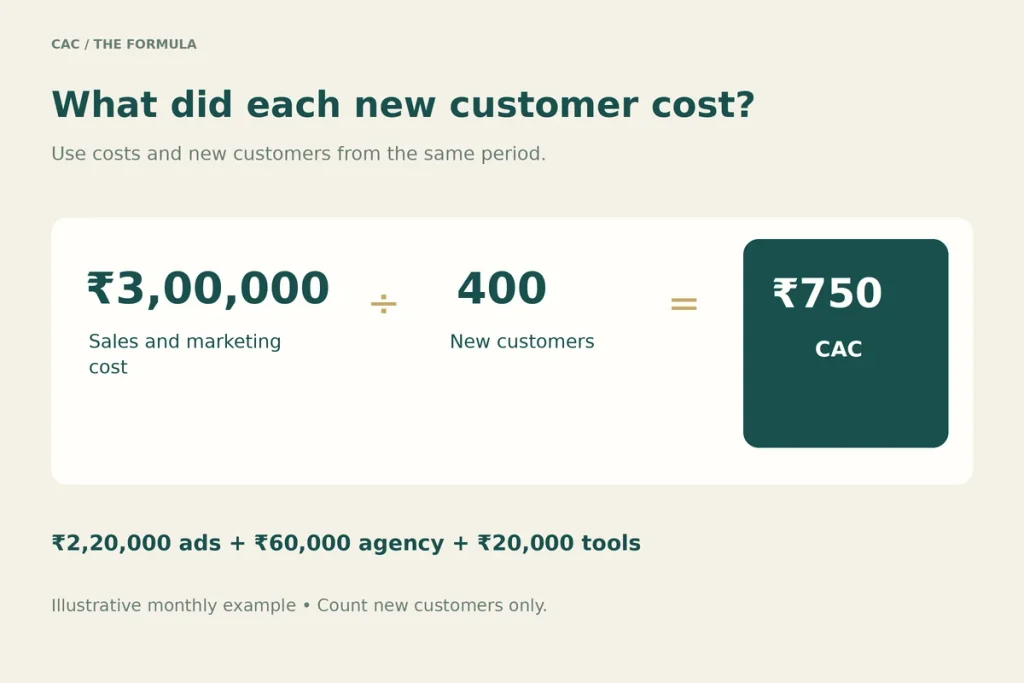
Example (illustrative):
- Meta and Google ad spend: ₹2,20,000
- Agency fee: ₹60,000
- Email and WhatsApp tools: ₹20,000
- New customers in the month: 400
CAC = ₹3,00,000 ÷ 400 = ₹750
Count only new customers. Repeat buyers didn’t need to be acquired again.
Three versions of CAC
People mean different things by CAC, so reports can disagree.
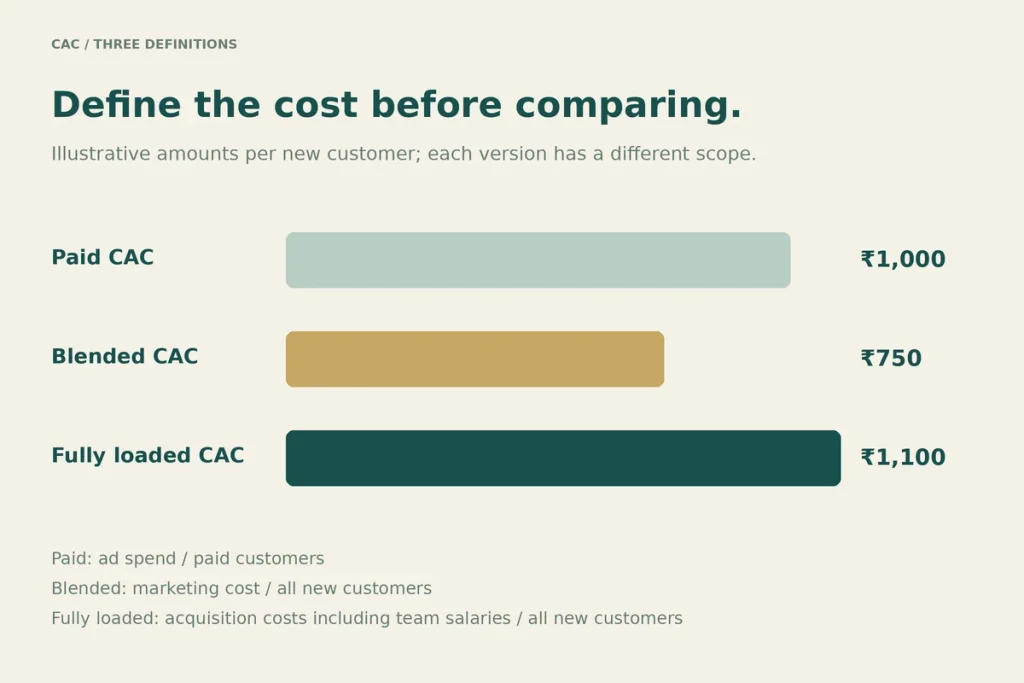
Paid CAC. Ad spend ÷ customers from paid ads only. Good for judging ad campaigns.
Blended CAC. All marketing cost ÷ all new customers, including organic and referral. Good for the business view.
Fully loaded CAC. Blended CAC plus salaries of the marketing and sales team. Closest to the true cost.
State which one you’re using. Paid CAC can look much higher than blended CAC, because blended spreads cost over organic customers too.
Compare CAC with LTV and payback
LTV (lifetime value) is the margin a customer brings over the whole relationship. A common rule of thumb in startups is to aim for LTV at least three times CAC, but the right ratio depends on your cash position and margins. See our guide to performance marketing ROI for the LTV to CAC ratio in detail.
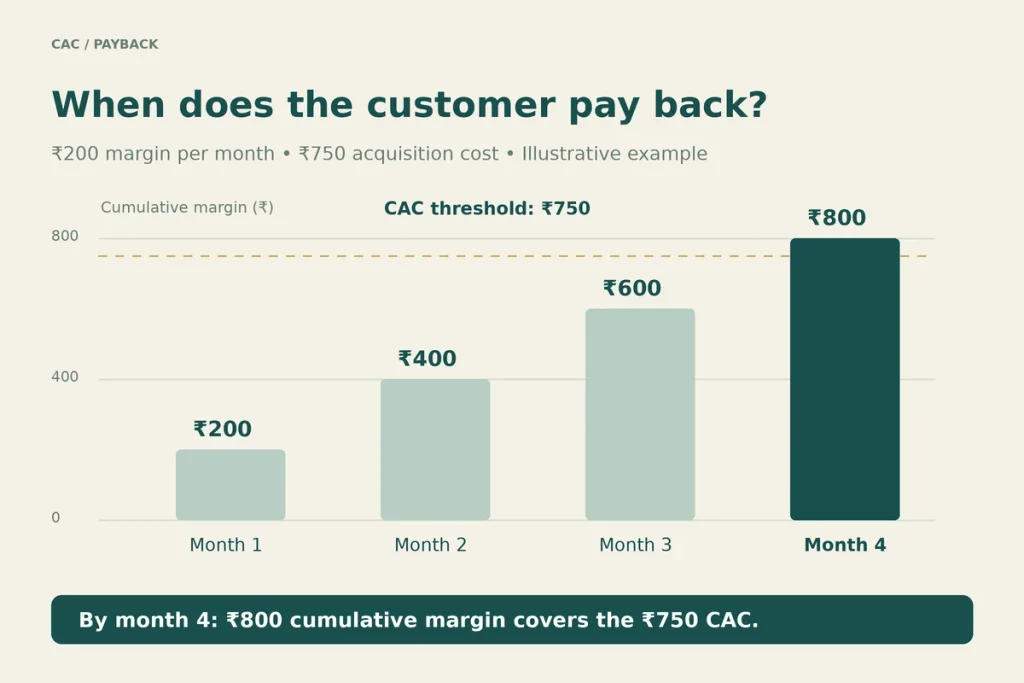
Payback period is how long it takes a customer’s margin to repay CAC. Illustrative: CAC ₹750, and a customer brings ₹200 of margin a month. Payback is about 4 months. If most customers stop buying before month 4, you lose money on each one.
The D2C business model guide shows how CAC fits into unit economics.
How to reduce CAC
- Raise conversion rate. The same ad spend brings more customers
- Raise AOV on the first order. CAC is easier to cover in one go
- Refresh creatives before performance drops
- Cut channels with poor customer quality, not just high cost per click
- Grow organic and referral so blended CAC falls
- Improve targeting using your best customers’ data
Mistakes to avoid
Counting repeat orders as new customers. It makes CAC look lower than it is.
Leaving out agency fees and tools. They are part of acquisition cost.
Comparing paid CAC with a competitor’s blended CAC. Different definitions.
Looking at CAC without LTV. A ₹2,000 CAC is fine if customers are worth ₹10,000.
Checklist
- CAC version defined (paid, blended or fully loaded)
- Only new customers counted
- Agency fees and tools included where relevant
- LTV or 12-month margin per customer estimated
- Payback period calculated
- CAC tracked monthly by channel
Questions we get asked
What is CAC full form in business?
Customer acquisition cost.
Is CAC the same as CPA?
Not quite. CPA is usually one ad platform’s cost per conversion. CAC covers all acquisition costs and counts only new customers.
What is a good CAC?
One that your customers’ margin repays within a period your cash can support. Compare with ROAS and LTV, not with other businesses.
Final thoughts
CAC tells you what growth costs. Define it clearly, compare it with LTV and payback, and work on conversion and order value to bring it down. More in our guide to digital marketing terms.
Want a clear read on your CAC by channel? Book a consultation. You can reach out to us on whatsapp at +91 7738844851 .
More in Blog
Keep reading
All articles →
Ready to talk about your growth?
Tell us what's stuck and we'll tell you what we'd do first. Free, 30 minutes, no pitch.