ROAS Full Form: What Return on Ad Spend Means and How to Calculate It
ROAS full form is return on ad spend. Learn the ROAS formula, 4x vs 400%, break-even ROAS in two lines, and why ad platform ROAS differs from actual sales.

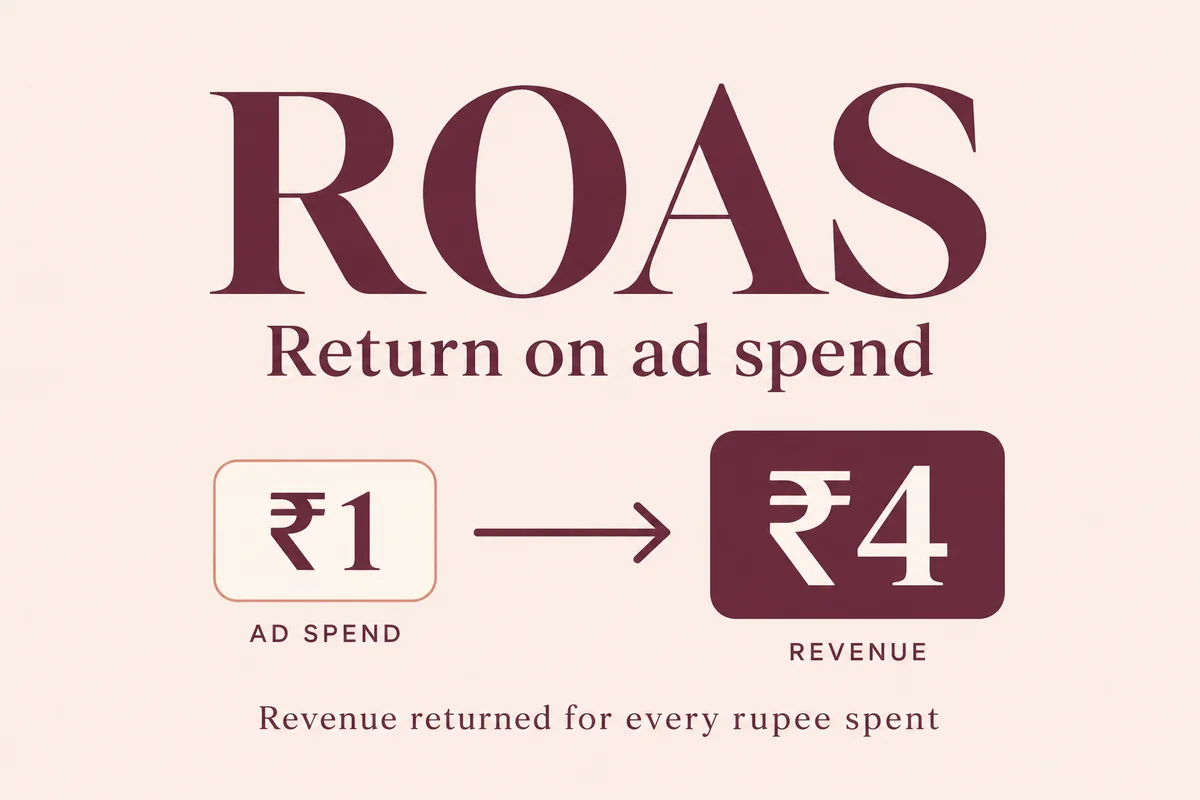
The short answer
The full form of ROAS is return on ad spend. It shows how much revenue your ads brought in for every rupee spent: ROAS = revenue from ads ÷ ad spend. If ₹50,000 of ads brought ₹2,00,000 in sales, ROAS is 4, usually written 4x or 400%. Google Ads writes it as a percentage; its own example is $5 of sales per $1 of spend equalling a 500% target ROAS. ROAS measures revenue, not profit. To know whether a ROAS is good, compare it with your break-even ROAS, which depends on your margin.
The ROAS formula
ROAS = revenue attributed to ads ÷ ad spend
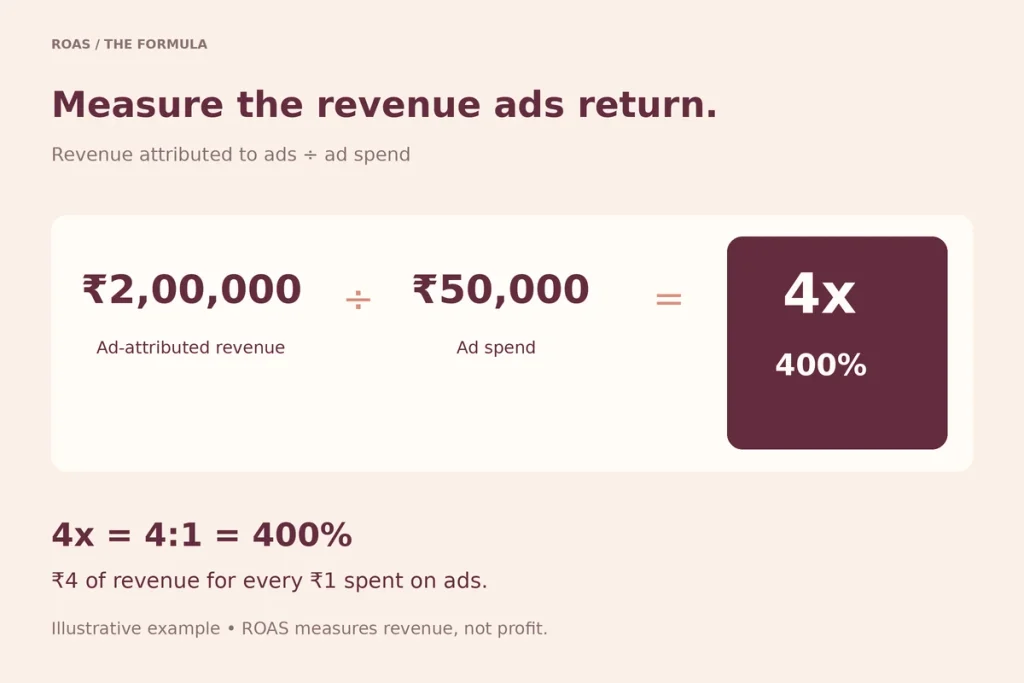
Example (illustrative): ₹2,00,000 ÷ ₹50,000 = 4
You’ll see it written three ways:
- 4x (common in reports)
- 4:1 (ratio)
- 400% (Google Ads target ROAS)
All three mean the same thing: ₹4 of revenue per ₹1 of ad spend.
ROAS vs ROI
ROAS uses revenue. ROI uses profit.
A 4x ROAS on a product with a 20% margin loses money once product costs are paid. The same 4x on a 70% margin product is very profitable. That’s why ROAS alone can’t tell you if ads are working.
On Amazon, sellers use ACoS, which is the inverse: ad spend ÷ ad sales.
Break-even ROAS
The ROAS at which ads neither make nor lose money (before other costs):
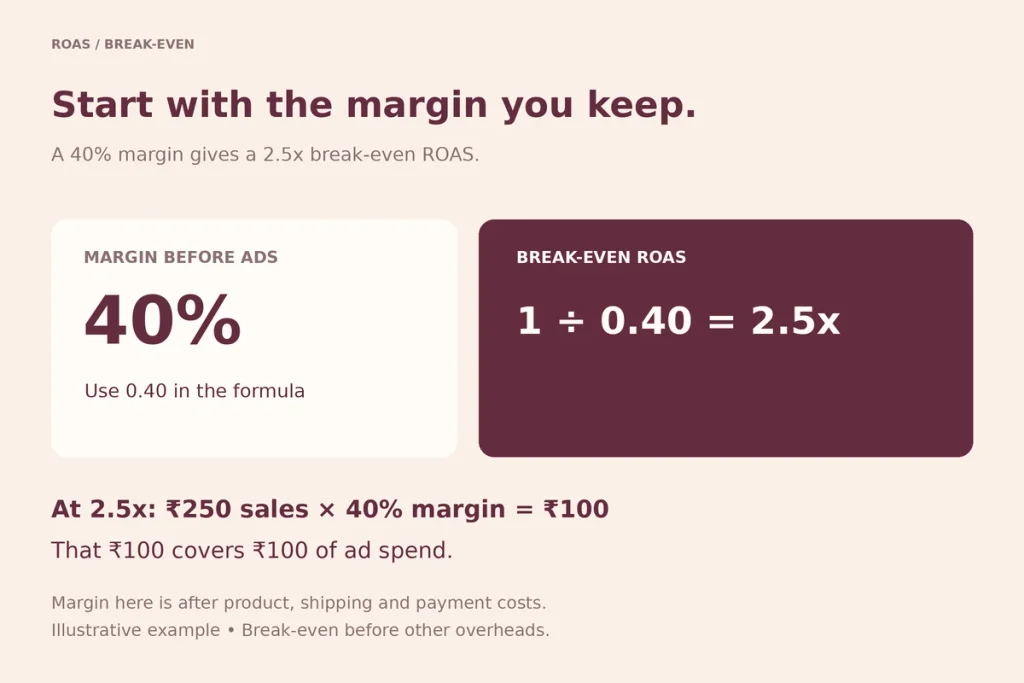
Break-even ROAS = 1 ÷ gross margin
Illustrative: if your margin after product, shipping and payment costs is 40%, break-even ROAS = 1 ÷ 0.40 = 2.5x. Below 2.5x, each sale from ads loses money. Above it, ads contribute profit.
For what counts as good by industry, see what a good ROAS is in India.
Why platform ROAS differs from your sales
Meta and Google each report their own ROAS. Add them up and you’ll often get more revenue than your store actually made.
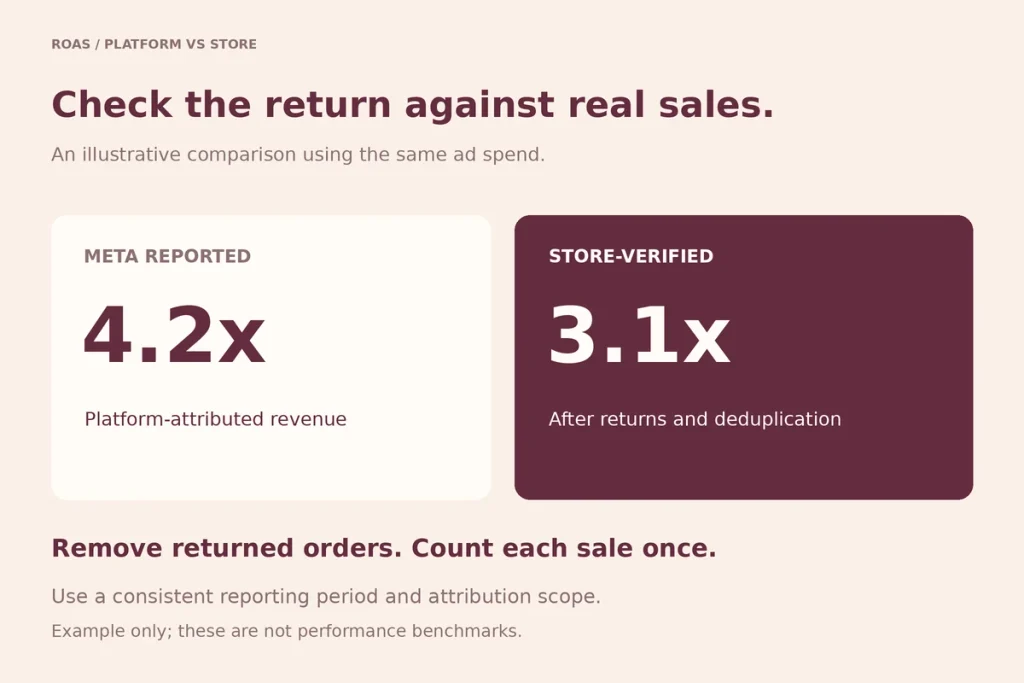
Common reasons:
- Double counting. A customer clicks a Meta ad and a Google ad; both claim the sale
- Attribution windows. Platforms credit sales that happen days after a click or view
- Returns and RTO. Platforms count the order, not whether it was delivered and kept
Check platform ROAS against store revenue. Tag links with UTM parameters and look at blended ROAS: total revenue ÷ total ad spend.
ROAS for lead generation
ROAS needs revenue, so it’s harder to use when ads bring leads rather than orders. A B2B firm, a clinic or a real estate developer can still estimate it:
- Find your average revenue per closed customer
- Multiply by your lead-to-customer rate to get value per lead
- Feed that value back to the ad platform, or calculate ROAS in a sheet
Illustrative: a ₹60,000 average deal and a 5% lead-to-customer rate give ₹3,000 per lead. If ads bring leads at ₹900 each, estimated ROAS is about 3.3x. Until you have that data, cost per qualified lead is usually the better KPI.
Mistakes to avoid
Chasing high ROAS on existing customers only. Retargeting ROAS looks great but may bring few new buyers. Watch CAC too.
Ignoring margin. Judge ROAS against break-even, not a round number.
Summing platform-reported revenue. It overstates results.
Comparing ROAS across very different products. Margins differ.
Checklist
- ROAS format agreed (4x or 400%)
- Break-even ROAS calculated from your margin
- Platform ROAS checked against store revenue
- Blended ROAS reported monthly
- Returns and RTO removed from revenue where possible
- CAC and new-customer share tracked alongside
Questions we get asked
What is the full form of ROAS?
Return on ad spend.
Is ROAS a percentage or a multiple?
Either. 4x and 400% mean the same.
Is 2x ROAS good?
Only if your break-even ROAS is below 2x, which needs a gross margin above 50%.
Final thoughts
ROAS tells you how much revenue ads bring back. Compare it with break-even, check it against real sales, and keep an eye on profit. More terms in our guide to digital marketing terms.
Want your ROAS checked against real sales? Book a consultation. You can reach out to us on whatsapp at +91 7738844851 .
More in Blog
Keep reading
All articles →


Ready to talk about your growth?
Tell us what's stuck and we'll tell you what we'd do first. Free, 30 minutes, no pitch.