Digital Marketing Terms: 45 Full Forms and Meanings, Grouped by What They Measure
Digital marketing terms explained: 45 full forms and meanings (KPI, ROI, CTA, CAC, ROAS, SEM, UTM and more) with formulas and rupee examples.

The short answer
Digital marketing terms fall into four groups. Reach terms describe how people find you: SEO, SEM, SMM, impressions. Persuade terms describe the message: USP, CTA, AIDA. Convert terms describe what people do next: CTR, CPC, CPL, conversion rate. Measure terms tell you whether it paid off: KPI, ROI, ROAS, CAC, LTV. Most confusion comes from mixing groups, for example judging an ad by clicks when the goal was sales. Learn the groups first, then the formulas. This guide covers 45 terms, each with a one-line meaning and a link to the full explainer.
Key takeaways
- Most digital marketing abbreviations are either a channel (SEO, SEM, SMM) or a ratio (CTR, CPC, ROAS)
- Ratios need a clear top and bottom number. “CTR” means nothing until you know clicks out of what
- ROAS measures ad revenue; ROI measures profit. They are often confused
- A KPI is simply the few numbers you’ve agreed to judge success by
- UTM tags are what make most of these numbers trustworthy
How to read this glossary
India had about 1.03 billion internet users at the end of 2025, and 500 million active social media user identities, according to DataReportal’s Digital 2026 India report. With that much activity, agency reports get long, and the abbreviations pile up quickly.
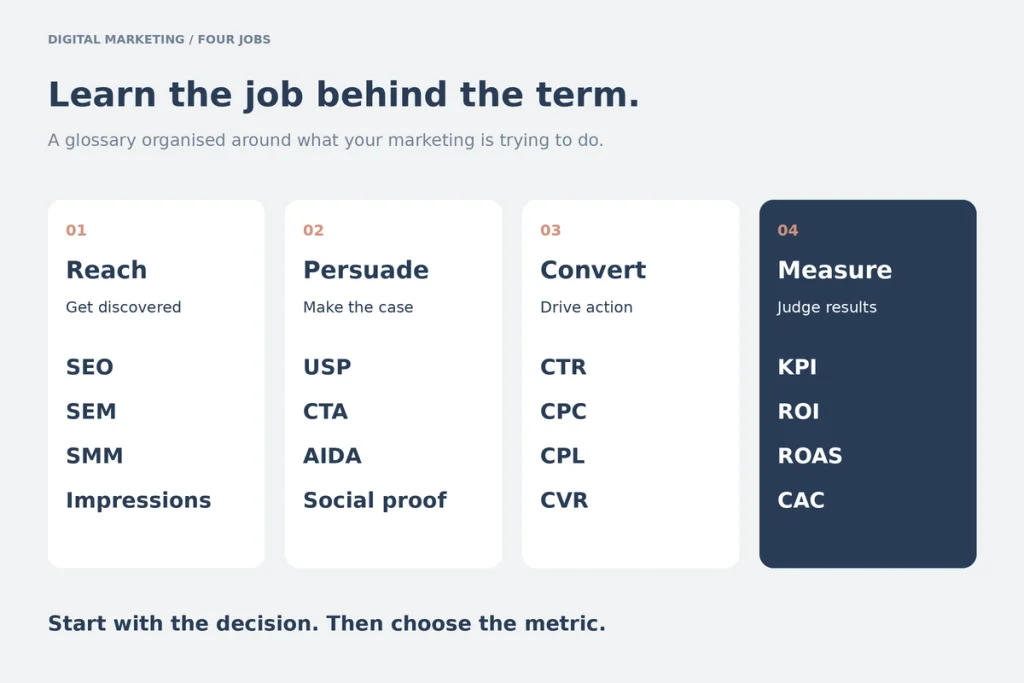
So instead of A to Z, the terms below follow the order a customer moves in: they see you, they’re persuaded, they act, and you measure what it was worth. If you’re reading a report and hit a term you don’t know, find which of the four jobs it belongs to. That tells you what question it answers.
Terms for reaching people
1. SEO (search engine optimisation). Improving your website so it ranks in unpaid Google results. Slow to build, cheap to keep.
2. SEM (search engine marketing). Getting traffic from search engines, usually meaning paid search ads on Google. See SEM full form.
3. PPC (pay per click). An ad model where you pay only when someone clicks. Google Search ads are the common example.
4. SMM (social media marketing). Promoting a brand on Instagram, Facebook, YouTube, LinkedIn and similar platforms. See SMM full form.
5. SMO (social media optimisation). Improving your social profiles and posts so they’re found and shared more.
6. Impressions. The number of times your ad or post was shown. One person can create several impressions.
7. Reach. The number of unique people who saw your content at least once.
8. Frequency. Impressions divided by reach: how many times, on average, each person saw it.
9. Organic. Traffic or reach you didn’t pay for directly.
10. Paid. Traffic or reach from ads.
11. Keyword. A word or phrase people type into a search engine.
12. SERP (search engine results page). The page Google shows after a search.
13. Retargeting (remarketing). Showing ads to people who already visited your site or engaged with you.
14. Lookalike audience. An ad audience that platforms build to resemble your existing customers.
Platform-specific reach terms are covered in our guides to Instagram SEO and YouTube SEO.
Terms for persuading people
15. USP (unique selling proposition). The one specific benefit you offer that competitors don’t. See USP meaning.
16. CTA (call to action). The instruction that tells people what to do next: “Book a demo”, “Shop now”. See CTA full form.
17. AIDA (attention, interest, desire, action). A classic model for structuring ads and landing pages. See AIDA model.
18. Creative. The ad itself: image, video, headline and copy.
19. Hook. The opening line or first seconds of a video that stop the scroll.
20. Landing page. The page people arrive on after clicking an ad.
21. UGC (user-generated content). Photos, videos and reviews made by customers rather than the brand.
22. Social proof. Reviews, ratings and testimonials that reduce doubt.
Terms for converting people
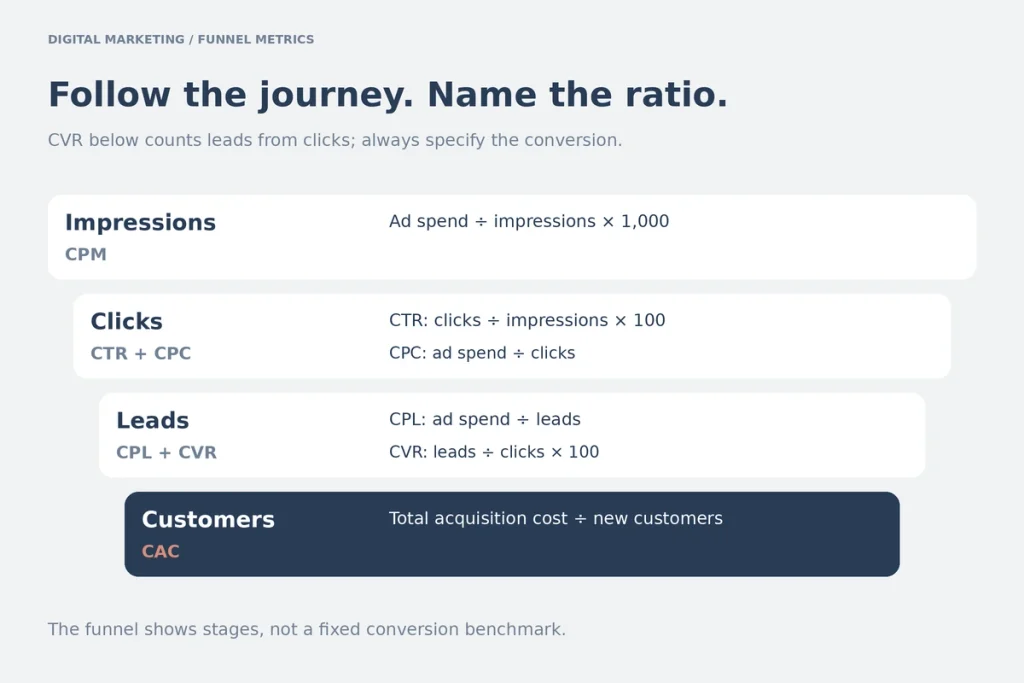
23. CTR (click-through rate). Clicks ÷ impressions × 100. See CTR full form.
24. CPC (cost per click). Ad spend ÷ clicks.
25. CPM (cost per mille). Cost per 1,000 impressions. “Mille” is Latin for thousand.
26. CPL (cost per lead). Ad spend ÷ leads.
27. CPA (cost per acquisition). Ad spend ÷ conversions, where a conversion is whatever action you count.
28. CPV (cost per view). What you pay per video view, common on YouTube.
29. Conversion. Any action you want people to take: purchase, form fill, call.
30. CVR (conversion rate). Conversions ÷ visits (or clicks) × 100. See conversion rate.
31. Bounce rate. In Google Analytics 4, the share of sessions that were not engaged.
32. AOV (average order value). Revenue ÷ orders. See AOV meaning.
33. Lead. A person who has shared contact details and shown interest.
34. MQL and SQL. Marketing-qualified lead and sales-qualified lead: the stages a lead passes through before sales calls.
Terms for measuring results
35. KPI (key performance indicator). The few numbers you’ve agreed to judge success by. See KPI full form.
36. ROI (return on investment). (Gain − cost) ÷ cost × 100. Measures profit. See ROI full form.
37. ROAS (return on ad spend). Ad revenue ÷ ad spend. Google Ads expresses it as a percentage: ₹5 of sales per ₹1 of spend is a 500% ROAS. See ROAS full form.
38. CAC (customer acquisition cost). Total sales and marketing cost ÷ new customers. See CAC full form.
39. LTV (lifetime value). The total revenue or margin you expect from a customer over the whole relationship.
40. ACoS (advertising cost of sales). Ad spend ÷ ad revenue, used on Amazon. See what is ACoS.
41. GMV (gross merchandise value). Total value of orders before returns and discounts. See GMV meaning.
42. Attribution. The rules for deciding which channel gets credit for a sale.
43. UTM parameters. Tags added to a link so analytics tools know where a visit came from. See UTM meaning.
44. Pixel. A snippet of code on your site that reports visits and purchases back to an ad platform.
45. GA4 (Google Analytics 4). Google’s current analytics product for websites and apps.
How the measurement terms fit together
Take a simple example (illustrative). A brand spends ₹50,000 on Meta ads in a month. The ads bring 100 new customers and ₹2,00,000 in revenue.
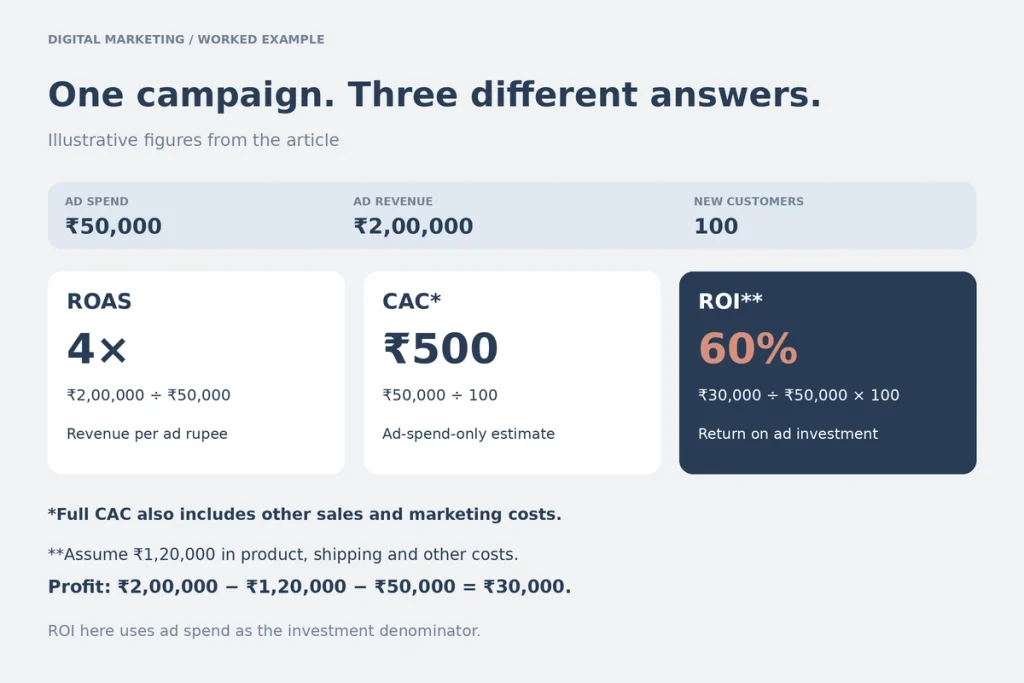
- ROAS = ₹2,00,000 ÷ ₹50,000 = 4x (or 400%)
- CAC = ₹50,000 ÷ 100 = ₹500 per customer (ad spend only; add salaries and tools for a full CAC)
- ROI depends on profit, not revenue. If product, shipping and other costs take ₹1,20,000, the gain is ₹80,000 − ₹50,000 = ₹30,000, so ROI = ₹30,000 ÷ ₹50,000 = 60%
The same campaign looks excellent on ROAS and modest on ROI. That’s why a report should name which one it uses.
Mistakes we see with marketing terms
Using “conversions” without saying which. A lead form and a purchase are both “conversions” in most ad tools.
Comparing CTR across platforms. Search ads and Instagram ads have different normal ranges.
Calling ROAS “ROI”. It overstates profit.
Untagged links. Without UTM parameters, email, WhatsApp and influencer traffic often lands in “direct” and gets no credit.
Checklist: before you read a marketing report
- You know the report’s main KPIs and why they were chosen
- Every ratio names its top and bottom number
- ROAS and ROI are not used as the same thing
- CAC includes (or clearly excludes) salaries and tools
- Campaign links carry UTM parameters
- Conversions are defined: purchase, lead or call
Questions we get asked
What are the most important digital marketing terms for a business owner?
Start with five: CAC, ROAS, conversion rate, AOV and LTV. They tell you what a customer costs and what they’re worth.
Is SEM the same as SEO?
No. SEO earns unpaid rankings; SEM usually means paid search ads. Some people use SEM to cover both.
What is the difference between CPA and CAC?
CPA is usually one platform’s cost per conversion. CAC is the total cost of winning a new customer across all channels.
Final thoughts
You don’t need to memorise 45 terms. Learn the four jobs (reach, persuade, convert, measure), then pick the handful of KPIs that match your goal. Every other number in a report is supporting detail.
Want a marketing report that uses the right numbers for your business? Talk to You can reach out to us on whatsapp at +91 7738844851 and book a consultation.
More in Blog
Keep reading
All articles →

Ready to talk about your growth?
Tell us what's stuck and we'll tell you what we'd do first. Free, 30 minutes, no pitch.