
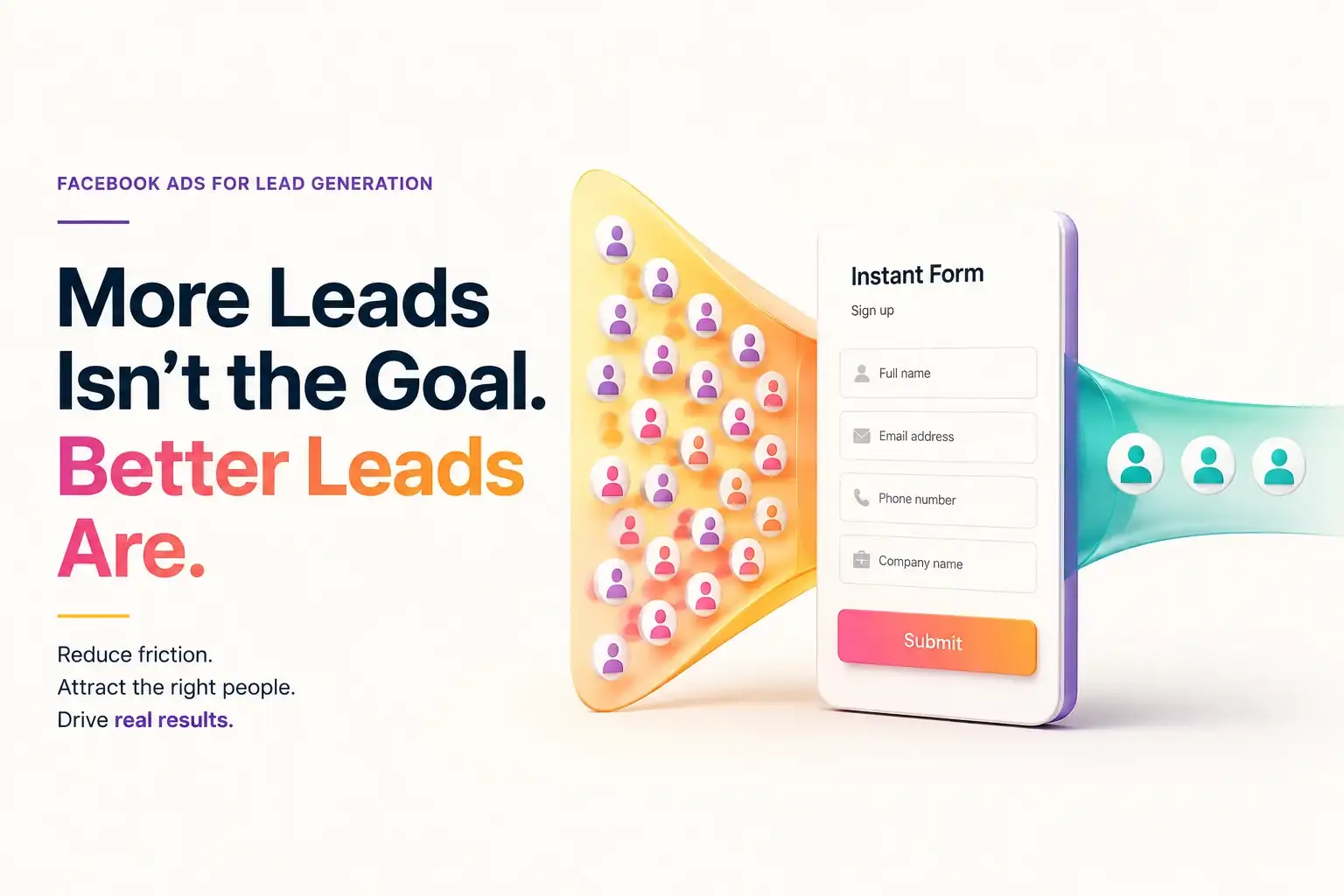
Someone scrolling Instagram sees your ad, taps, and a form appears with their name and email already filled in. Two taps later they are a lead.
They did not type anything. They may not have finished reading the offer. When your sales team calls on Thursday, there is a reasonable chance they will not remember doing it.
This is the design working exactly as intended, and it is why so many businesses report brilliant cost per lead and dismal cost per customer.
The short answer
Facebook lead ads use instant forms that pre-fill a user’s contact details, so submission takes seconds. That convenience is the whole product and it is also the problem: friction is what separates curiosity from intent, and removing it produces volume without qualification. Meta offers two form types — “more volume” and “higher intent,” the latter adding a review step the user must confirm. Most advertisers never change the setting. Which type you choose should follow from whether you have a qualification process downstream.
Key takeaways
- Meta ships a friction control and defaults it to volume. Instant forms offer “more volume” or “higher intent,” the second adding a confirmation screen.
- A friction-less form does not remove qualification work. It moves it to your sales team, who are more expensive than a form field.
- Speed matters more here than on search. The person was not looking for you; they were scrolling. Attention decays in minutes.
- Cost per lead is the wrong metric. Cost per qualified lead, and eventually cost per customer, are the only figures that survive contact with the sales team.
- Lead ads are not always the right tool. For high-value or complex purchases, a landing page that filters is usually cheaper overall.
Why the leads are bad, mechanically
Worth being precise, because “Facebook leads are low quality” is usually said as though it were a property of the platform. It is not. It is a consequence of a choice.
The form pre-fills. Meta already knows the name, email and often the phone number. The user confirms rather than types.
Submission can take under five seconds. With the “more volume” form type there is no confirmation step between completing and submitting.
The user never leaves the app. No landing page, no scrolling through detail, no price, no time spent forming an intention.
Ad recall is minimal. Someone who spent four seconds with your ad has almost no memory of it an hour later, let alone two days.
Each of those is a deliberate reduction of friction, and each one strips out a moment where an uninterested person would have dropped out. The form is not attracting the wrong people. It is failing to filter the right ones.
The Friction Dial
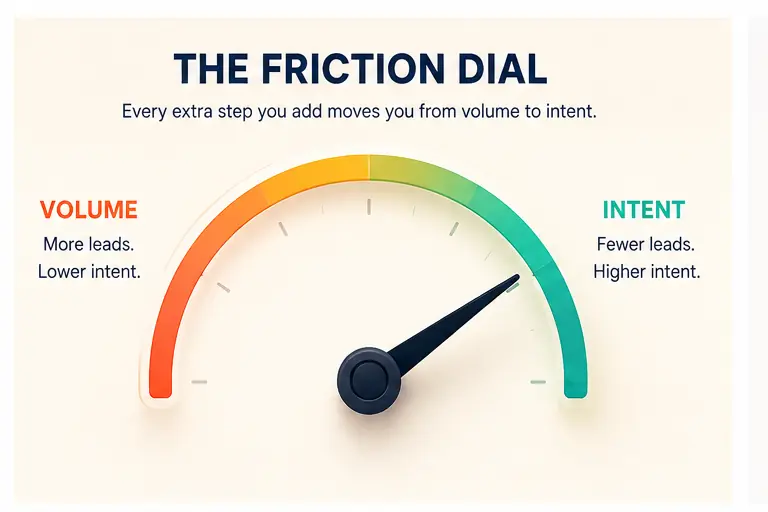
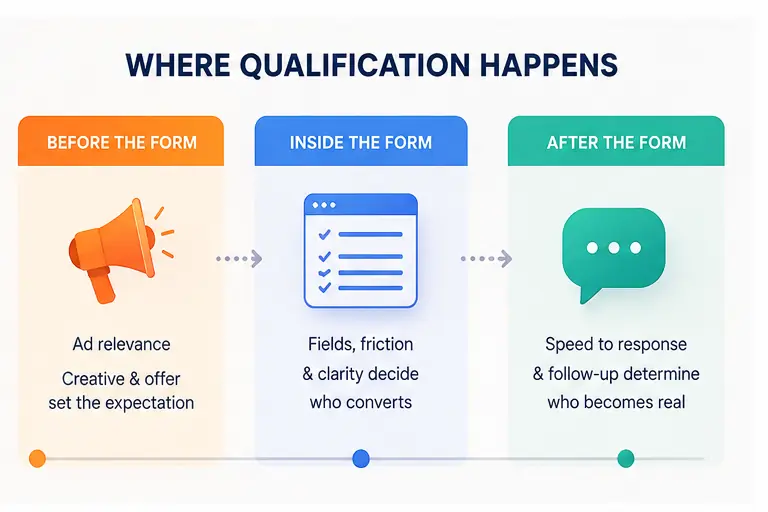
Friction is not waste. Friction is a filter. Every point you remove buys volume and sells intent. The decision is not how much friction to have but where to put it — before the form, inside the form, or after it, where it lands on your sales team.
Three positions, and most businesses pick the third by accident.
Friction before the form
Qualification that happens before anyone submits anything. It costs you nothing and it filters at scale.
State the price, or the range. The single most effective filter available and the one people are most afraid of. Someone who cannot afford you does not submit, and you stop paying to discover that on a phone call.
Say who it is not for. “For businesses spending over ₹1,00,000 a month” removes more unqualified enquiries than any form field.
Use the ad copy to disqualify. Longer copy is not a problem here. It is the filter.
Send to a landing page instead of a form where the purchase is considered. Yes, fewer leads. That is the mechanism, not a side effect. The landing page checklist we use on Indian client pages covers what that page needs to do.
Friction inside the form
Meta’s own control lives here, and it is the fastest change on this list.
Switch the form type to higher intent. Meta’s instant forms come in two types. “More volume” is optimised for completion — minimal fields, no confirmation. “Higher intent” adds a review screen where the person must see their answers and actively confirm before submitting.
Practitioners who have tested both consistently report fewer leads and better downstream conversion from higher intent, with figures commonly cited around 20–40% fewer submissions. Those numbers come from agency testing rather than from Meta, so treat the direction as reliable and the magnitude as indicative.
Add one qualifying question. Budget range, timeline, company size, or which service they want. One is usually enough. It also gives your sales team something to open with.
Require a manually typed field. A phone number the user must enter rather than confirm removes accidental submissions almost entirely.
Do not add fields for the sake of it. Friction only qualifies when it is relevant to the purchase. Asking for a postcode you will never use just annoys good leads and filters nobody.
Friction after the form
The default, and the expensive one.
Choosing “more volume” and planning to qualify later is a legitimate strategy — but only if the qualification actually exists. A named person, a defined process, a response time measured in minutes.
Most businesses do not have that. So the leads arrive, sit in a spreadsheet, get called two days later by someone with no context, and the conclusion is that Facebook does not work.
The friction did not disappear. It moved from a form field, which is free, to your sales team, which is not.
Speed matters more here than anywhere else
On search, someone typed a query. They have a problem and a memory of looking for a solution. A next-day call still makes sense to them.
On Meta, they were scrolling. There was no problem in mind, no search, no decision in progress. You created the interest, and interest you created decays much faster than interest that already existed.
The evidence on response times is not new and it is not encouraging. The Harvard Business Review audit of 2,241 companies found an average first-response time of 42 hours, with 23% never responding at all. That study covered web enquiries generally; on lead ads, where the person did not go looking for you, a 42-hour gap is close to worthless.
Practical version. Route lead ads into something that fires immediately — an automated WhatsApp message, an SMS, a call within minutes rather than hours. Meta’s CRM integrations exist for exactly this, and a lead sitting in Meta’s Ads Manager waiting for a weekly export is a lead you paid for and discarded.
In India specifically, WhatsApp is often the better destination entirely. A conversation started in the app someone already lives in outperforms a form followed by a cold call in most consumer and considered-purchase categories.
Measuring it properly
Cost per lead will look good. Ignore it.
Work out what a lead is actually worth. Take your average order value, apply your gross margin, multiply by your close rate on qualified leads, then multiply again by the proportion of form fills that are genuine. That gives you a maximum cost per form fill. Working out what a lead is actually worth sets out the arithmetic with a calculator.
Track the ratio, not just the count. Qualified leads divided by total leads is the number that tells you whether your friction is set correctly. If it falls, you have too little. If your lead volume collapses while the ratio stays flat, you have too much.
Feed the outcome back. Meta’s system optimises toward whatever you tell it a conversion is. If a form fill is the conversion, it will find you people who fill in forms. Send qualified-lead or closed-deal events back through the Conversions API and it optimises toward something worth having.
Give it enough volume to learn. Meta’s learning phase needs roughly 50 optimisation events per ad set within a rolling seven days. If you optimise toward qualified leads and only produce fifteen a week, the system cannot learn from them — which is a real constraint on how far up the funnel you can push your conversion event. Whether your budget can fund Meta properly covers the threshold arithmetic.
Mistakes that cost real money
Leaving the form type on the default without knowing there is a choice.
Reporting cost per lead to the business. It will fall every time quality drops, which makes it worse than useless as a performance signal.
Optimising toward form fills while complaining about lead quality. You instructed the system precisely; it obeyed.
Exporting leads manually. Every hour of delay costs you contact rate, and weekly exports are common enough to be worth stating.
Adding fields that do not qualify. Friction only works when it is relevant to the decision.
Blaming the platform for a sales process problem. If nobody calls within the hour, no form design will save the campaign.
When lead ads are the wrong tool
High-value or complex purchases. Where the buyer needs to understand a proposition before enquiring, a landing page that explains and filters usually costs less per customer even at a far higher cost per lead.
When you have no qualification capacity. Frictionless forms require a process downstream. Without one, choose friction you can automate over friction you cannot staff.
When you cannot respond quickly. Fix the response time before increasing lead volume. It is free, and it changes more than any campaign edit will.
When your conversion volume is too low for the system to learn. Below Meta’s threshold, performance stays unstable regardless of form design.
When the product needs demonstration. Some things are sold in a conversation that starts elsewhere, and a form is the wrong opening move.
The lead ads checklist
☐ Value per lead calculated from margin, close rate and qualification rate
☐ Maximum acceptable cost per form fill set from that figure
☐ Form type chosen deliberately — more volume or higher intent
☐ At least one qualifying question included, relevant to the purchase
☐ Price or price range stated in the ad or the form where possible
☐ CRM integration live, with leads arriving in real time rather than by export
☐ Automated first response configured — WhatsApp, SMS or call
☐ Named owner for follow-up, with a target response time in minutes
☐ Qualified-lead ratio tracked, not just lead count
☐ Qualified or closed-deal events sent back via the Conversions API
☐ Conversion event chosen with Meta’s learning threshold in mind
☐ WhatsApp tested as a destination against the form
Questions we get asked
Do Facebook lead ads actually work?
Yes, for the right categories and with a follow-up process. They work poorly for high-consideration purchases and for businesses that cannot respond quickly, and those two account for most of the disappointment.
Instant form or landing page?
Instant forms for volume in consumer categories with a fast sales process. Landing pages where the buyer needs to understand something before enquiring. The instant form’s advantage is completion rate; its cost is everything a landing page would have explained.
Why are my Facebook leads so bad?
Usually three things together: the form type is set to volume, there is no qualifying question, and follow-up takes more than a day. Fixing the third alone often changes the picture.
How much does a Facebook lead cost in India?
It varies too widely by category for an average to help. Work out your maximum acceptable cost from margin and close rate, then measure against that rather than against someone else’s benchmark.
Should I use Advantage+ Leads campaigns?
It is now the default starting point for lead generation, and for most advertisers it is a reasonable one. The form-type decision and the qualification question matter more than the campaign type.
Can I send leads straight to WhatsApp?
Yes, and in India it frequently outperforms a form. The conversation happens where the person already is, and response can be immediate.
What to change this week
Open your instant form and look at the form type. If it says “more volume” and you have not chosen that deliberately, you have found your first change.
Then measure one thing you probably are not measuring: of last month’s leads, what proportion were genuinely worth a sales conversation? That ratio, not the cost per lead, tells you whether your friction is set correctly.
Most businesses doing this for the first time discover the ratio is well under half — and that the fix was a setting, a question and a faster phone call rather than a new campaign.
If you would like someone to look at where your friction currently sits and what it is costing, you can reach out to us on whatsapp at +91 7738844851
More in Blog
Keep reading
All articles →
Ready to talk about your growth?
Tell us what's stuck and we'll tell you what we'd do first. Free, 30 minutes, no pitch.