
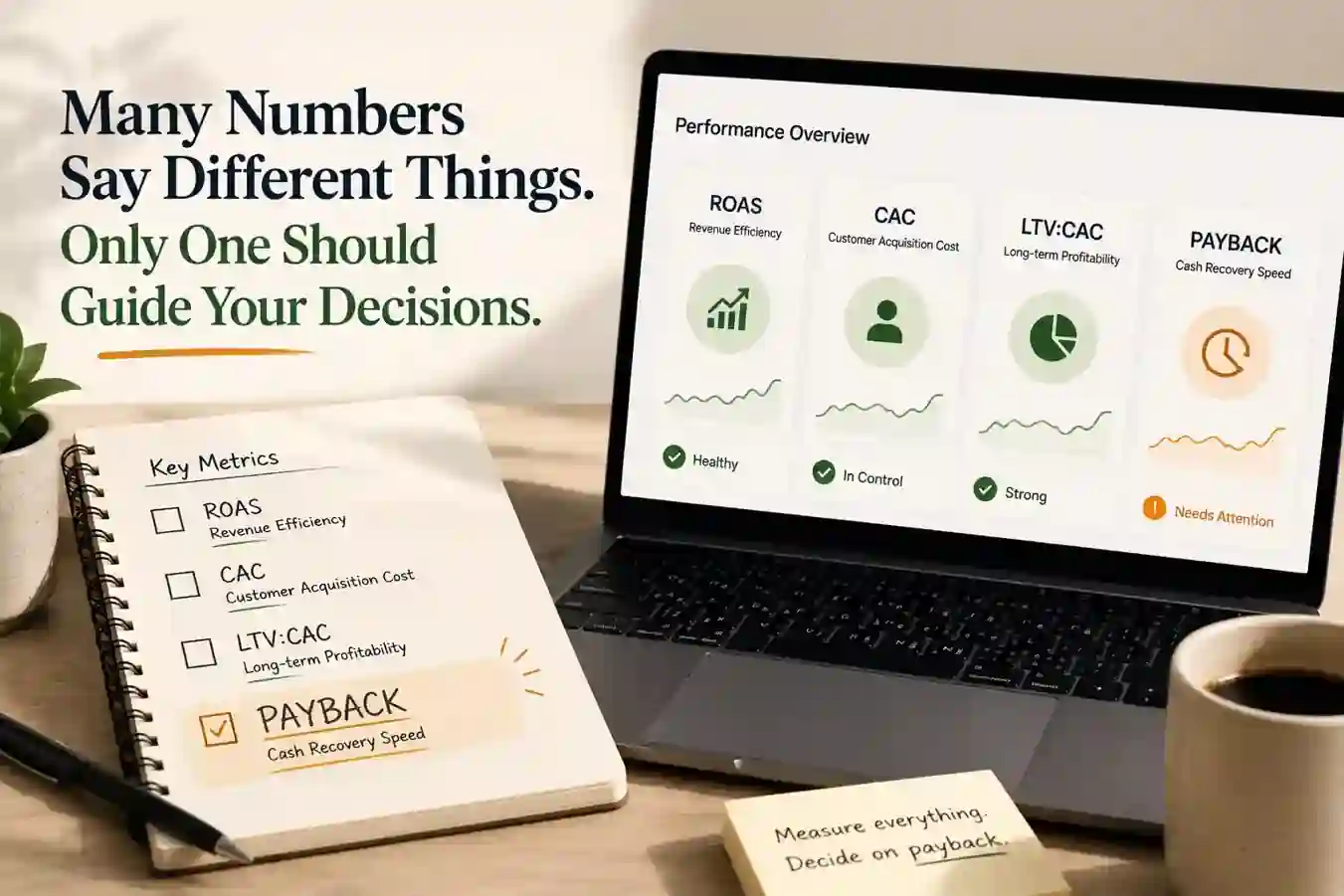
Search this question and you will find a lot of confident numbers.
₹5 to ₹3,000 a click. An average of ₹24 for search campaigns. Legal and insurance at ₹1,500 or more. Education at ₹25 to ₹120. Local services at ₹10 to ₹60. The figures appear on page after page in nearly identical shapes.
Now try to find where any of them came from.
Google does not publish CPC benchmarks for India. There is no Indian equivalent of the large advertiser datasets that produce these figures for the United States. Every one of those numbers is circulating between agency blogs without a primary source underneath it.
Which is worth knowing before you build a budget on one.
The short answer
Nobody can tell you what Google Ads will cost in India, because the price depends on your specific keywords, your location and who else is bidding — none of which a published average captures. Google’s Keyword Planner will give you a real estimate for your own keywords in ten minutes, free. And the click price is the least important of the four numbers that decide what a customer actually costs you.
Key takeaways
- No published India CPC figure has a verifiable source. The numbers circulate between agency blogs. Treat them as folklore with a rupee sign.
- Keyword Planner answers the question properly, for your keywords and your geography, at no cost, before you spend anything.
- Cost per customer equals CPC divided by conversion rate times close rate. A 2% landing page and a 10% close rate needs 500 clicks per customer. At ₹24 that is ₹12,000 — and doubling the landing page rate halves it without touching CPC.
- Two of the four multipliers are entirely yours. Your page and your follow-up. The click price is the one you control least and the only one anyone publishes.
- Paid search is a ₹16,581 crore market in India, about 23% of digital advertising spend in 2025 per dentsu India. Prices rise as more advertisers compete for the same terms.
Why the published figures cannot be trusted
Three reasons, and none of them requires anyone to be dishonest.
There is no source. For the United States, WordStream and similar firms publish benchmarks drawn from thousands of managed accounts. Nothing equivalent has been published for India. So when a page states an average Indian CPC of ₹24, the honest question is: measured across which accounts, over what period, in which industries?
An average across industries is meaningless anyway. If legal is ₹1,500 and local services is ₹15, the average tells you about the mix of accounts in the sample, not about your business. And nobody publishes the sample.
CPC is not a fixed price. It is an auction outcome. What you pay depends on your keywords, your location, the time of day, your Quality Score and who else is bidding this week. Google’s own documentation explains that Ad Rank and Quality Score determine what you actually pay, which is why two advertisers on the same keyword pay different amounts.
Below, the circulating figures are repeated because you came here for them. Read them as an indication of relative order — legal costs more than education — and not as prices.
Broadly circulating ranges, no primary source available for any of them: professional services in law, insurance and finance at the top of the range; real estate, healthcare and B2B technology in the middle; education, local services and retail toward the bottom. The spread across published sources runs from single-digit rupees to several thousand per click.
That is genuinely the most useful version of that information anyone can give you honestly.
The free method that actually answers it
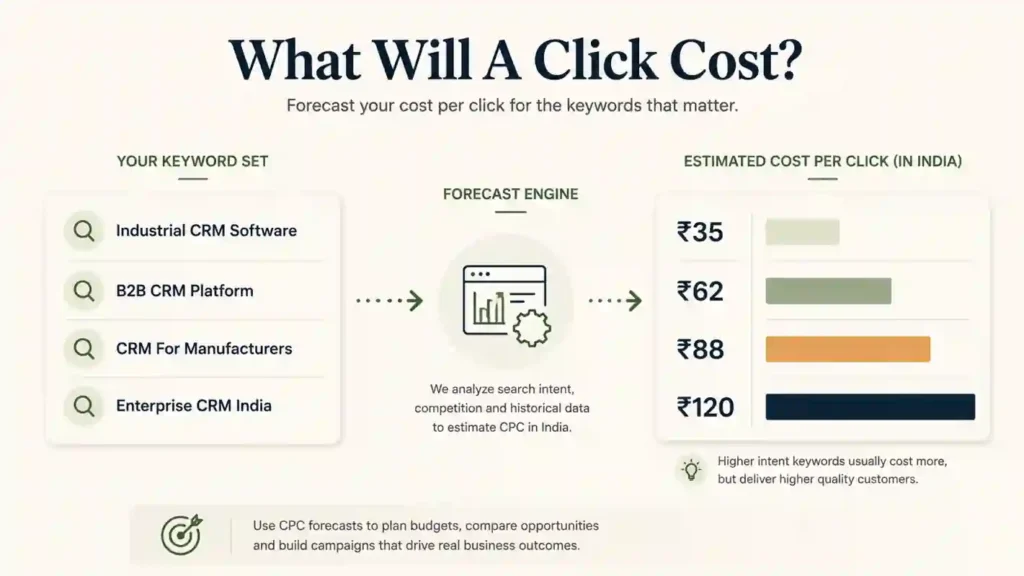
Ten minutes, no spend, and it produces a number for your business rather than someone’s average.
Open Google Keyword Planner. It is free with a Google Ads account, and you do not need a live campaign to use it.
Enter the keywords a buyer would actually type. Not your category — the specific phrases. “CNC machining service Pune”, not “manufacturing”.
Set the location to where you sell. City-level if you serve a city. Costs vary meaningfully between Mumbai and a tier-two market, and the tool reflects that.
Read the top-of-page bid estimates. Keyword Planner shows a low and high range for each keyword. That range, for your terms in your geography, is worth more than every benchmark table on this SERP combined.
Multiply by the volume you need. Which requires the arithmetic in the next section.
The estimates are not perfect — they are forecasts based on historical auction data, and real costs vary. But they are yours, they are current, and they cost nothing.
The Four Multipliers
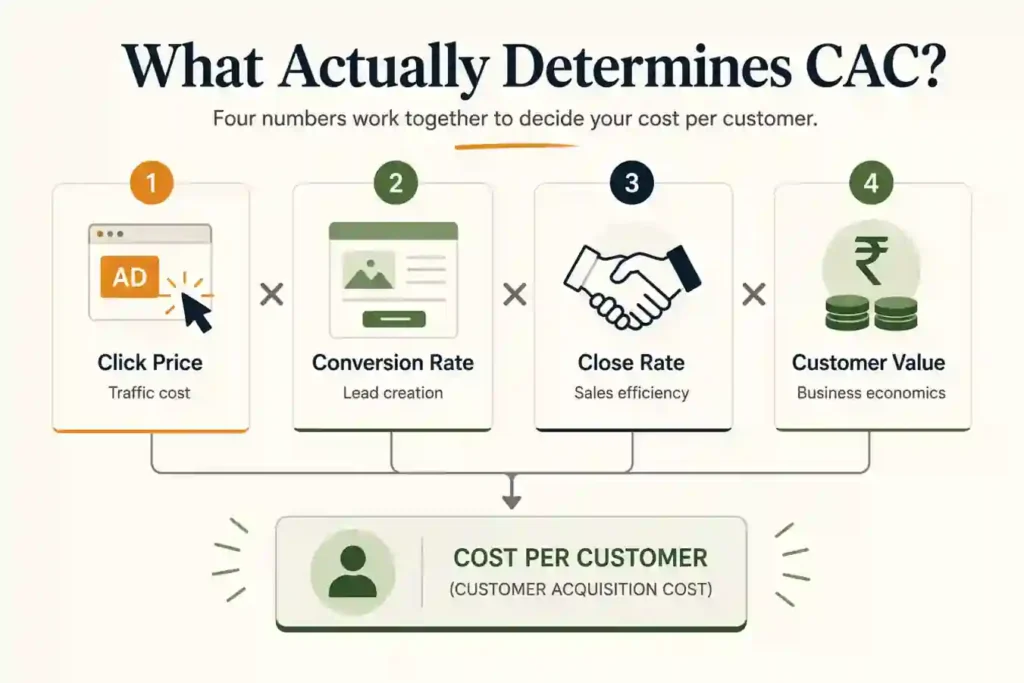
Here is why the click price matters less than everyone assumes.
Cost per customer = CPC ÷ (conversion rate × close rate). Four numbers decide what Google Ads costs you. Two of them are entirely within your control, and the one everybody publishes is not.
One — the click price. Set by the auction, influenced by your Quality Score, largely determined by your category and competition. You can improve it at the margins. You cannot change the category you are in.
Two — landing page conversion rate. The share of clicks that become enquiries. Entirely yours. This is the multiplier with the most room in it and the least attention paid to it — our 21-point landing page checklist for Indian pages sets out what actually moves it.
Three — close rate. The share of enquiries that become customers. Also yours, and heavily affected by response speed. Harvard Business Review’s audit of 2,241 companies found the average first response took 42 hours and 23% never responded at all. That is a close-rate problem masquerading as an advertising cost problem.
Four — what a customer is worth. Deal value times gross margin, ideally over the lifetime rather than the first sale. This sets the ceiling on what you can afford to pay.
Work an example. Suppose your CPC is ₹24, your landing page converts at 2%, and you close one in ten enquiries.
Fifty clicks produce one enquiry. Ten enquiries produce one customer. So five hundred clicks per customer, at ₹24, is ₹12,000 to acquire one.
If that customer is worth ₹40,000 in gross profit, this works comfortably. If they are worth ₹8,000, it does not, and no amount of bid management will rescue it.
Now improve the landing page from 2% to 4%. Cost per customer halves to ₹6,000, with the CPC completely unchanged. That is why the multiplier nobody writes about is worth more attention than the one everybody publishes.
What budget to start with
The honest answer is that it depends on two things, and neither is a round number.
Enough clicks to learn something. You need sufficient volume to see which keywords convert. For most small Indian accounts that means a few hundred clicks a month at minimum — multiply your Keyword Planner estimate by the clicks you need and you have a floor.
Enough conversions for the system to work. Google’s bid strategies need conversion volume. If your budget produces four enquiries a month, automated bidding has almost nothing to learn from, which is a problem we cover in full in the context of B2B accounts and conversion volume.
The commonly quoted starting range of ₹15,000 to ₹50,000 a month is not wrong for many small Indian businesses. It is also not derived from anything. Use Keyword Planner and your own arithmetic instead, and you will arrive at a number you can defend to whoever signs the cheque.
Agency and management costs
Separate from media spend, and often forgotten in the budget.
Agencies charge as a percentage of ad spend, a flat retainer, or a hybrid. There is no published rate card for India, and fees vary more by account complexity than by any standard. What matters more than the number is the model, because each one creates a different incentive — we cover the ownership questions to ask before signing separately.
Budget for fee plus media together. A ₹30,000 media budget with a ₹25,000 retainer is a ₹55,000 commitment, and the arithmetic in the Four Multipliers has to work on the total.
Mistakes that cost real money
Building a budget on a published average. The number has no source and your category has no relationship to the sample.
Ignoring the two multipliers you control. Most businesses obsess over CPC and never test a landing page.
Forgetting management fees in the total. The media budget is not the cost.
Comparing your CPC to someone else’s. Different keyword, different location, different Quality Score, different competitors. The comparison tells you nothing.
Starting too small to learn. A budget that produces three clicks a day gives you no data and a year of ambiguity.
Buying more clicks when the problem is the follow-up. If enquiries wait a day, doubling spend doubles the waste.
When the honest answer is that you cannot afford it
Some businesses genuinely should not run Google Ads, and working the arithmetic before spending is how you find out cheaply.
When cost per customer exceeds gross profit per customer. Run the four multipliers. If ₹12,000 to acquire buys you ₹8,000 in margin, the channel does not work at your current conversion rates. Fix the page and the follow-up first; if it still does not work, spend elsewhere.
When your category CPC is very high and your margin is thin. Legal, insurance and finance are expensive for a reason — the customers are valuable. If yours are not, you are bidding against people who can outspend you indefinitely.
When nobody searches for what you sell. Paid search captures existing demand. No budget creates it.
When you cannot fund a full quarter. Stopping after three weeks buys you noise and no learning. If a quarter is not affordable, wait until it is.
The costing checklist
☐ Keyword Planner opened, with your real keywords and your actual location
☐ Top-of-page bid range recorded for your ten most commercial terms
☐ Current landing page conversion rate measured, not estimated
☐ Close rate from enquiry to customer calculated from real deals
☐ Gross profit per customer worked out with finance, not from memory
☐ Cost per customer calculated using the four multipliers
☐ That figure compared against gross profit per customer
☐ Management fees added to the media budget for the true total
☐ A full quarter’s spend confirmed as affordable before starting
☐ Enquiry response time measured before any spend begins
☐ One number agreed that the account will be judged on
☐ Keyword Planner estimates re-checked quarterly — auction prices move
Questions we get asked
How much does Google Ads cost in India?
Between very little and a great deal, depending on your category, and anyone giving you a single figure is repeating an unsourced number. Ten minutes in Keyword Planner with your own keywords will tell you more than every published benchmark combined.
What is the average CPC in India?
Published figures cluster around ₹20 to ₹30 for search, but no source underlies them and an average across industries is not applicable to any individual business. Legal and insurance genuinely cost many times what education or local services cost.
What is the minimum budget?
Enough to produce a few hundred clicks and enough conversions for the bidding to learn from — which for most small Indian accounts lands in the tens of thousands of rupees a month, but should be calculated rather than assumed.
Why is my CPC so high?
Competition in your category, and Quality Score. Google’s documentation is explicit that Ad Rank and Quality Score determine what you actually pay, which is why relevance work on ads and landing pages reduces cost as well as improving conversion.
How much do agencies charge to manage Google Ads in India?
No published rate card exists. Fees vary by account complexity and the commercial model matters more than the number. Budget fee plus media as a single figure.
Is Google Ads cheaper in tier-two cities?
Generally yes, because fewer advertisers compete. Keyword Planner will show you the difference for your own terms — set the location and compare.
What to do before you spend anything
Open Keyword Planner. Enter your ten most commercial keywords. Set your location. Write down the top-of-page bid range.
Then find three more numbers: your landing page conversion rate, your close rate, and gross profit per customer. Divide the click price by conversion rate times close rate and you have your cost per customer.
Compare it to the gross profit. That single comparison tells you whether to spend, how much, and what to fix first — and it takes an afternoon rather than a quarter of live budget.
If the numbers are close and you would like a second opinion before committing, you can reach out to us on whatsapp at +91 7738844851 . We will run the arithmetic with you, and if the honest answer is that the channel does not suit your economics, we will say so.
More in Blog
Keep reading
All articles →

Ready to talk about your growth?
Tell us what's stuck and we'll tell you what we'd do first. Free, 30 minutes, no pitch.