

Most advice on improving hook rate amounts to “make the opening more interesting.”
That is not an instruction. It is a restatement of the problem, and it is why teams read five articles and change nothing.
The useful version starts somewhere else: with the conditions your ad is actually seen under. It plays with the sound off. It plays at roughly the size of a playing card. And it plays while a thumb is already in motion. Almost every hook that works is solving one of those three, and almost every hook that fails ignored all three.
The short answer
Hook rate is three-second video views divided by impressions, expressed as a percentage. It measures how many people your opening stopped. Circulating benchmarks put a working range around 20–25%, with 30% and above treated as strong — though Meta publishes no official figure and hook rate is not even a native metric, so build it as a custom column and compare against your own history. To improve it, work the three conditions the ad is seen under: make it comprehensible muted, legible at thumbnail size, and give the eye a reason to stop within the first half-second.
Key takeaways
- Hook rate = three-second video views ÷ impressions. Build it as a custom column; Meta does not provide it.
- The quoted benchmarks have no source. 20–25% working, 30%+ strong is operator consensus without sample or category breakdown.
- Your own baseline is the only comparison worth making, per placement.
- Three conditions govern everything: muted, small, moving.
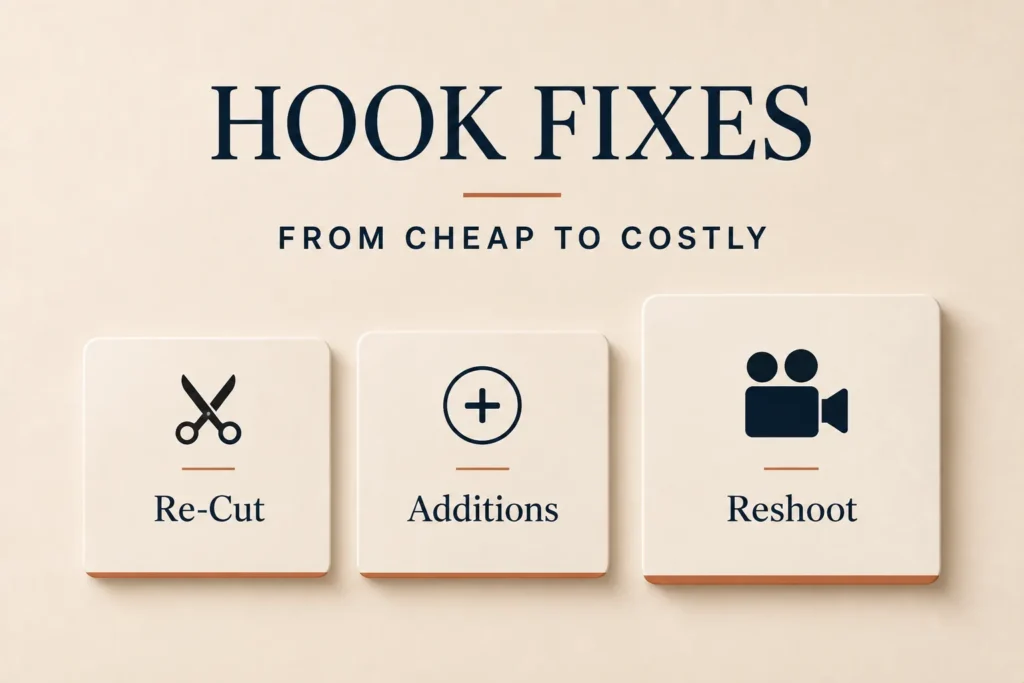
- The cheapest fixes are re-cuts, not reshoots. Most accounts have footage that already contains a better opening.
- Logo intros and slow establishing shots are the two most reliable ways to lose the first three seconds.
The metric, briefly
The formula. Three-second video plays divided by impressions, times a hundred.
Meta counts a three-second video play when the video plays for at least three seconds, or nearly its full length if shorter. It is not a native column. You create it in Ads Manager as a custom metric, and the fact that you have to build it yourself is the first clue about how seriously to take any published benchmark.
Hold rate is the sibling metric — ThruPlay against three-second views — and it answers a different question. Hook rate asks whether the opening stopped anyone. Hold rate asks whether the rest was worth staying for. A high hook and a low hold means the opening wrote a cheque the ad could not cash.
The benchmarks, and what they are worth
The bands quoted across the industry sit at roughly 20–25% as a working range, 30% and above as strong, with 35–40%+ described as excellent. Hold rate is usually quoted around 40–50%.
Treat those as orientation, not as targets. Meta publishes nothing official. None of the circulating figures carries a sample size, a methodology or a category breakdown. And hook rate varies enormously by placement — a Reels-heavy account and a Feed-heavy account are measuring different things and cannot be compared on the same number.
What to do instead. Record your own hook rate per placement over a stable month. That becomes your baseline, and every creative is judged against it. A 19% hook rate is fine if your account runs at 17%, and a problem if it runs at 28%.
The Thumb Test

Three conditions decide the first three seconds. The ad plays muted. It plays small. And it plays while the thumb is already moving. Every hook rule that works is solving one of those three — and every fix can be graded by which one it addresses and what it costs to make.
Condition one: it plays muted
Feed and Reels autoplay without sound. Whatever your opening line is, most people never hear it.
Make the first three seconds comprehensible with no audio at all. If the ad only makes sense once someone unmutes, you have built a hook that fires after the decision has already been made.
What works. On-screen text carrying the actual claim, not a decorative caption. Faces speaking with visible expression. Demonstration — the product doing the thing — which needs no words. Captions burned in rather than relying on platform auto-captions, which are inconsistent in Indian languages.
Cost. Adding text to an existing opening is close to free. Reshooting to build a visual demonstration is not.
Condition two: it plays small
On a phone, in feed, your video occupies a few centimetres. On the low-end Android handsets that carry a large share of Indian impressions, it occupies fewer, on a screen that may be dim and outdoors.
So detail disappears. Wide shots, small products, thin fonts, low-contrast text and busy backgrounds all read as visual noise at that size.
What works. One subject filling the frame. Text at a size that survives being shrunk — test it by viewing the file at thumbnail scale before approving it. High contrast between text and background. Product close enough to be identifiable in a single glance.
A test worth adopting. Look at the first frame at the size of a postage stamp. If you cannot tell what it is, neither can anybody else.
Cost. Reframing and re-typesetting an existing edit is cheap. It is also the fix most often skipped, because the asset looked fine on a laptop.
Condition three: it plays while the thumb is moving
The viewer is already scrolling. You are not competing for attention; you are interrupting a motion already underway.
Which means the first frame cannot be still. Motion in the opening half-second is what registers peripherally, and peripheral registration is what stops the scroll.
What works. Movement in the first frame — a hand entering, a subject already mid-action, a fast cut. Starting mid-sentence rather than mid-breath. A visual that does not belong to the surrounding feed, because contrast with what came before is what the eye notices.
A pattern that consistently earns its place is opening on the problem rather than the product. The viewer recognises the situation before they recognise that they are being sold to, and recognition is what buys the next two seconds.
Cost. Usually free — the motion is often already in your footage, three seconds after where the edit currently starts.
What reliably kills the first three seconds
The logo intro. Two seconds of animated brand mark spends your entire hook window telling people something they did not ask.
The slow establishing shot. Beautiful, cinematic, and finished before anything happens.
Waiting for the beat. Music-led edits that build to a drop at four seconds have already lost the people who leave at two.
Opening with a greeting. “Hi guys, in this video I’m going to…” is three seconds spent announcing that value is coming later.
Brand-first copy. A company name in the first frame answers a question nobody asked yet.
Text nobody can read. Elegant thin fonts, white on pale backgrounds, or a full sentence where three words would do.
A first frame that is a title card. It reads as an advertisement instantly, which is the one thing you cannot afford in the first half-second.
Fixing hooks without a reshoot
Most of the available gain sits here, and it costs almost nothing.
Start the edit later. The best three seconds in most footage are not the first three. Scrub through and find the moment something actually happens, then cut there.
Cut several openings from one asset. A single existing video usually contains three or four viable hooks — the demonstration, the reaction, the problem, the result. Each becomes a separate ad with the same body.
Add or rewrite the on-screen text. Different claim, same footage, meaningfully different hook rate.
Reorder the edit. Put the outcome first and the explanation after. It works more often than it should.
Change the first frame only. Thumbnail and opening frame carry disproportionate weight relative to how cheap they are to change.
Then judge the results honestly. Hook rate moves fast and needs far less volume than a conversion metric, which makes it one of the few creative variables a small account can compare with any confidence. Where a genuinely controlled test is needed, making the page do its job covers what that requires.
Mistakes worth the money they cost
Chasing a published benchmark instead of your own baseline. Different placements, different categories, different numbers.
Optimising hook rate while conversions fall. A shocking opening can lift hook rate and depress everything after it. Read hook rate alongside hold rate and cost per result.
Approving creative on a laptop. Everything looks legible at full size. Almost nothing does at feed size.
Reshooting when a re-cut would do. The most expensive way to fix a problem the edit created.
Assuming a falling hook rate means a bad hook. It is also the earliest fatigue signal — how to tell whether creative is actually fatigued separates the two.
Relying on auto-captions. Coverage and accuracy vary, particularly across Indian languages. Burn text in.
When hook rate is the wrong thing to fix
When hold rate is the actual problem. People are stopping and then leaving. The opening is working; the middle is not.
When the offer is uncompetitive. More people watching an unattractive proposition changes very little.
When conversions are falling but hook rate is stable. Look downstream — page, offer, tracking.
When the account runs mostly static. Hook rate is a video metric. A static-heavy account should be reading click-through and thumb-stop equivalents instead.
When volume is too low to read anything. A few thousand impressions produces a number that moves on noise.
The hook checklist
☐ Hook rate built as a custom column in Ads Manager
☐ Your own baseline recorded per placement over a stable month
☐ Hold rate tracked alongside it, never alone
☐ First three seconds comprehensible with the sound off
☐ On-screen text carrying the actual claim, burned in rather than auto-generated
☐ First frame checked at thumbnail size before approval
☐ One subject filling the frame, high contrast, legible type
☐ Motion present in the opening half-second
☐ No logo intro, no greeting, no title card
☐ Edit start point reviewed — is the good part three seconds later
☐ Several alternative openings cut from each existing asset
☐ Hook rate read alongside cost per result before any conclusion
Questions we get asked
What is a good hook rate?
The circulating bands put 20–25% as a working range and 30%+ as strong, but Meta publishes nothing official and placement changes the number substantially. Your own baseline is the comparison that means something.
How do you calculate hook rate?
Three-second video plays divided by impressions, times a hundred. Set it up as a custom metric in Ads Manager; it is not there by default.
What is the difference between hook rate and hold rate?
Hook rate measures whether the opening stopped anyone. Hold rate measures whether they stayed. High hook and low hold usually means the opening promised something the ad did not deliver.
How do I improve my hook rate?
Start with re-cuts, not reshoots. Move the edit start point to where something happens, add legible on-screen text, make sure the first half-second contains motion, and remove anything branded from the opening frame.
Why is my hook rate low?
Most often one of four things: a static first frame, a logo or title card opening, text that cannot be read at feed size, or an ad that only makes sense with sound.
Does hook rate affect CPM?
Engagement signals feed Meta’s estimate of ad quality, and better-performing creative generally sees better delivery. Treat it as a correlation to work with rather than a lever you pull directly.
What to do this afternoon
Open your three most-spent video ads and watch the first three seconds of each with the sound off, at the size they actually appear.
Then find the moment in each where something first happens. If it is later than the current start point — and it usually is — cut a new version starting there, change nothing else, and run it alongside the original.
That is a free experiment on the one part of the ad that decides whether the rest is ever seen.
If you want your hook rates read properly against your own baseline and a set of re-cuts briefed from existing footage, you can reach out to us on whatsapp at +91 7738844851 .
More in Blog
Keep reading
All articles →
Ready to talk about your growth?
Tell us what's stuck and we'll tell you what we'd do first. Free, 30 minutes, no pitch.