
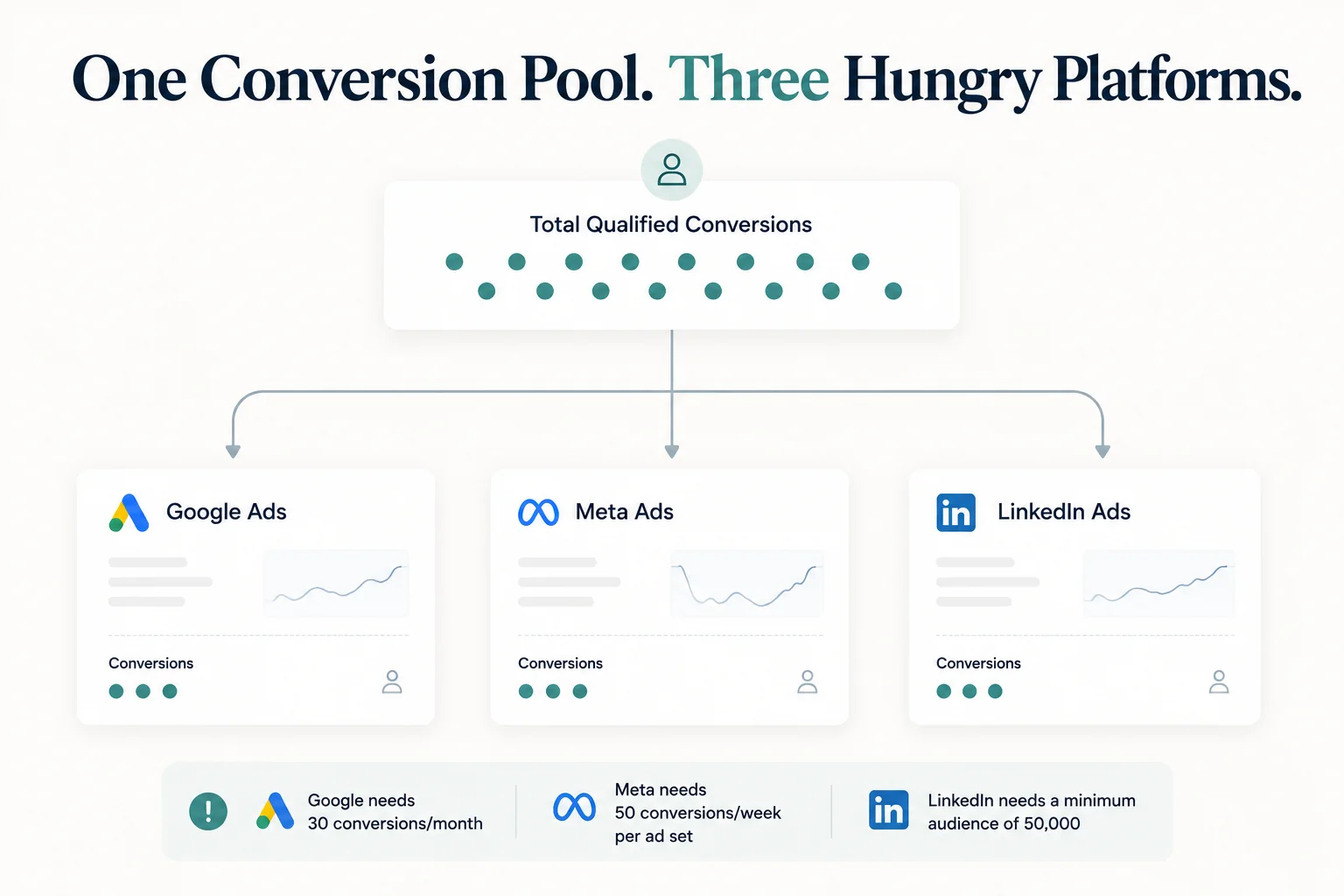
Google recommends at least 30 conversions in 30 days before its Target CPA bidding works reliably. Fifty for Target ROAS.
Meta’s learning phase needs roughly 50 optimisation events per ad set within a rolling seven days — about 200 a month, from one ad set.
LinkedIn recommends a minimum audience of 50,000 members for Sponsored Content, against a technical floor of 300.
Now think about a B2B business producing twenty qualified leads a month.
It is below every one of those thresholds simultaneously, on every platform, at the same time. And nothing in the standard advice about channel selection, funnel stages or pricing models addresses that.
The short answer
Performance marketing platforms are built for consumer data volumes. Their automated bidding, audience optimisation and delivery systems all assume a steady stream of conversions to learn from. B2B businesses produce a fraction of that volume, so the machinery runs on insufficient signal regardless of which channel you choose or how skilfully it is managed. B2B performance marketing is therefore mostly an exercise in working around a data shortage — and the four available responses are more useful to know than any channel comparison.
Key takeaways
- All three major platforms publish data thresholds, and typical B2B volume clears none of them.
- The constraint is your pipeline, not your budget. No spend increase manufactures conversions that do not exist.
- Four responses exist: qualify manually, feed outcomes back, consolidate hard, or stop optimising for conversions altogether.
- Consolidation is the cheapest of the four and the most commonly refused.
- Around 5% of B2B buyers are in-market at any moment, which is the underlying reason the volume is thin in the first place.
Why the standard advice does not help
Search this subject and you will find the same structure everywhere. A definition. A channel list — search, paid social, programmatic display. A pricing model list — CPC, CPA, CPL. A conclusion that search captures demand while social builds awareness and you should use both across the buying journey.
All of it is accurate. None of it touches the constraint.
Because the constraint is not which channel. It is that every channel’s optimisation system needs more conversions than a B2B business generates, and that remains true after you have chosen your channels perfectly.
One ranking page comes close, describing B2B as having “smaller audience pools.” It treats this as a targeting characteristic — fewer people to reach. The more consequential version is that fewer people converting means less data to learn from, and that is an optimisation problem rather than a reach problem.
The Volume Gap
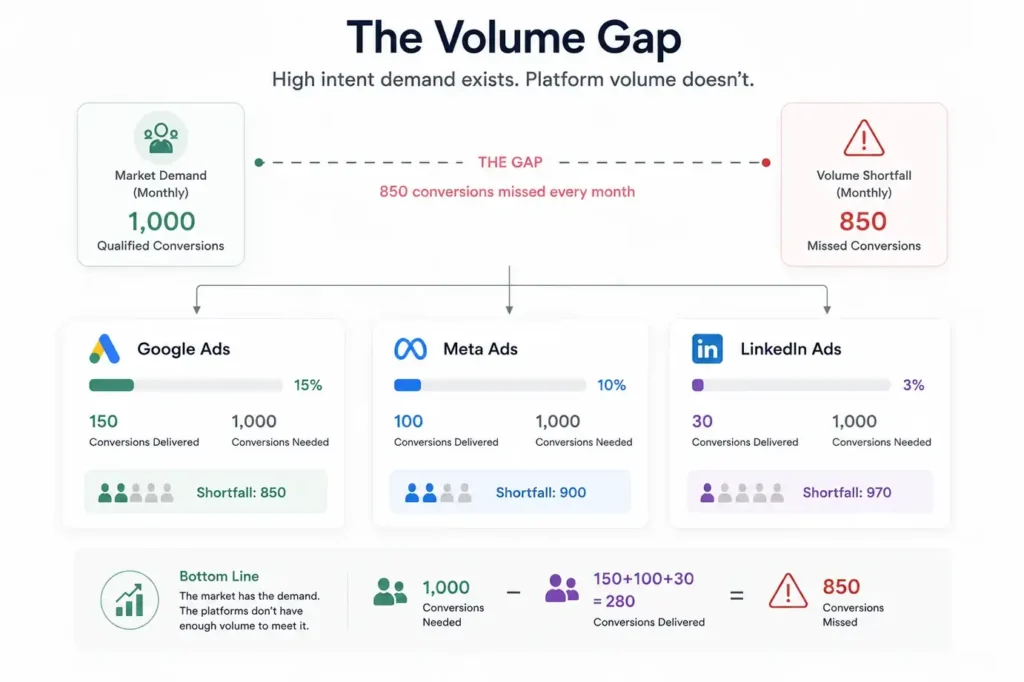
Every performance marketing platform publishes what its automation needs to work. Set those numbers against what a B2B business actually produces and the gap is not marginal — it is an order of magnitude, on every platform, at once. Strategy in B2B paid media starts there.
Work through it with a realistic business.
A B2B services company with a ₹40 lakh contract value. Sixty form fills a month, of which perhaps twenty are worth a sales conversation, of which three or four become opportunities.
Against Google. Target CPA is recommended at 30 conversions in 30 days per campaign. If the campaign optimises toward qualified leads, it has twenty — and that is across all campaigns, not per campaign. Split across three campaigns and each has seven.
Against Meta. The learning phase needs around 50 events per ad set per week. Twenty qualified leads a month is roughly five a week, from all ad sets combined. An ad set optimising toward qualified leads will never exit learning.
Against LinkedIn. Audience size rather than conversion count, but the same shape of problem. A precisely defined B2B audience — job title, seniority, company size, industry, geography — frequently lands under 10,000 people in India, well below the 50,000 recommended for Sponsored Content, which means higher bids to win scarce impressions.
Three platforms. Three different mechanisms. The same underlying shortage.
And it is not a budget problem. Doubling spend on twenty qualified leads produces twenty qualified leads and a higher cost per lead. The constraint is how many people in your market are ready to buy — around 5% of B2B buyers at any given time, per Ehrenberg-Bass research for the LinkedIn B2B Institute — and no amount of money changes that this month.
The four responses
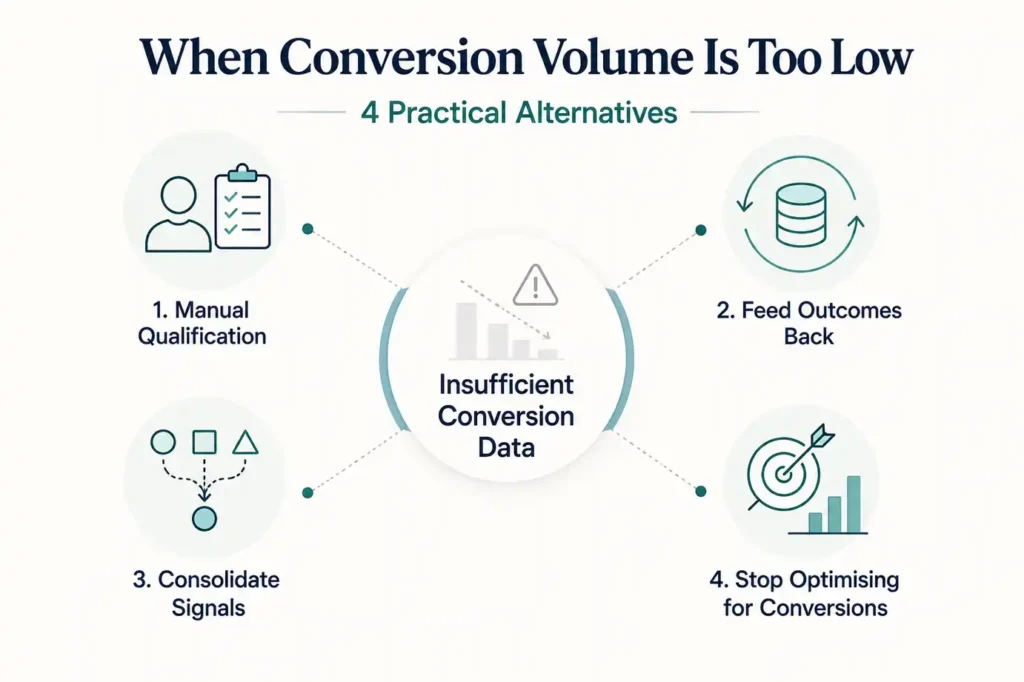
There are only four things you can do about it. Most B2B advertisers do the first by accident and none of the others deliberately.
1. Optimise shallower, and qualify yourself
Accept a shallower conversion event — form fills rather than qualified leads — because that is the only event with enough volume to feed the system. Then do the filtering manually.
Why it is the default. Sixty form fills is closer to a workable number than twenty qualified leads, so the platforms reward you for choosing it.
Why it produces the complaint. The system gets very good at finding people who fill in forms. Not people who buy. The lead quality problem in B2B paid media is almost always this, and it is the platform doing exactly what it was told.
What makes it work anyway. Qualification you actually perform — friction placed deliberately at the form, a qualifying question, price stated in the ad. What changes when the page is B2B covers the page-level version, and the Meta-specific mechanics are in why your pipeline caps what you can optimise toward.
What it costs. Sales time. You have moved the filtering from an algorithm to people, and people are more expensive.
2. Feed the outcome back
Send qualified leads and closed deals back to the platforms through offline conversion imports and the Conversions API, so the systems optimise toward customers rather than form-fillers.
Why it helps below the threshold. Even where volume is too low for the system to learn quickly, the signal quality improves and you stop instructing it toward the wrong outcome.
What it requires. A disciplined CRM, a defined qualification standard, and a sales cycle short enough that the feedback arrives while the campaign still exists. A nine-month cycle returns information about a campaign that has already changed three times.
Why most B2B advertisers do not do it. It requires marketing and sales to agree on what qualified means, and to keep the record clean enough to export. That is an organisational problem wearing a technical costume.
3. Consolidate hard
The cheapest response, and the one most often refused.
If you have twenty qualified leads a month, they must sit in as few campaigns and ad sets as possible. Three campaigns with seven conversions each learn nothing. One campaign with twenty at least approaches a threshold.
The refusal is organisational. Marketers want campaigns split by service line, by region, by persona, because that is how reporting is requested internally. Every split divides the data that makes the automation work.
The rule. Structure for the algorithm, then report by segment using filters and labels. Reporting granularity does not require campaign granularity, and most people conflate the two. Why fewer campaigns usually perform better sets out the search-side version in full.
This also applies across platforms. Splitting a budget over Google, Meta and LinkedIn simultaneously divides thin data three ways — whether LinkedIn or Google suits your deal values covers choosing between them properly.
4. Stop optimising for conversions
The response nobody sells, and sometimes the correct one.
If your volume cannot feed any conversion event worth optimising toward, use reach, traffic or engagement objectives, and measure the effect somewhere other than the platform dashboard.
What that means practically. Branded search volume in Search Console over months. Direct traffic. Enquiries that mention having seen you. Self-reported attribution on sales calls.
Why it is legitimate rather than defeatist. Most of your market is not buying this quarter, and reaching them cheaply while they are not buying is a real activity with a real return — how B2B demand generation actually works covers measuring it.
When it is wrong. When the business needs attributable pipeline this quarter. Then the honest answer is to fund the channel that captures existing demand and accept that its ceiling is however many people are already searching.
What this changes about channel selection
Briefly, because each channel has its own page and the point here is what they share.
Google captures existing demand, which is why it produces the most immediately attributable pipeline in B2B. Its constraint is the number of people searching, and no budget increases that.
Meta reaches people who are not searching, cheaply, with targeting that infers rather than verifies. Since detailed targeting became largely advisory, the conversion event does most of the steering — which returns you directly to the volume problem.
LinkedIn verifies who someone is and tells you nothing about whether they need anything today. It costs several times Meta per click and the premium buys declared job titles.
The choice between them is a deal-value question, covered properly in the comparison page. What matters here is that all three sit on the same underlying constraint, and choosing well does not remove it.
Measuring it without lying to yourself
Do not add platform-reported conversions together. Someone who saw a LinkedIn post, remembered you, then searched your brand and clicked a Google ad may appear in both reports — why platforms count the same sale twice covers the reconciliation.
Report cost per qualified lead, not cost per lead. The gap between them is the whole B2B measurement problem in one comparison.
Know what a lead is worth before setting any target. Gross profit per customer, multiplied by close rate — working out what a lead is actually worth has the arithmetic.
Match the review interval to the sales cycle. A quarterly review on a six-month cycle measures the wrong quarter.
Track branded search as a leading indicator. It is the cleanest available proxy for demand you created but cannot attribute.
Mistakes that cost real money
Splitting thin data across many campaigns. The most common structural error in B2B accounts, and the easiest to fix.
Optimising toward form fills and then complaining about lead quality. You specified the outcome precisely.
Running three platforms on a budget that cannot feed one. Hedging produces three underperforming accounts.
Judging B2B paid media on last-click. It systematically credits the channel closest to the purchase and punishes everything that made the purchase possible.
Increasing budget to fix a data shortage. Spend cannot manufacture in-market buyers.
Reporting by campaign structure rather than by filter. The cause of most unnecessary splitting.
When B2B performance marketing is the wrong investment
When your addressable market is very small. A few hundred target accounts in India means account-based outreach, relationships and trade bodies rather than auction-based media.
When gross profit per customer is modest. Both the media cost and the sales time have to be recoverable.
When your follow-up is slow. Paid media delivers people at the moment of interest, and that advantage does not survive a two-day response.
When nobody has defined a qualified lead. Every response above depends on knowing which conversions are worth having, and half the accounts we see cannot state it.
When the offer is the constraint. Advertising makes an existing advantage visible faster and cannot manufacture one.
The B2B paid media checklist
☐ Monthly volume counted at three depths — raw enquiries, qualified leads, closed deals
☐ Each compared against Google’s 30-in-30, Meta’s ~200 a month per ad set, and LinkedIn’s 50,000 audience
☐ Conversion event chosen from what the pipeline can actually supply
☐ Campaign and ad set count reduced to the minimum the data supports
☐ Reporting segmentation achieved with filters and labels, not with extra campaigns
☐ Platform count limited to what the budget can fund past one threshold
☐ Qualified-lead definition written down and agreed with sales
☐ Offline conversion import configured where the sales cycle allows
☐ Claim gap measured if more than one platform is running
☐ Cost per qualified lead tracked, never cost per lead alone
☐ Branded search volume recorded as a baseline
☐ Review interval matched to the sales cycle, not the reporting calendar
Questions we get asked
What is B2B performance marketing?
Paid channels run against measurable business outcomes for a business buyer. The definition is the easy part; the difficulty is that B2B produces too little conversion data for the platforms’ automation to work as designed.
Which channels work best for B2B?
Google where demand exists, LinkedIn where the buyer is a specific job title and deal values justify the premium, Meta where nobody is searching yet. All three share the same volume constraint.
Why do B2B paid campaigns underperform?
Most often because the account is optimising toward a shallow event with enough volume rather than a meaningful one without it, and because thin data has been split across too many campaigns.
How much budget does B2B performance marketing need?
Enough to reach one platform’s threshold on one campaign. Work backwards from your target cost per qualified lead multiplied by the relevant threshold, rather than from a percentage of revenue.
How do you measure B2B paid media?
Cost per qualified lead, branded search volume, self-reported attribution, and reconciliation against your own sales records. Platform-reported conversions alone will overstate results.
Can I just spend more?
Not usefully. Additional spend on a fixed number of in-market buyers raises cost per acquisition rather than volume.
Three numbers, this afternoon
Count last month’s enquiries. Then count how many were worth a sales conversation. Then count how many became opportunities.
Set those three against 30 for Google, roughly 200 a month per ad set for Meta, and 50,000 for a LinkedIn audience.
Most B2B businesses find they clear none of them, which is uncomfortable and also the most useful thing they can know — because it means the next decision is which of the four responses to take, rather than which channel to try next.
If you would like that arithmetic run against your pipeline, and an honest view on whether paid media is where your next rupee should go, you can reach out to us on whatsapp at +91 7738844851 .
More in Blog
Keep reading
All articles →

Ready to talk about your growth?
Tell us what's stuck and we'll tell you what we'd do first. Free, 30 minutes, no pitch.