
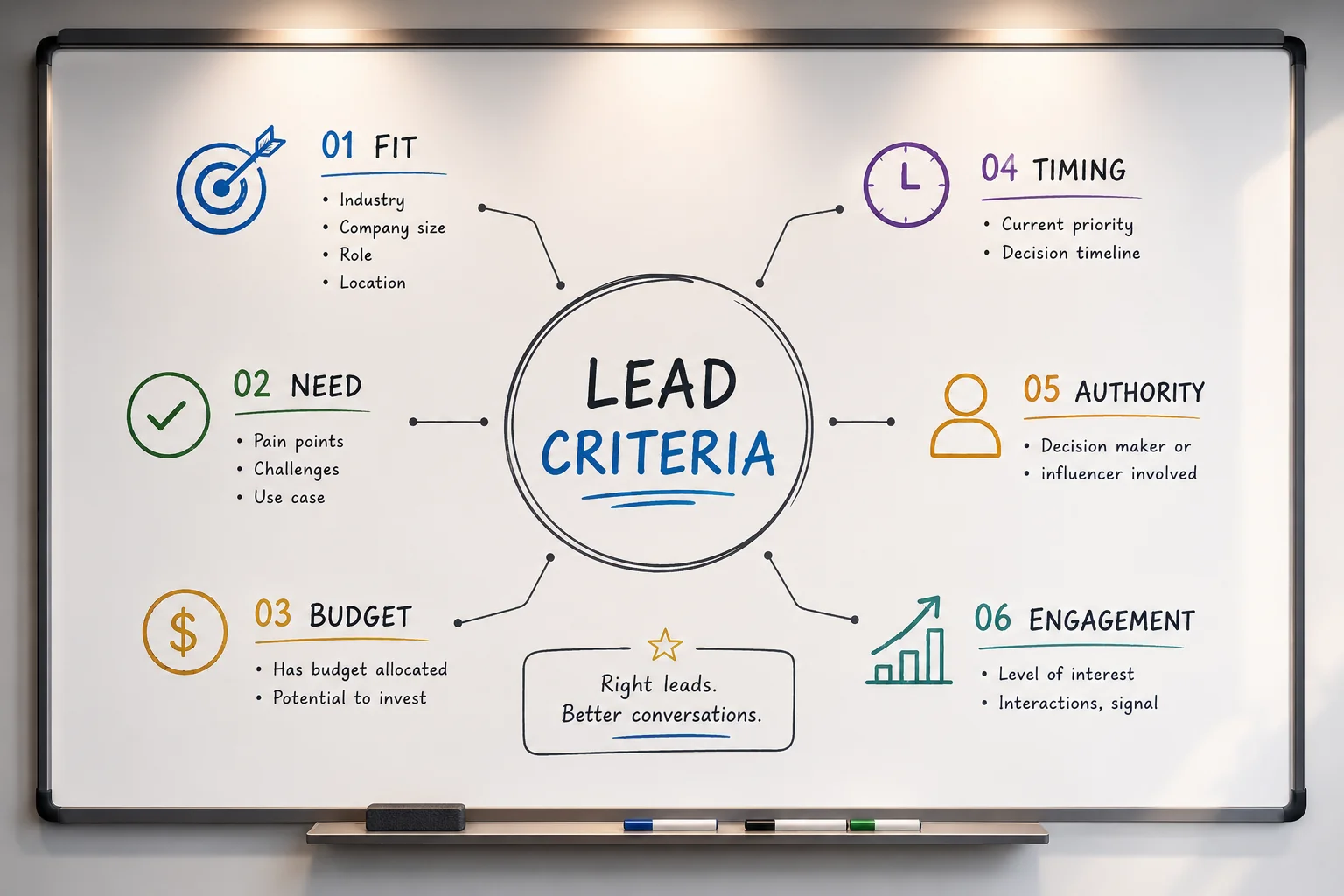
There is an argument happening in most Indian B2B companies right now, and it goes like this.
Marketing says it delivered ninety leads last month. Sales says most of them were rubbish. Marketing points at the number. Sales points at the outcome. Both are telling the truth, because nobody ever wrote down what a good lead looks like.
That is not a lead quality problem. It is a definition problem wearing a lead quality costume, and it costs Indian businesses more than any channel decision they will make this year.
The short answer
A qualified B2B lead is one that meets a written standard your sales team agreed to and can apply without asking permission. The standard should be built only from things you can verify in a first conversation — whether they fit your served market, whether something has actually triggered a need, whether you can get a second conversation, and whether you can serve them. Budget, authority and timeline belong later. Most companies put them first, cannot verify them, and fall back on instinct.
Key takeaways
- “Qualified” is an agreement, not a property. If two people looking at the same lead reach different answers, you do not have a definition.
- BANT was built for IBM in the 1950s and MEDDIC for six- and seven-figure enterprise deals at PTC in the 1990s. Neither was designed for a mid-market Indian business, and importing them wholesale produces a form nobody completes.
- Three of BANT’s four letters cannot be observed at first contact. Budget, authority and timeline are things you would like to know, not things you can check.
- Timeline is the least knowable of all. Gartner found buyers revisit each of six buying jobs an average of 1.7 times, in no fixed order. A stated timeline is a guess the buyer is also making.
- The test of a real definition is whether sales can decline a lead with it and nobody escalates. If every rejection needs a discussion, it is a preference, not a standard.
Why “lead quality” arguments are really definition arguments
Watch the argument closely and the structure is always the same.
Marketing is measured on volume, so it counts anything that arrives. Sales is measured on revenue, so it counts only what closes. Between those two positions sits an undefined middle, and both sides fill it with their own assumptions.
This gets worse the moment money is involved. Any agency paid per lead will deliver leads against whatever definition exists, and if none exists, against the loosest one that could be defended. We have written elsewhere about how B2B agencies charge and what that predicts — the short version is that per-lead pricing without a written definition of qualified guarantees a monthly argument.
The wasted spend is the smaller cost. The larger one is the leads that get ignored because sales has stopped trusting the source, which is how a channel that was working quietly stops working.
Why BANT and MEDDIC do not fit
Both are genuinely good frameworks. They were built for circumstances most Indian mid-market companies do not have.
BANT — Budget, Authority, Need, Timeline — originated at IBM in the 1950s. It was designed for outbound enterprise selling, where a salesperson led the buyer through a process and could reasonably expect answers to direct questions about money and approval.
MEDDIC — Metrics, Economic Buyer, Decision Criteria, Decision Process, Identify Pain, Champion — came out of PTC in the 1990s for complex six- and seven-figure deals with long cycles and formal procurement.
Now place either against a ₹20 crore Indian manufacturer selling a ₹5 lakh order, where the promoter decides but defers to a plant head on specification, where asking about budget in the first call is read as presumptuous, and where the buying process is a series of phone conversations rather than a documented procedure.
The mismatch is not that the frameworks are wrong. It is that they were built to qualify opportunities in a seller-led process, and most companies are trying to use them to qualify leads at first contact. Different job, different information available.
There is a further problem with timeline specifically. Gartner’s research found B2B buyers complete six buying jobs — problem identification, solution exploration, requirements building, supplier selection, validation and consensus creation — and revisit each one an average of 1.7 times, in no reliable order. When a buyer tells you they will decide in six weeks, they are making the same guess you are.
The Observable Four
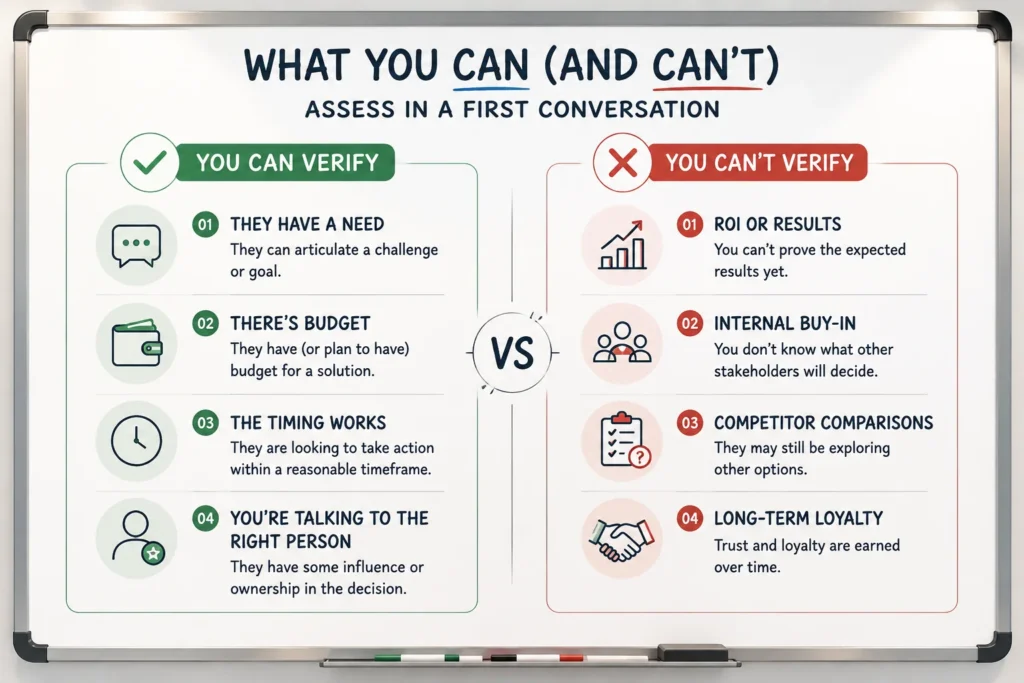
Build your definition only from things you can verify in one conversation.
The rule: if a criterion cannot be checked during the first conversation, it does not belong in the qualification gate. Move it to the opportunity stage, where you will have earned the right to ask.
One — fit. Are they in the market you actually serve? Industry, company size, geography, and the kind of requirement you handle. This is checkable before you even speak, from the company name and a two-minute search, and it disqualifies more leads than anything else on the list.
Two — trigger. Has something happened that created this need? A new plant, a failed supplier, a compliance deadline, a growth target, a contract ending. Buyers answer this question readily because it is not sensitive, and the answer tells you far more about urgency than a stated timeline does. A lead with no trigger is usually someone gathering information for later.
Three — reachability. Can you get a second conversation scheduled? Not “will they answer the phone” but “will they commit to a specific next step”. This is binary, immediately observable, and it predicts outcomes better than most scored criteria. On shared-lead channels it matters even more, which we cover in why response speed decides shared leads.
Four — serve-ability. Can you actually deliver what they are asking for, at a price you would accept, in the timeframe implied? You know this without asking them anything. It is also the criterion most often skipped, because saying no to work feels like losing.
Four criteria. All checkable. None requiring the buyer to disclose anything they would rather not.
What does not belong in the qualification gate
Four things people put in definitions and cannot verify.
Budget. Most Indian mid-market buyers will not state a number early, and many genuinely do not have one until they have quotes. Asking directly in a first conversation reads as qualifying them out, and you will get either silence or a figure invented to end the question.
Authority. Org charts do not tell you who decides. In many Indian businesses the promoter has authority and delegates judgement, which means the person you are speaking to may be neither the decision-maker nor irrelevant. Gartner’s finding that six to ten stakeholders shape a typical decision makes single-point authority a poor filter even where it can be established.
Timeline. Covered above. Buyers loop, and a stated date is a hope.
Intent scores. A number assigned to behaviour that stands in for information you do not have. Useful at scale with thousands of leads and a data team. In a business handling forty enquiries a month, it is arithmetic dressed as insight, and nobody will maintain the model.
None of this is useless information — all of it matters once a real opportunity exists. The mistake is demanding it at the gate, where it is unavailable, and then qualifying on gut feel because the form could not be completed.
Writing your definition in one sitting
Ninety minutes, sales and marketing in the same room, and one page at the end.
Start from closed deals, not from theory. Take your last twenty won deals and your last twenty losses. What was true of the wins at first contact that was not true of the losses? The pattern is usually visible without analysis, and it is more honest than any framework.
Write it as one sentence. For example: a qualified lead is a manufacturer in Maharashtra or Gujarat with 50 or more employees, who has a stated reason for looking now, has agreed a follow-up call, and needs something we can deliver within eight weeks.
That sentence is specific enough that two people would apply it identically. That is the standard.
Test it against ten real leads from last month. Have the sales lead and the marketing lead score them separately, then compare. Disagreement on more than one or two means the sentence is still too vague.
Agree the rejection right. Sales must be able to decline a lead using the definition without escalating. This is the part that makes it real. A definition that cannot be used to say no is a preference.
Write down what happens to the rejections, which most companies never do — and which is the next section.
Revisit it quarterly, not weekly. A definition that changes constantly is not a standard. Give it a quarter of real use before adjusting.
What to do with the leads that fail
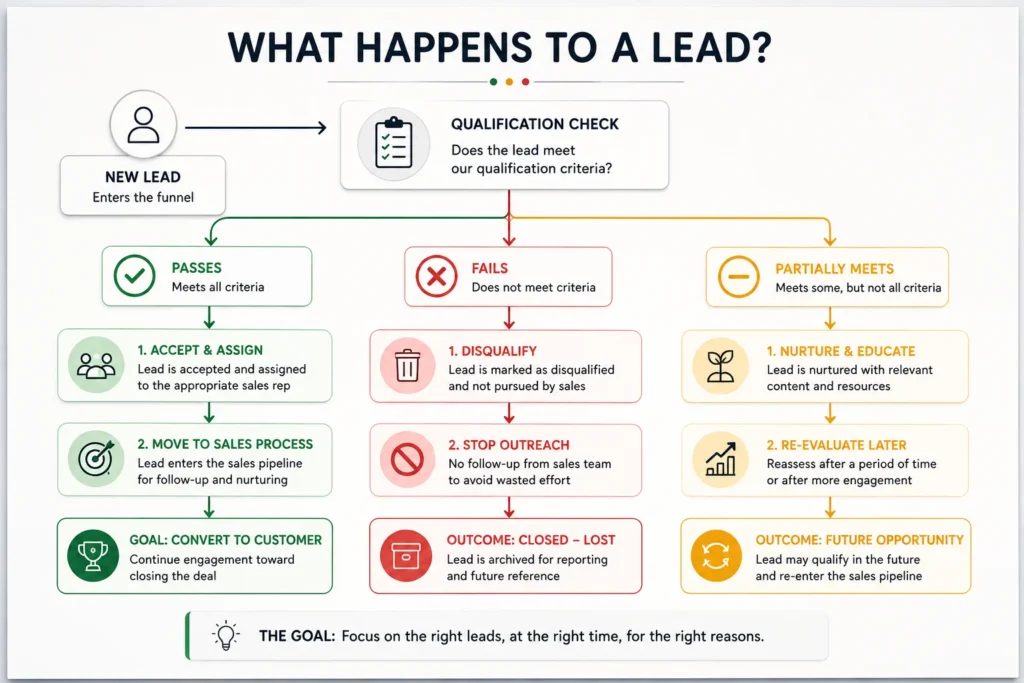
Most companies do nothing, which wastes a real asset.
Fails on fit — decline properly and politely, and where you can, refer them to someone who does serve them. Referrals returned are the cheapest goodwill available in Indian B2B.
Fails on trigger — this is your most valuable rejection pile. These are real buyers who are not buying yet. They belong in a light, long nurture — an occasional useful email, not a sequence — and they are exactly the audience that demand generation exists for. Research for the LinkedIn B2B Institute by Professor John Dawes at the Ehrenberg-Bass Institute found roughly 5% of B2B buyers are in market at any moment; the other 95% look like unqualified leads today.
Fails on reachability — three documented attempts, then park. Do not delete. A meaningful share become reachable later, and a record of the attempt saves the next person repeating it.
Fails on serve-ability — record the reason. If the same unservable requirement appears repeatedly, that is product information, not a lead problem.
The discipline is that every rejection gets a recorded reason. Do that for one quarter and you will learn more about your market than from any report.
Mistakes that cost real money
Qualifying on criteria you cannot check. The whole argument of this article.
Letting marketing write the definition alone. Sales will not apply a standard they did not agree to, and you will end up with two versions of the truth.
Confusing qualification with scoring. Scoring ranks leads. Qualification decides which ones you work at all. Businesses under a few hundred leads a month need the second and rarely the first.
Buying leads before writing the definition. Any per-lead agreement without a written standard produces a monthly dispute, and the relationship rarely recovers from it.
Treating rejection as failure. A high rejection rate against a good definition is a functioning filter. What it usually reveals is a targeting problem upstream, which is useful information.
Changing the definition mid-quarter. You lose the ability to compare anything, and the team stops believing the standard is real.
When qualification is not your problem
Your response time is the problem. If enquiries wait a day, they go cold regardless of how well you define quality. Harvard Business Review’s audit of 2,241 companies found the average first response took 42 hours and 23% never responded at all. Fix that before touching your definition — it is free.
Your traffic is wrong. If almost every lead fails on fit, the definition is working correctly and your targeting is not. That is a channel and keyword problem, and we cover why B2B leads get more expensive over time separately.
Your volume is tiny. Below roughly twenty enquiries a month, work all of them and pay attention to what closes. You will have a better definition in six months from evidence than you would write today from assumption.
Your win rate is the real issue. If qualified leads arrive and you lose them, the gate is fine and the problem sits in proof, pricing or follow-through.
The qualification checklist
☐ Last twenty wins and twenty losses reviewed for what differed at first contact
☐ Definition written as one sentence, not a scorecard
☐ Built only from criteria checkable in the first conversation
☐ Budget, authority and timeline moved to the opportunity stage
☐ Sales lead and marketing lead both signed it
☐ Tested by scoring ten real leads separately and comparing answers
☐ Sales granted the right to decline without escalation
☐ Rejection reasons made a required field
☐ A destination agreed for each failure type — refer, nurture, park, record
☐ Any agency or lead supplier given the definition in writing before the contract
☐ Fixed for a full quarter before revision
☐ Reviewed against closed deals at the end of that quarter
Questions we get asked
What is the difference between an MQL and an SQL?
A marketing qualified lead has shown enough interest for marketing to hand it over; a sales qualified lead has been spoken to and confirmed. The distinction only earns its place when two separate teams need a handoff contract. One team, one definition.
Does BANT still work?
As an opportunity qualification tool in a seller-led process, yes. As a first-contact filter for a mid-market Indian business, mostly not — three of its four criteria cannot be verified when you need them, and asking about budget early damages more conversations than it saves.
Who should own the definition — sales or marketing?
Written jointly, with sales holding the pen. Marketing has to be able to hit it and sales has to be willing to work anything that meets it. Both signatures or it will not hold.
Should we use lead scoring?
Only at volume you cannot handle manually. Below a few hundred leads a month, scoring is a model nobody maintains and a false precision that replaces judgement. A one-sentence definition applied consistently beats a scoring system applied occasionally.
How do we agree a definition with an agency?
Before signing, in writing, with worked examples. Give them five leads you would accept and five you would reject, and ask them to classify ten more. Disagreement at that stage is cheap. Disagreement in month two is not.
What if sales rejects almost everything?
Check whether they are rejecting against the definition or against preference. If it is the definition, your targeting needs work. If it is preference, the definition was never really agreed, and the ninety-minute conversation has not actually happened yet.
What to do this week
Get your sales lead and your marketing lead in a room for ninety minutes with the last twenty deals you won and the last twenty you lost.
Ask one question: what was true of the wins at first contact that was not true of the losses? Write the answer as a single sentence. Then test it on ten real leads from last month, scored separately by each person, and compare.
If the two of them disagree on more than a couple, the sentence is not finished. Keep going until they agree — that agreement is the entire deliverable, and it is worth more than any lead generation campaign you will run this quarter.
If you would like that session run against your own closed-won data, and the definition built into whatever system your team actually uses, you can reach out to us on whatsapp at +91 7738844851 . It is a short piece of work with an unusually long payback.
More in Blog
Keep reading
All articles →


Ready to talk about your growth?
Tell us what's stuck and we'll tell you what we'd do first. Free, 30 minutes, no pitch.