
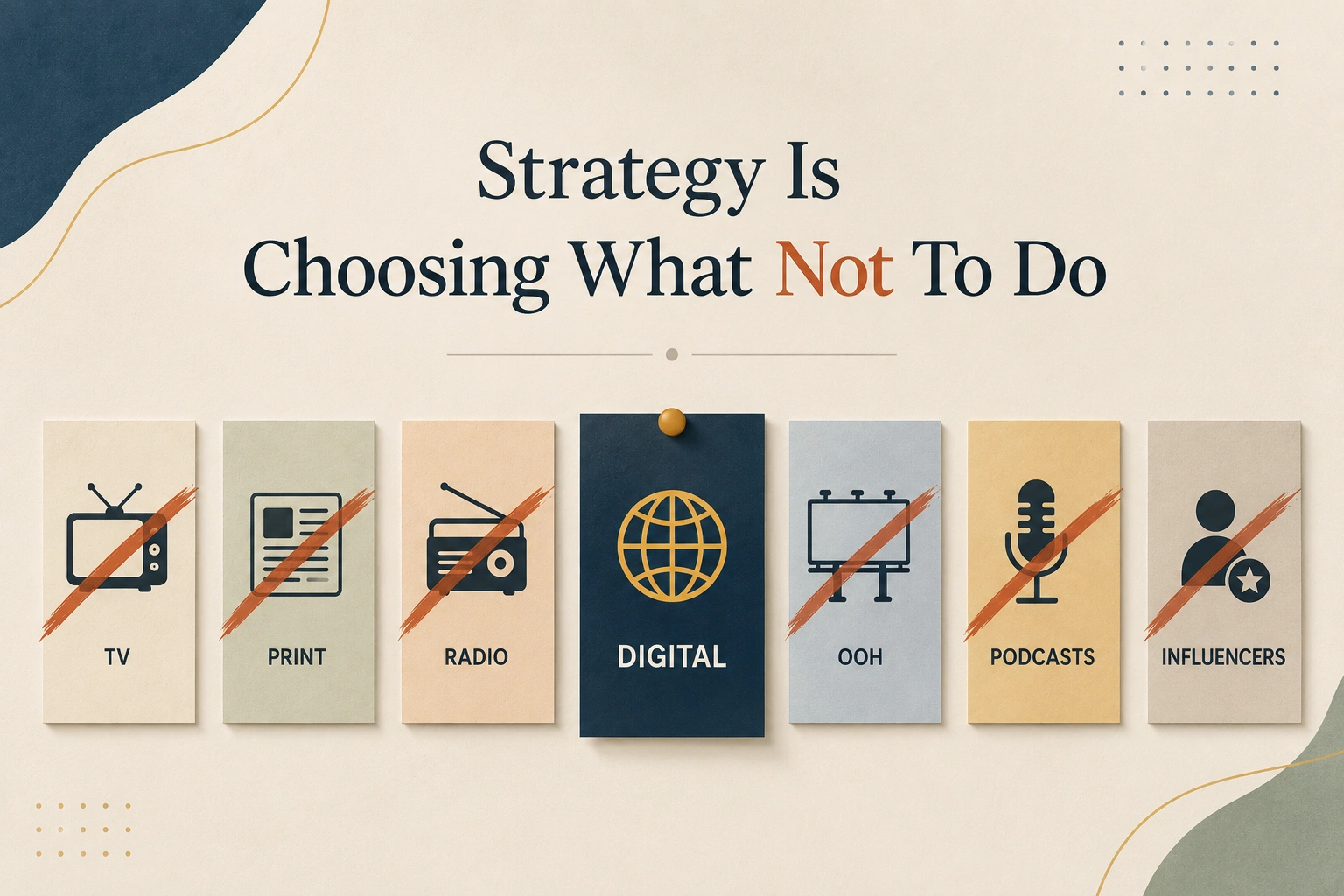
There is an article ranking near the top of this search titled “Types of Performance Marketing Channels and How to Select the Right Ones.”
It defines twelve channels. Then it concludes that the best approach usually involves a combination of several methods.
That is not a selection method. It is a list with a shrug at the end, and almost every guide on this subject ends the same way — because selecting means ruling things out, and ruling things out means telling some readers that the channel their agency proposed will not work for them.
The short answer
Performance marketing channels are the paid platforms where you buy measurable actions: search, paid social, LinkedIn, video, remarketing, display, native, affiliate and email. Money is not what decides which are available to you. Each one requires something from the business before budget does anything — search requires that people already search for your category, paid social requires creative you can keep producing, LinkedIn requires both a firmographic audience of real size and a deal value that carries the click. Work out what you can supply, and the list shortens considerably.
Key takeaways
- Every channel has a non-monetary entry requirement. It is usually the real constraint, not budget.
- Search requires existing category demand. If nobody searches for the problem, the channel is empty regardless of spend.
- Paid social requires a creative cadence, not a creative. Performance decays without new material.
- LinkedIn requires audience size and deal value together. Its technical minimum is 300, but Sponsored Content wants 50,000 or more.
- Remarketing cannot be a first channel. Its audience is capped by whatever traffic feeds it.
- Two of the pages ranking for this term sell the channel they recommend. Read channel guides accordingly.
What a channel actually asks of you
The standard framing treats channels as interchangeable spending options with different prices and audiences. Pick one, load a budget, measure the return.
That framing hides the thing that decides most outcomes. A channel is a machine with input requirements, and if you cannot supply the inputs it does not matter how well funded it is.
A business with no category search demand can spend ₹5 lakh a month on Google Ads and get very little, because the searches do not exist. A business that can produce one video a quarter cannot sustain paid social, because the creative fatigues faster than it is replaced. Neither problem is visible on a budget spreadsheet.
So the useful question is not “which channel is best.” It is: what does each channel need from us, and what can we actually supply?
The Entry Requirement
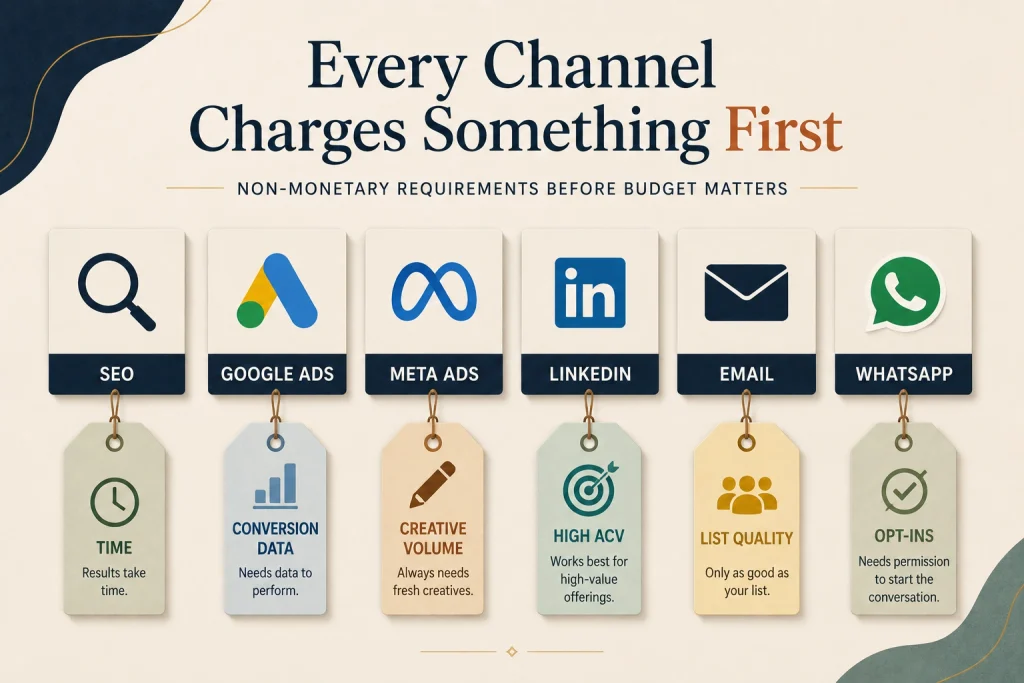
Every channel charges an admission fee that is not money — demand, creative capacity, audience size, deal value, margin, a list, or production capability. Check the fee before checking the budget, because the fee is what usually rules the channel out.
What follows is the fee for each major channel, and how to tell whether you can pay it.
Search — requires existing category demand
The fee. People must already be typing something that describes your problem or product.
How to check. Look at search volume for the problem, not for your brand. “Cold storage rental Mumbai” is demand. “Findise” is recognition. Only the first one tells you the channel has anything to sell you.
What you get for it. The highest-intent traffic available anywhere, and the lowest platform learning requirement of the major channels — Google’s Target CPA wants at least 30 conversions in 30 days, against Meta’s roughly 50 optimisation events a week.
When you cannot pay it. New categories, genuinely novel products, and problems people have not yet named. These businesses must create demand rather than capture it, which costs more and takes longer.
Detail: how Google and Meta actually differ for a given budget.
Paid social — requires a creative cadence
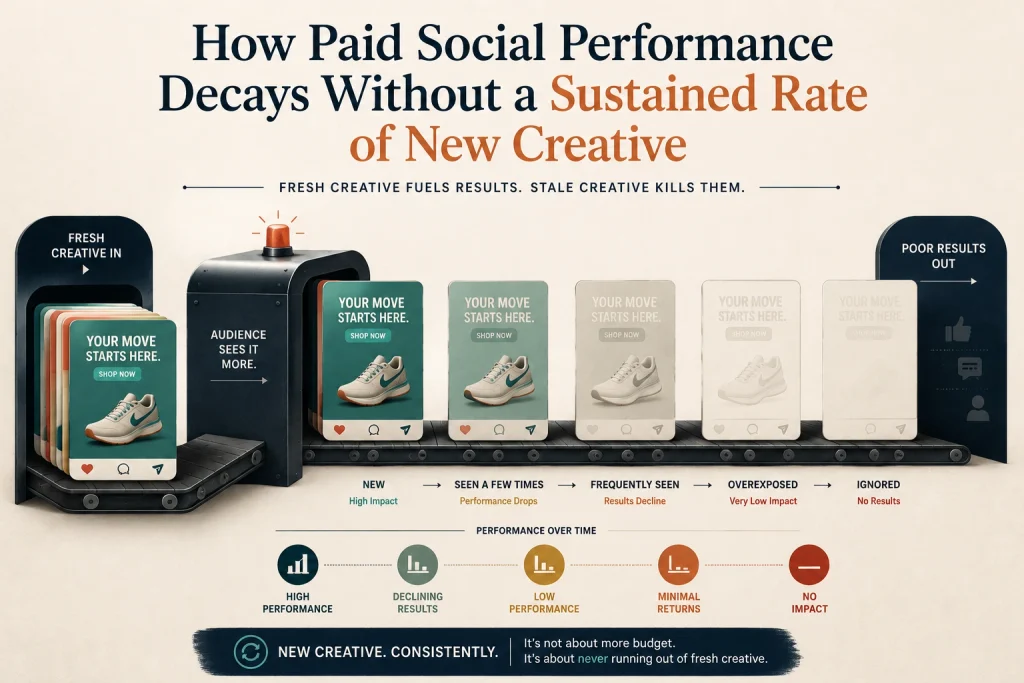
The fee. Not a creative. A rate of new creative you can sustain indefinitely.
Meta’s delivery depends on fresh material. The same asset shown repeatedly to the same audience loses effectiveness, costs rise, and the account slowly degrades while the settings stay identical. Businesses that treat creative as a one-off launch cost discover this in month three.
How to check. Ask honestly how many genuinely different ad concepts your team can produce every month, indefinitely. Two is workable. Zero after the initial batch means the channel will decay.
What you get for it. Reach into people who were not looking, precise targeting, and the ability to build audiences you can later retarget.
The other half of the fee. Volume. Meta’s ad sets need roughly 50 optimisation events a week — about 217 a month — before delivery stabilises. At a ₹700 lead that is over ₹1.5 lakh a month for a single ad set, which is why the choice of optimisation event matters so much: what each stage costs to run properly.
LinkedIn — requires audience size and deal value together
The fee, part one. A firmographic audience that exists at scale. LinkedIn’s technical minimum is 300 members, but Sponsored Content campaigns are recommended at 50,000 or more. Target too precisely and delivery starves.
The fee, part two. A deal large enough to carry LinkedIn’s cost per click, which is the highest of the major platforms. A ₹15,000 annual contract does not survive it. A ₹15 lakh contract barely notices.
Both, not either. A large audience with small deals loses money. Big deals in a tiny audience cannot deliver.
What you get for it. Targeting by job title, company size, industry and seniority that no other platform matches.
Detail: LinkedIn against search for B2B.
Remarketing — requires upstream traffic
The fee. Somebody else’s channel, running first.
A retargeting pool cannot be larger than the traffic that fed it. If 3,000 people visited your site last month, that is your entire addressable audience, and past a certain frequency you are showing the same people the same ad until they resent it.
Why it gets mis-sold. Remarketing reports the best numbers in most accounts, because it addresses people who already showed intent. Those numbers are real and they are not scalable — the pool is the ceiling.
When you can pay it. Once an upstream channel is producing traffic reliably. Never first.
Email and CRM — requires a list and permission
The fee. A list you built legitimately, and consent to use it.
What you get for it. The cheapest conversions in the account, by a distance, and audiences you can upload to Google and Meta so past customers stop being treated as strangers.
The catch. A list decays about a fifth a year through job changes and abandoned addresses, so this channel needs constant feeding from the others. It is a compounding asset, not a standalone acquisition channel.
Video and YouTube — requires production capacity
The fee. The ability to make video regularly, at a standard that survives being placed next to professional content.
How to check. Not “can we afford one video” but “can we make six this year.” Video demands more than any other format and the requirement recurs.
What you get for it. Cheap reach, strong demonstration for products that show well, and audiences that can be retargeted afterward.
Where it fits India. dentsu’s 2026 report puts Indian digital advertising at ₹71,621 crore, with digital video at ₹20,004 crore — 28% of the total, close behind social at 29% and ahead of paid search at 23%. Video is a large share of where Indian money goes, which is a reason to consider it and not a reason to assume it fits you.
Affiliate — requires margin to share and clean attribution
The fee. Enough gross margin to pay a commission and still profit, plus a purchase you can attribute reliably to a referrer.
Where it works. E-commerce with reasonable margins and a short path to purchase.
Where it does not. Considered B2B purchases, long sales cycles, and anything where the sale completes offline. The attribution required simply does not exist.
Native and programmatic — requires scale and a tolerance for low intent
The fee. Volume large enough that small efficiency differences matter, plus acceptance that the traffic did not come looking for you.
Read this section knowing the SERP is not neutral. Two of the pages ranking for “performance marketing channels” are published by native advertising companies, and both arrive at native advertising as an answer. That does not make it a bad channel. It does mean the recommendation is not disinterested, and the same test applies as everywhere else: can you supply what it requires?
Honest position. For most Indian SMEs and mid-market businesses, native and programmatic come after search, social and remarketing are working. They are scale channels.
The three-question test
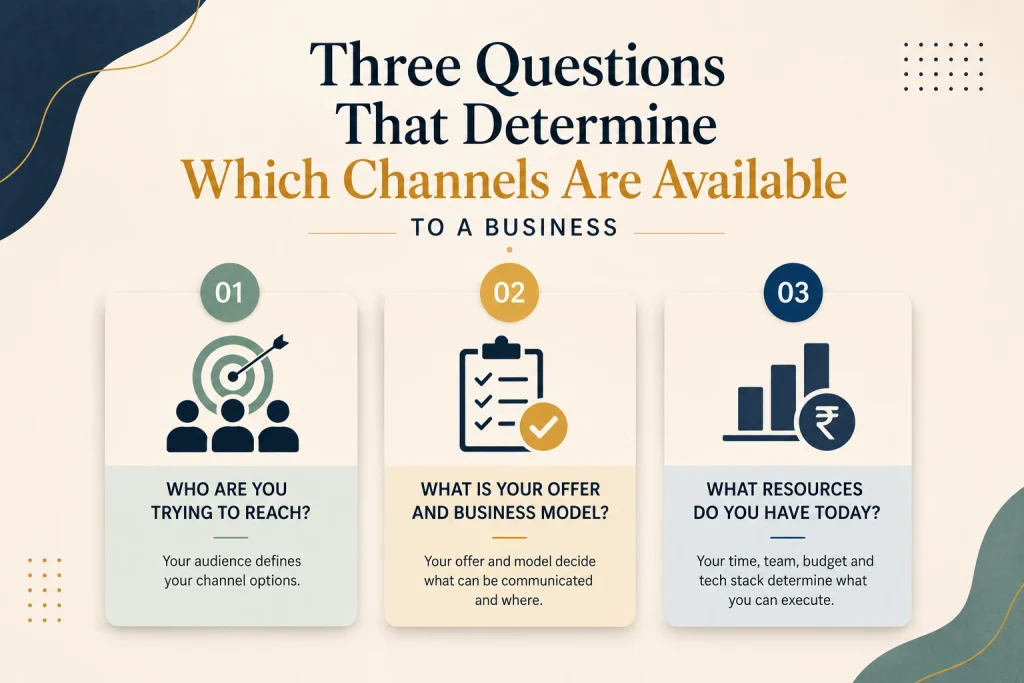
Before any budget conversation, answer these.
Do people search for what we solve? If yes, search is available and should usually come first — capturing demand is cheaper than creating it. If no, skip search and accept that customer acquisition will cost more.
Can we produce new creative every month, forever? If yes, paid social is available. If no, either fix that or leave the channel alone.
Is one customer worth enough to carry an expensive click? If yes and your audience exists at scale, LinkedIn is available for B2B. If either half fails, it is not.
Everything else follows from traffic you do not have yet. Remarketing, lookalike audiences and list-based targeting all require an upstream channel to be running first, which is why they cannot be where you start.
Mistakes that cost the most
Choosing channels by budget alone. The budget question comes second. The requirement question comes first, and it rules more channels out.
Running four channels on a one-channel budget. Nothing accumulates enough data to be judged, and the conclusion is always that none of them worked.
Buying paid social without a creative plan. Month one looks good. Month four looks like a different account.
Treating remarketing performance as scalable. Its excellent numbers are a property of the audience, not of the channel.
Believing channel guides published by channel vendors. Including, for the avoidance of doubt, agency blogs. Check the incentive, then check the requirement.
Adding channels rather than deepening one. Most accounts have more room in the channel they already run than they think.
When the honest answer is fewer channels
When one channel is not yet at its ceiling. Adding a second before the first is saturated splits attention and data for no gain.
When nobody owns execution. Every channel needs a person. Four channels and one part-time marketer produces four neglected accounts.
When measurement cannot separate them. Running several platforms at once means each claims the same sale — why platforms count the same sale twice covers the reconciliation before you multiply the problem.
When the requirement is not met and you are hoping. Buying a channel you cannot supply inputs for is the most reliable way to conclude that performance marketing does not work.
The selection checklist
☐ Category search demand checked with real volume data, not assumption
☐ Monthly creative capacity stated honestly, as a recurring number
☐ Firmographic audience size checked against LinkedIn’s recommended 50,000 before considering it
☐ Average customer value compared against the platform’s typical cost per click
☐ Gross margin checked before considering affiliate
☐ Existing list size and consent status confirmed
☐ Video production capacity assessed as a yearly rate, not a one-off
☐ Upstream traffic confirmed before budgeting remarketing
☐ One channel chosen to start, and funded above its learning floor
☐ Owner named for that channel
☐ Every channel guide you read checked for who publishes it
☐ Second channel deferred until the first has stopped improving
Questions we get asked
What are the main performance marketing channels?
Paid search, paid social, LinkedIn, video, remarketing, display, native, affiliate and email. The useful distinction is not the list but which of them your business can supply inputs for.
Which performance marketing channel is best?
The one whose entry requirement you already meet. For most Indian businesses with existing category demand, that is search — it has the lowest learning threshold and the highest intent.
How do I choose the right marketing channel?
Answer the three questions above before the budget question. Most media plans get built in the wrong order, which is why so many contain channels the business was never able to run.
What is the difference between paid search and paid social?
Search captures demand people already have. Social creates demand among people who were not looking. That difference drives everything else — cost, timeline, creative requirements and how you judge results.
How many channels should a business run at once?
As many as you can fund above their learning floors and staff properly. For most SMEs that is one, sometimes two. Proposals suggesting four are usually selling breadth rather than results.
Is affiliate marketing still worth it?
For e-commerce with margin to share and clean attribution, yes. For considered B2B purchases, rarely — the tracking required does not survive a six-month sales cycle.
Before you read the next proposal
Take whatever media plan is in front of you and, for each channel on it, write down what that channel requires from your business.
Then mark the ones you can actually supply.
Most proposals lose two or three lines at that step. The ones that survive are the plan — and they are usually funded better than they would have been, because the money that was going to be spread across five channels is now behind two.
If you want that exercise run properly against your own business, you can reach out to us on whatsapp at +91 7738844851 .
More in Blog
Keep reading
All articles →
Ready to talk about your growth?
Tell us what's stuck and we'll tell you what we'd do first. Free, 30 minutes, no pitch.