
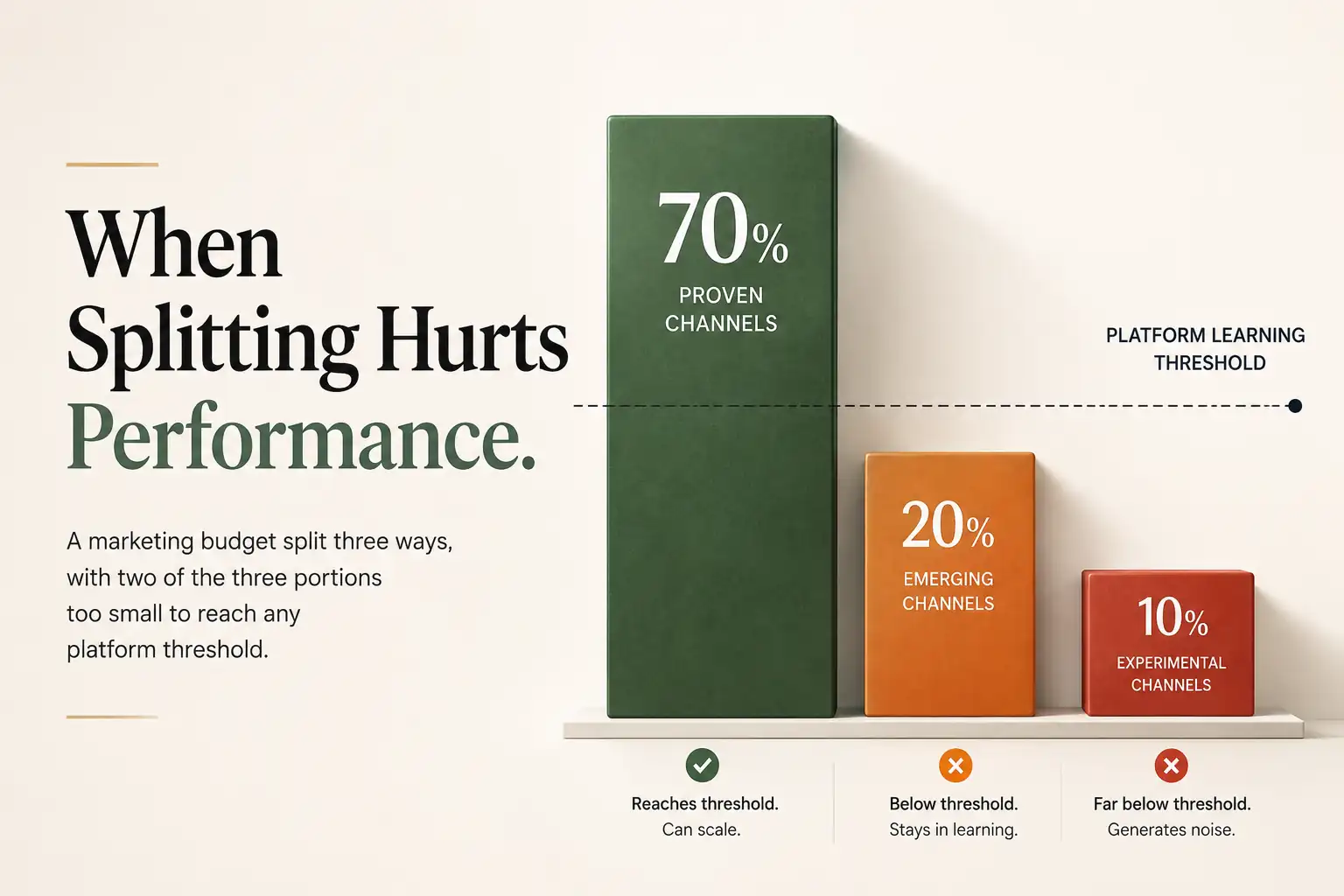
The standard advice on this is the 70/20/10 rule. Seventy per cent of your budget to proven channels, twenty to emerging ones, ten to experiments.
It is sensible, widely taught, and quietly assumes you are spending enough for all three portions to do something.
At ₹50,000 a month, the experimental tier is ₹5,000. That will not produce a usable signal on any platform. The emerging tier is ₹10,000, which funds a campaign that never exits learning.
Follow the framework at that budget and you end up with one channel that works and two that produce the feeling of diversification.
The short answer
Budget allocation frameworks are scale-dependent, and nobody who publishes them says so. Splitting a budget only helps once each portion is large enough to clear the relevant platform’s data thresholds — Google recommends 30 conversions in 30 days for Target CPA, Meta needs roughly 50 optimisation events per ad set weekly. Below that line, concentration beats allocation. The right strategy is a function of your budget stage, and it changes as you grow rather than being chosen once.
Key takeaways
- 70/20/10 assumes enterprise budgets. At Indian SME scale, two of the three tiers buy nothing.
- The split threshold is calculable from your target cost per acquisition and the platforms’ published minimums.
- Below the threshold, concentrate. One channel funded properly beats three funded partially.
- Set the budget upward from what a customer is worth, not downward from a percentage of revenue.
- Allocation is a stage, not a decision. What is right at ₹50,000 a month is wrong at ₹10 lakh.
Why percentage-of-revenue is the wrong starting point
The other standard answer is a percentage. Reported guidance puts typical marketing budgets at 7–12% of annual revenue, with consumer businesses generally allocating more than B2B ones.
Those figures circulate widely without stated methodology, sample or definition — they include or exclude salaries, tools and agency fees inconsistently. Treat them as a sanity check on whether you are wildly out of step, and as nothing more.
The deeper problem is the direction of the calculation. A percentage of revenue tells you what you can afford to lose. It says nothing about what acquiring a customer costs or whether the channel can work at that spend.
Work upward instead. Gross profit per customer, multiplied by your close rate on qualified leads, gives your maximum acceptable cost per acquisition. Multiply that by the volume the platform needs to optimise, and you have a floor — the budget below which the channel cannot function regardless of skill. Working out what a lead is actually worth sets out the first half with a calculator.
That floor, not a percentage, is the number that determines your strategy.
The Split Threshold
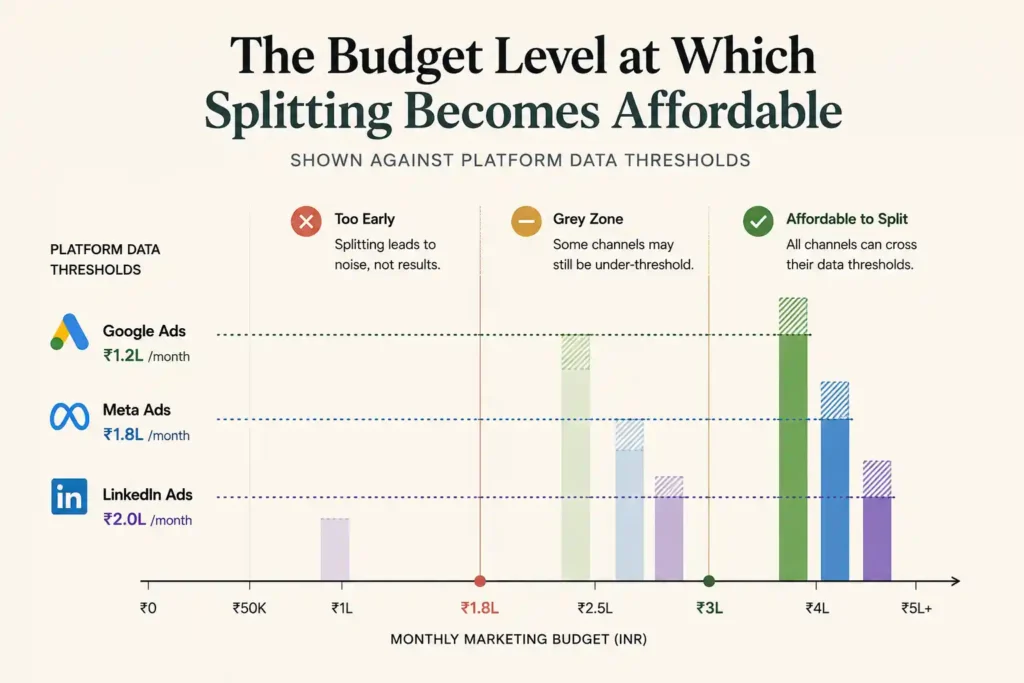
Splitting a budget helps only when each portion is large enough to clear the data thresholds of the channel it funds. Below that line, every additional split subtracts. Diversification is not a risk-management decision at small budgets — it is a way of guaranteeing that nothing works.
The arithmetic is straightforward once you have two numbers.
Your target cost per acquisition. Derived from gross profit and close rate, as above.
The platform’s data requirement. Google recommends at least 30 conversions in 30 days for Target CPA bidding. Meta’s learning phase needs roughly 50 optimisation events per ad set within a rolling seven days — around 200 a month.
Multiply them. A business with a ₹1,500 target cost per acquisition needs roughly ₹45,000 a month to reach Google’s threshold on one campaign, and around ₹3,00,000 to reach Meta’s on one ad set. Those are floors for a single channel to function, not budgets for a programme.
Now apply 70/20/10 to a ₹1,00,000 monthly budget. Seventy per cent is ₹70,000, which clears the Google floor comfortably. Twenty per cent is ₹20,000 — below it. Ten per cent is ₹10,000, which is not an experiment, it is a donation.
The threshold, stated plainly. You can afford a second funded channel once your budget is roughly twice the floor of your primary one. You can afford a genuine experimental tier once the 10% slice on its own clears a threshold — which for most businesses means a budget several times larger than they expect.
The general version of this argument, at platform level, is in whether you can afford more than one platform. What matters here is that the same constraint governs the allocation framework itself.
Three budget stages
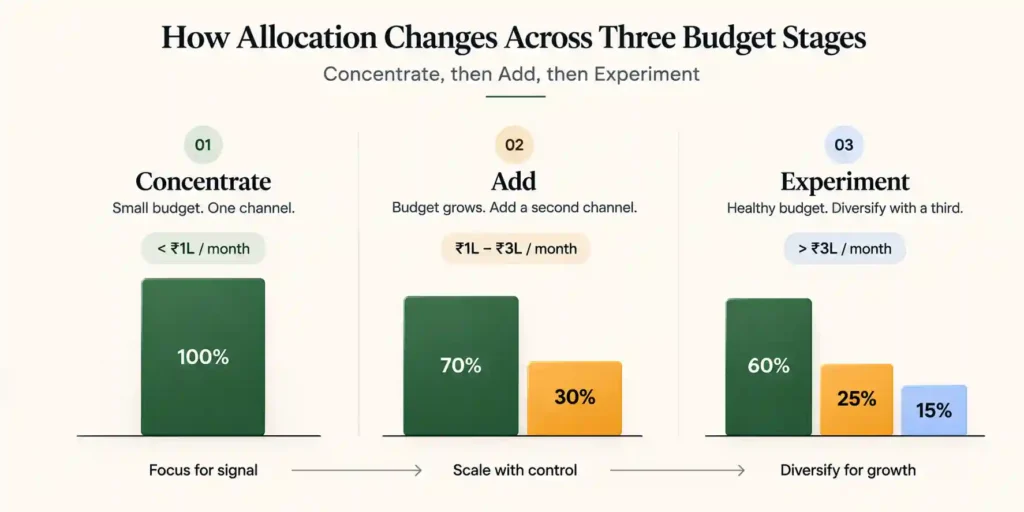
Strategy changes shape as the number grows. Most advice is written for the third stage and read by people in the first.
Stage one: concentrate
Below roughly twice your primary channel’s floor.
What to do. Fund one channel properly. Usually the one that captures existing demand, because capturing is cheaper than creating and produces attributable results sooner.
What allocation looks like. Effectively 100/0/0. Not because experimentation is worthless, but because at this budget the experimental slice cannot produce evidence.
How to experiment anyway. Sequentially rather than in parallel. Run one thing for a quarter, learn, then change it. That is a real experiment; a ₹5,000 parallel test is not.
The discipline this requires. Saying no to channels people inside the business want to try. The pressure to look diversified is organisational rather than commercial.
Stage two: add a second channel
Once the budget comfortably exceeds twice your primary floor.
What to do. Add one channel, chosen because it does something the first cannot — usually demand creation where the first captures demand.
What allocation looks like. Something closer to 70/30, with both portions above their thresholds. Still no experimental tier.
What changes in measurement. Two channels means your reporting starts double-counting. Someone who saw a social ad, remembered you and then searched your brand appears in both. Why platforms count the same sale twice covers reconciling it — and reconciling matters more at this stage than at any other, because you are now making split decisions on combined numbers.
The failure mode. Adding the second channel before the first has stabilised, which produces two learning periods running simultaneously and no reliable read on either.
Stage three: allocate properly
Once every tier clears its own threshold.
What to do. Now 70/20/10 works as published, because 10% of your budget is a real experiment rather than a gesture.
What allocation looks like. Core channels funded to efficiency, emerging channels funded to a threshold, and an experimental tier that can produce a conclusive answer within a quarter.
What becomes available. Genuine testing. Incrementality measurement. The ability to lose money deliberately on demand creation for people who will buy in a year — around 5% of buyers are in market at any moment, per Ehrenberg-Bass research for the LinkedIn B2B Institute, and reaching the rest is a stage-three activity.
What to guard against. Proliferation. Stage three permits more channels; it does not require them, and the same consolidation logic that governs stage one still applies within each tier.
What a plan should actually contain
Briefly, because plans are usually longer than they need to be and shorter on the parts that matter.
One number that defines success, agreed before spending. Cost per qualified acquisition, against a stated maximum.
The floor calculation, written down, so the budget conversation has a basis other than last year’s figure.
A stated stage, and what would move you to the next one.
One channel per stage-one plan. Two per stage two. The temptation to list six is the thing to resist.
A review interval matched to the sales cycle, not to the financial calendar.
A stop condition. What result, by what date, would mean this is not working — decided in advance, because deciding it afterwards never happens.
Mistakes that cost real money
Applying 70/20/10 at a budget it was not designed for. The error this article exists for.
Setting the budget as a percentage of revenue. It tells you what you can lose, not what acquisition costs.
Splitting to hedge. At small budgets, hedging guarantees that nothing clears a threshold.
Adding channels because they exist. Each one divides data that was already thin.
Running parallel experiments on a stage-one budget. Sequential experiments are real; parallel ones at that scale are noise.
Judging allocation on platform-reported results without reconciling. Two channels will overstate their combined contribution, and you will reallocate on fiction.
When performance marketing is the wrong place for the budget
When the floor exceeds what you can commit for two quarters. A channel funded for six weeks has bought a learning period.
When nobody has calculated what a customer is worth. Every number in this article depends on it, and half the businesses we speak to cannot state it.
When the offer or the follow-up is the constraint. Advertising makes an existing advantage visible faster and cannot compensate for a weak one or an unanswered phone.
When your market is small enough to reach directly. A few hundred target accounts is a relationships problem, not an auction problem.
When testing is being sold to you at a volume that cannot support it — how much traffic a test actually needs covers the arithmetic on the conversion side, and the same logic applies to media.
The allocation checklist
☐ Gross profit per customer calculated, using gross profit rather than revenue
☐ Close rate on qualified leads established
☐ Maximum acceptable cost per acquisition derived from both
☐ Primary channel’s monthly floor calculated — target cost per acquisition × platform threshold
☐ Current budget compared against that floor
☐ Budget stage identified — concentrate, add, or allocate
☐ Channel count matched to the stage, not to ambition
☐ Experimental tier funded only if its slice alone clears a threshold
☐ Sequential experiments planned where parallel ones are unaffordable
☐ Reporting reconciled against actual sales if more than one channel runs
☐ One success metric agreed before spending
☐ Stop condition and review date written down in advance
Questions we get asked
How much should I spend on performance marketing?
Work upward from what a customer is worth and what the platform needs to optimise, rather than downward from revenue. The floor is your target cost per acquisition multiplied by the platform’s minimum conversion volume.
What is the 70/20/10 rule in marketing?
Seventy per cent to proven channels, twenty to emerging, ten to experimental. It works once every tier is large enough to produce a signal, which is a higher budget than most businesses applying it have.
How do I allocate budget across channels?
At small budgets, do not. Fund one channel past its threshold, then add a second once you can afford two floors.
What percentage of revenue should go to marketing?
Reported ranges sit around 7–12%, without consistent methodology or definitions. Useful as a sanity check, useless as a plan.
How do I build a performance marketing plan?
One success metric, the floor calculation, a stated stage, the channels that stage supports, a review interval matched to your sales cycle, and a stop condition.
When should I add a second channel?
When your budget comfortably exceeds twice the floor of your first, and the first has been stable for at least a quarter.
Two numbers before your next budget meeting
Work out your maximum acceptable cost per acquisition — gross profit per customer multiplied by your close rate on qualified leads.
Then multiply it by 30, which is what Google recommends for reliable Target CPA bidding on a single campaign.
That product is the monthly floor for one channel to function. Compare it against your current budget, and you will know immediately which stage you are in — and whether the three-way split you were about to approve is a strategy or a way of ensuring that none of the three works.
If you would like that calculation run against your margins and your market before the budget is set, you can reach out to us on whatsapp at +91 7738844851— or see our performance marketing services.
More in Blog
Keep reading
All articles →


Ready to talk about your growth?
Tell us what's stuck and we'll tell you what we'd do first. Free, 30 minutes, no pitch.