UTM Meaning: What UTM Parameters Are and How to Tag Your Links
UTM meaning explained: what UTM parameters are, the five main tags, a naming convention to copy, and examples for WhatsApp, Instagram, email and QR codes.

The short answer
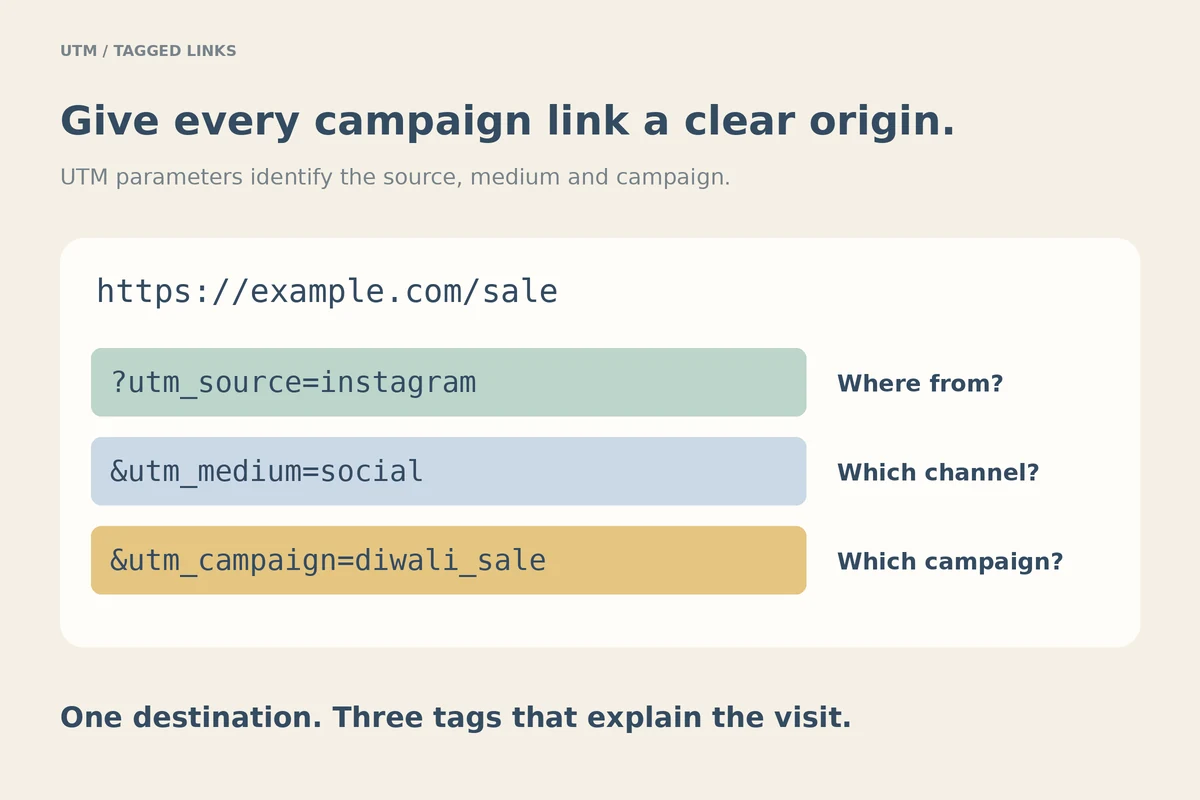
UTM stands for Urchin Tracking Module, named after Urchin, the analytics company Google bought and turned into Google Analytics. UTM parameters are short tags you add to the end of a link so analytics tools know exactly where a visitor came from. For example: yoursite.com/sale?utm_source=instagram&utm_medium=social&utm_campaign=diwali_sale. When someone clicks that link, Google Analytics 4 records the source, medium and campaign. Google’s help pages say you should always use utm_source, utm_medium and utm_campaign. Without UTM tags, traffic from WhatsApp, email and influencers often shows up as “direct” and gets no credit.
Why UTM tags matter
Ad platforms tag their own clicks automatically in many cases. But lots of marketing happens outside them:
- WhatsApp broadcasts and groups
- Influencer bio links and stories
- Email newsletters
- QR codes on packaging, flyers and hoardings
- Partner websites
Tag those links and your analytics can tell you which ones actually bring sales. That’s how ROAS and channel KPIs become trustworthy.
The UTM parameters
Google Analytics lists several parameters. These five cover almost every case:
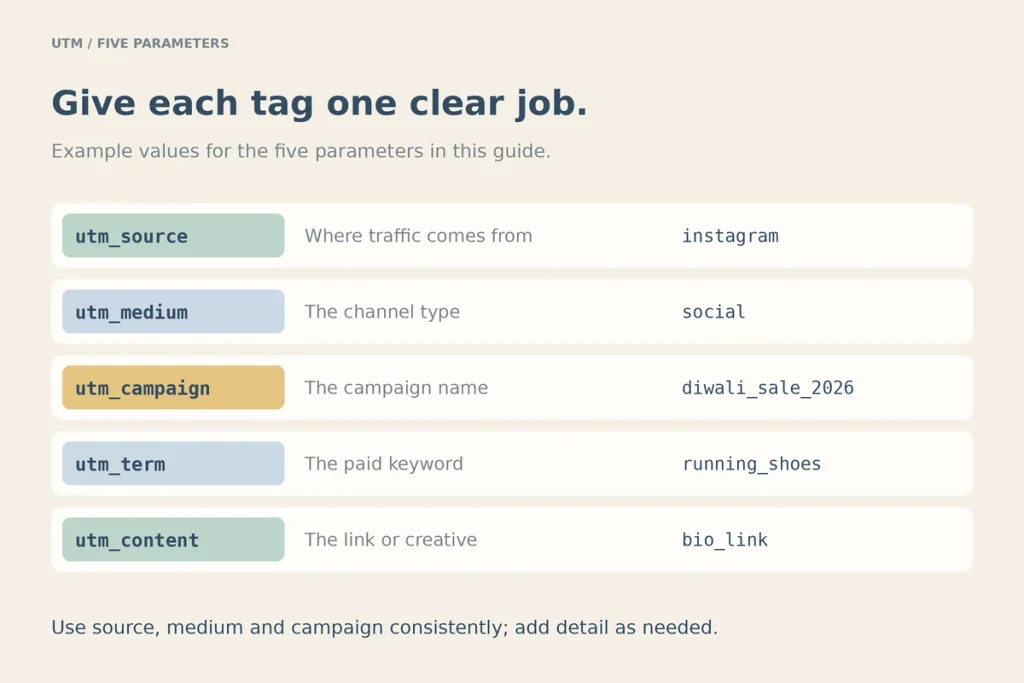
utm_source (always use): where the traffic comes from. Examples: instagram, whatsapp, newsletter, flyer
utm_medium (always use): the type of channel. Examples: social, email, cpc, referral, qr
utm_campaign (always use): the campaign name. Examples: diwali_sale_2026, webinar_oct
utm_content (optional): which link or creative. Examples: reel_1, bio_link, top_button
utm_term (optional): the paid keyword, mostly for search ads
Google also lists utm_id and a few newer parameters. If you leave out the core three, Google warns that reports can show “(not set)”.
UTM examples for common channels
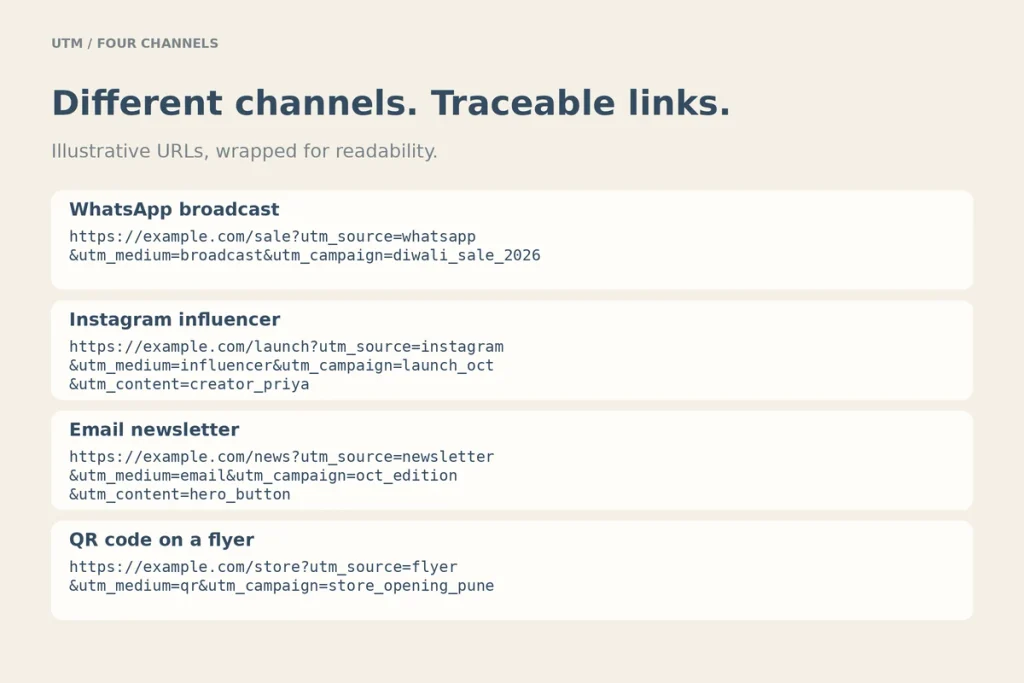
WhatsApp broadcast
?utm_source=whatsapp&utm_medium=broadcast&utm_campaign=diwali_sale_2026
Instagram influencer (one link per creator)
?utm_source=instagram&utm_medium=influencer&utm_campaign=launch_oct&utm_content=creator_priya
Email newsletter
?utm_source=newsletter&utm_medium=email&utm_campaign=oct_edition&utm_content=hero_button
QR code on a flyer
?utm_source=flyer&utm_medium=qr&utm_campaign=store_opening_pune
For influencer programmes, one link per creator shows exactly who drives sales; useful when working with many nano influencers. For WhatsApp and email reporting, see WhatsApp marketing metrics and email marketing metrics.
A naming convention to copy
- Lowercase only. Analytics treats “Instagram” and “instagram” as different sources
- Underscores, no spaces. diwali_sale, not Diwali Sale
- Fixed list of mediums. For example: social, email, cpc, influencer, broadcast, qr, referral
- Campaign = what + when. diwali_sale_2026
- One shared sheet where the team builds and logs every link
How to build a UTM link
- Start with the page URL
- Add ? then the parameters joined with &
- Or use a free URL builder, such as Google’s Campaign URL Builder
- Shorten the link if it’s going on print or in a bio
- Click it yourself and check GA4’s real-time report before sending
Mistakes that break your reports
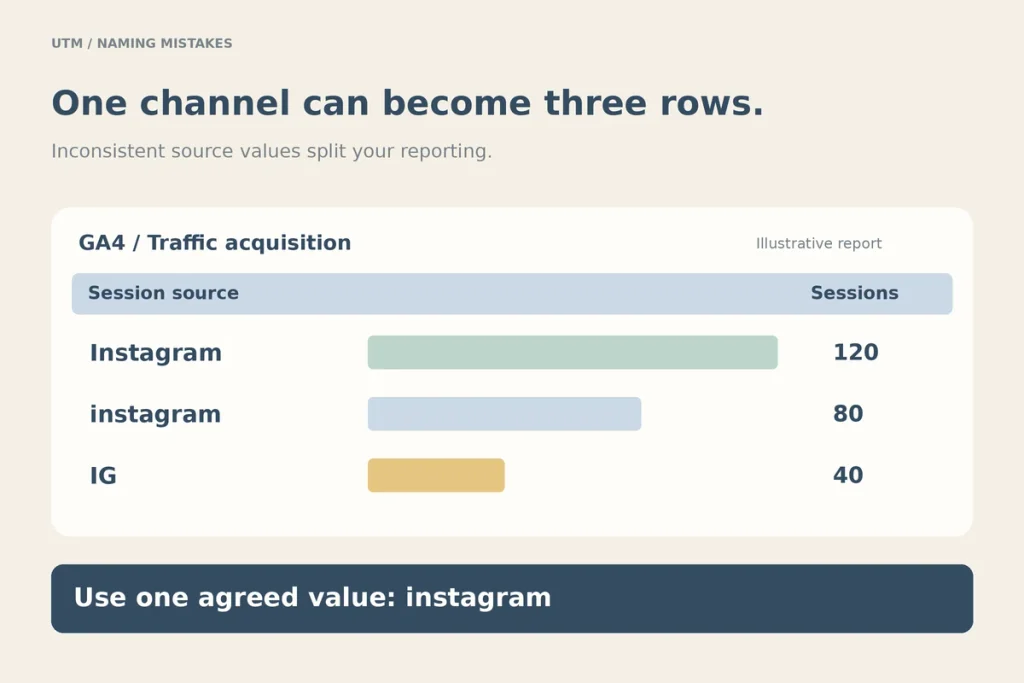
Inconsistent names. “IG”, “Instagram” and “instagram” become three sources.
Tagging internal links. UTM tags on links within your own site overwrite the real source. Don’t do it.
Missing the core three. Leads to “(not set)” in reports.
Personal data in UTMs. Never put names, phone numbers or emails in a URL.
Checklist
- Source, medium and campaign on every tagged link
- Lowercase and underscores only
- Fixed list of medium values
- Shared UTM sheet for the team
- No UTMs on internal links
- Test click checked in GA4 real-time
- No personal data in any parameter
Questions we get asked
What is the full form of UTM?
Urchin Tracking Module.
Do UTM parameters affect SEO?
Not in any meaningful way when used on external campaign links. Avoid adding them to internal links, and keep canonical tags pointing to the clean URL.
Do I need UTMs on Google Ads links?
Usually not, if Google Ads is linked to GA4 with auto-tagging on. Use UTMs for everything else.
Final thoughts
UTM tags are small, but they decide whether your channel reports are accurate. Agree a naming convention, tag every external campaign link, and check before you send. More in our guide to digital marketing terms.
Want your analytics set up so every channel gets fair credit? Book a consultation. You can reach out to us on whatsapp at +91 7738844851 .
More in Blog
Keep reading
All articles →

Ready to talk about your growth?
Tell us what's stuck and we'll tell you what we'd do first. Free, 30 minutes, no pitch.