
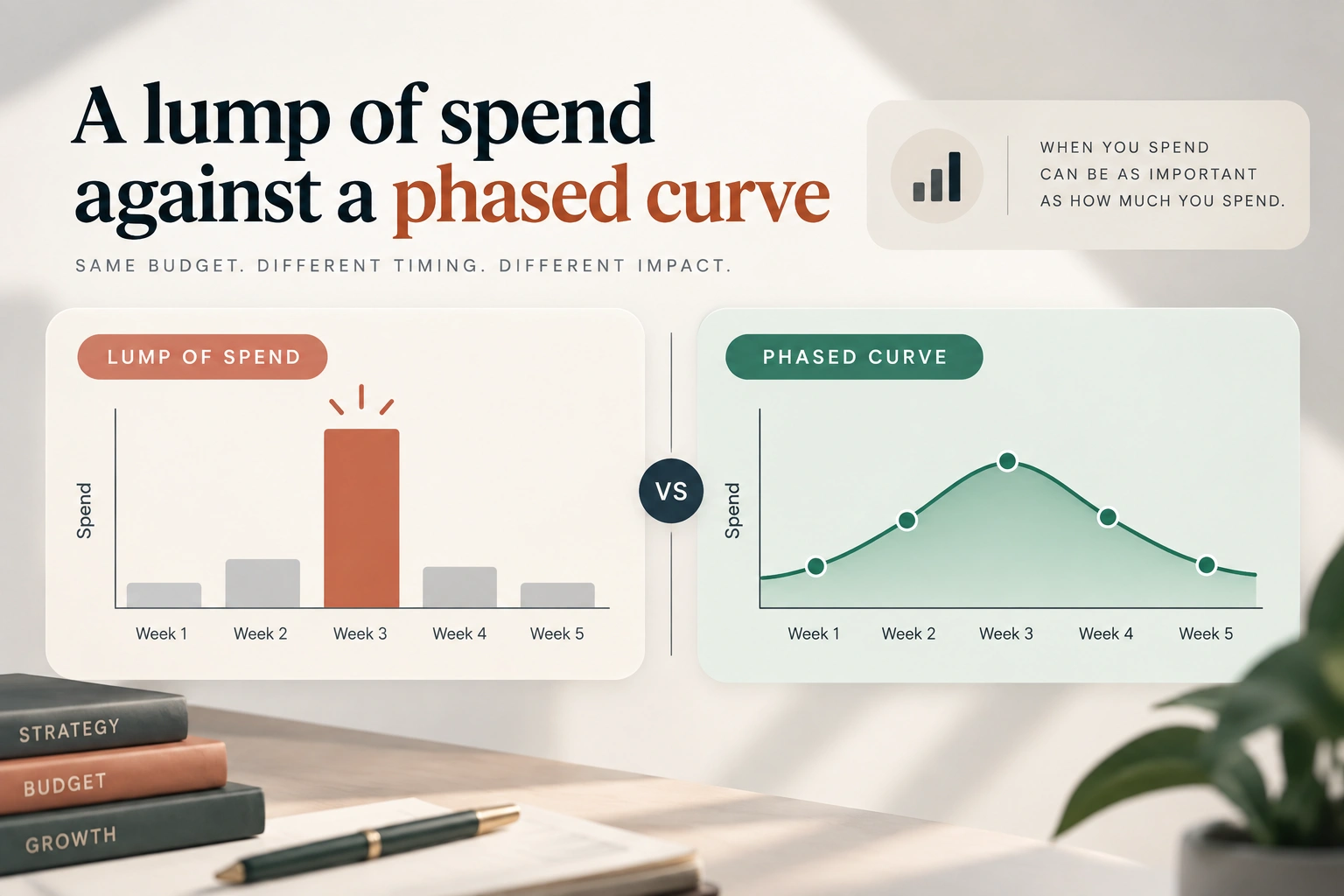
Most Indian festive budgets are held back and then spent hard across the peak fortnight, which is the most expensive way to buy the season. Arriving at the year’s most contested auction with no warm audiences and no recent conversion history means paying the highest prices of the year for the platform’s least informed delivery. The alternative is a three-phase shape: spend before the window at ordinary cost to build audiences and data, harvest inside it, and keep spending for a fortnight afterwards when competitors have switched off and remarketing is briefly the cheapest it will be.
The plan almost always looks the same. Nothing much happens in August. Budget is approved somewhere in September. It is then spent across two or three weeks in October or November, at whatever the auction demands.
Our festive pillar sets out what that auction does to costs, and what simply holding your existing position is worth in rupees.
What it does not cover, and what almost nobody plans around, is that the timing of the spend changes the price you pay for it.
Arriving cold is the expensive part
Think about what a platform knows about your account on the first day of the peak window if you have not spent since August.
No recent conversion history to optimise against. No warm audiences of any size. No signal about which creative works this season, which offer converts, or which segment responds.
So it does what it always does with a new or dormant campaign — it explores. Our paid media work covers how that process operates and why it costs money before it earns any, and we are not going to re-derive it here.
The difference at festive is that the exploration is happening at the highest prices of the year.
You are paying peak rates for the platform to learn things it could have learned in August at ordinary rates. That is the single largest avoidable cost in most Indian festive plans, and it does not appear as a line anywhere — it shows up as a disappointing first week that everybody attributes to competition.
Three phases, and most plans have one
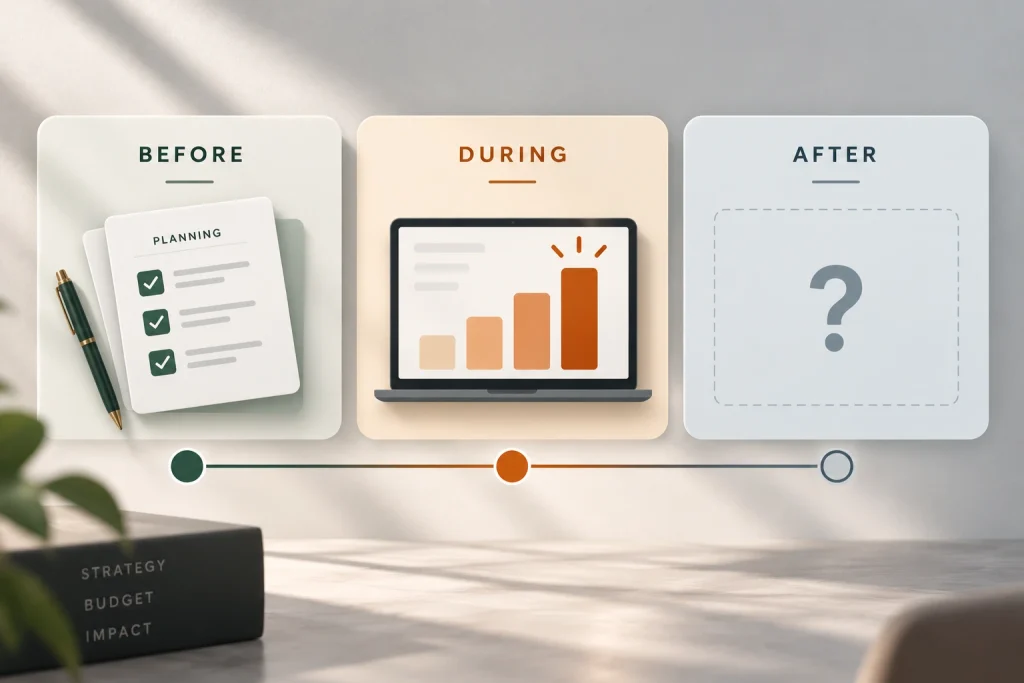
Before the window. Spend at normal cost, at whatever level is affordable, with the explicit objective of arriving warm. Audiences built, conversion history recent, creative already tested. This spend is not measured on its own return — it is measured on what the peak week costs afterwards, which is an uncomfortable thing to put in a proposal and the honest way to describe it.
Inside the window. Harvest. This is the phase every plan already has, and the only thing worth adding is that it should be aimed at the peaks your customers actually observe, per our calendar article, rather than at a single national fortnight.
After the window. Almost universally abandoned, which is exactly why it is worth having.
Everybody switches off within days of the festival. Competitive pressure collapses, and the audiences you built at peak prices are still there, still warm, and now reachable cheaply. For a fortnight, remarketing is about as inexpensive as it gets all year.
What you sell into that fortnight differs by business — a second purchase, a service attachment, a subscription, a review request. What you should not do is stop, and what happens next is the subject of a separate article on the January problem.
The approval calendar is the real blocker
Here is why almost no Indian business runs the plan above, and it is not a media problem.
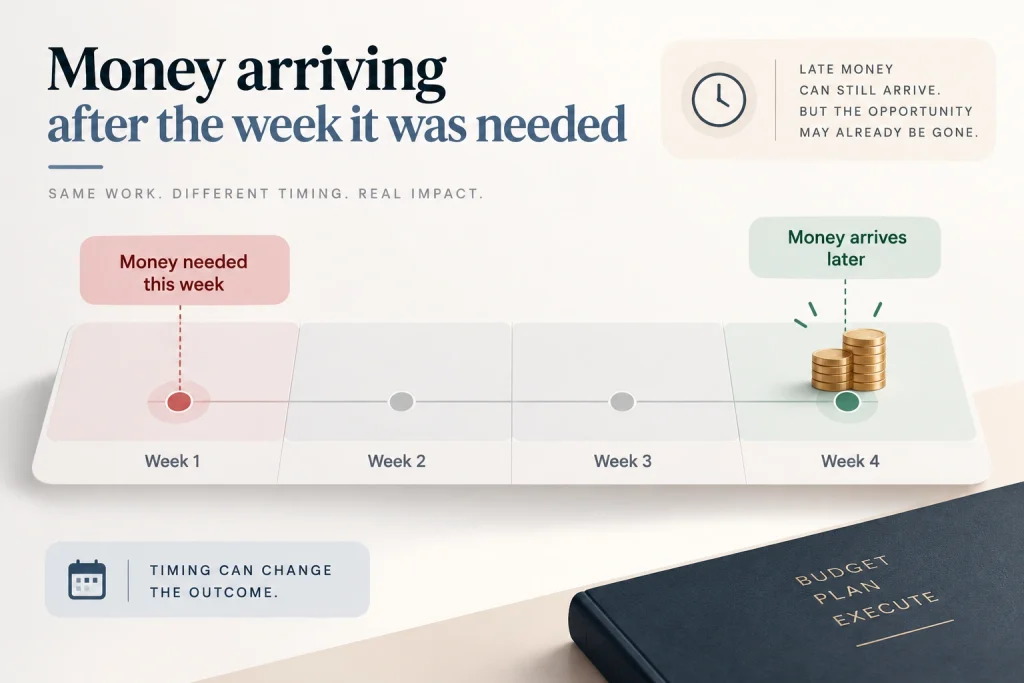
Festive budgets are approved in September for an October peak. Sometimes later. The pre-window spend — the phase that makes the peak affordable — needs to happen in July and August, which is before the money exists.
So the correct plan is unfundable by construction, and the marketing team is not being stupid. They are being paid on a calendar that prevents the thing they know they should do.
Which makes this a conversation with finance rather than with an agency, and it is worth having in April.
The argument that works is not a media argument. It is that a smaller total, released earlier, buys more than a larger total released late — and that is a claim you can evidence from one season’s own data by comparing the cost per acquisition in the pre-window against the peak week.
Run that comparison this season specifically so you can put it in front of somebody next April.
Pacing inside the window, which is where money leaks
A narrower failure, common enough to name.
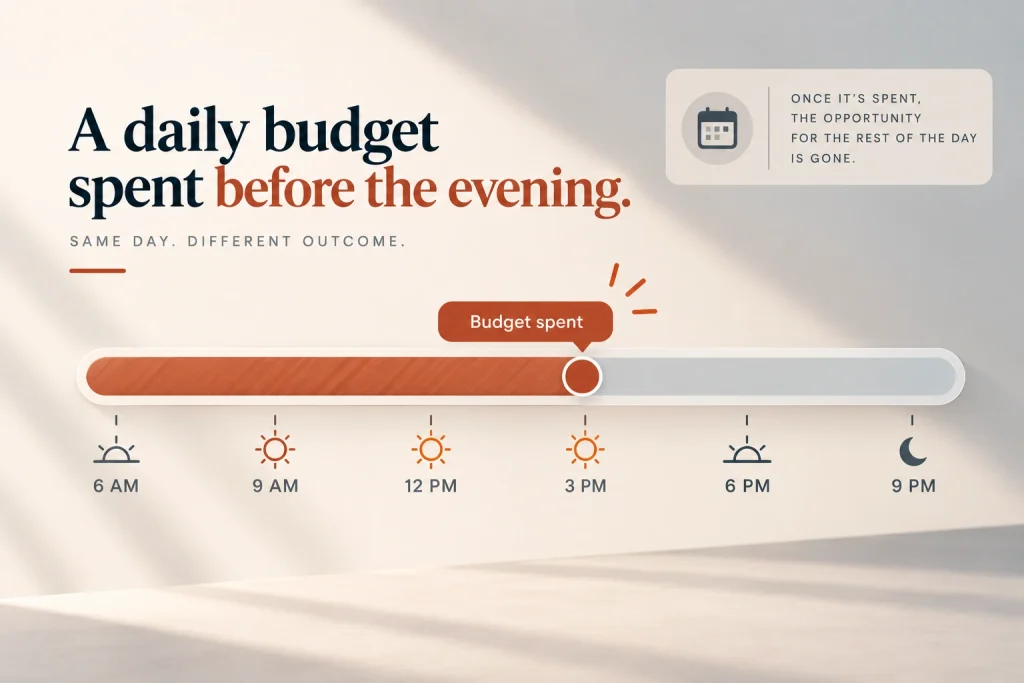
A daily budget set for ordinary conditions is exhausted early on a peak day, because costs and volumes are both higher. The campaign then stops delivering by the middle of the afternoon.
Indian buying in these windows skews heavily to evenings and late nights — after work, after the family has eaten, on a phone. So a budget spent by four in the afternoon has bought the least valuable hours of the highest-value day.
Two things to do about it. Raise the daily figures before the peak days rather than during them, because a mid-day increase disrupts delivery precisely when you need it stable. And use whatever scheduling the platform offers to weight spend toward the hours your own data shows converting, which is a question your account can answer and no article can.
The platforms also provide mechanisms for signalling an expected change in conversion rate around a known period. They are worth using and they are not a substitute for having the money available.
Hold a reserve, and mean it
Most Indian festive plans allocate every rupee before the season starts.
Then something works better than expected and something breaks, and the response is to rob one campaign to feed another mid-season — which disrupts both and usually happens on the worst possible day.
Hold back a fixed proportion, unallocated, decided in advance. The number matters less than the discipline. It exists so that a campaign performing unexpectedly well can be funded without dismantling one that is merely performing.
The reserve should also cover the thing nobody plans for: needing to advertise less. If capacity becomes the constraint — the subject of the next article in this cluster — the correct move is to slow spending, and that is easier when the plan was not already committed to the last rupee.
What to cut when the budget is fixed
The question everybody actually faces, and the answer that runs against instinct.
When the number is smaller than the plan, businesses cut the pre-window phase. It is the easiest to cut, because it has no visible return attached to it and nobody has to defend removing something that was not obviously working.
Cut the peak-week ambition instead.
A smaller, warm, well-optimised presence across the peak outperforms a larger, cold, exploring one — and if you cannot afford both the preparation and the ambition, the preparation is what makes the remaining money work.
The version of this that fails every year is a business that spends nothing until October, spends everything in a fortnight, gets a poor result, and concludes that festive advertising does not work for them.
What we cannot tell you
We cannot tell you a split between the three phases. It depends on your category, your cycle and what your account already holds, and any percentage quoted to you is somebody else’s plan.
We cannot tell you what the peak will cost. Our pillar gives the shape of the increase and the arithmetic behind it; the specific number is yours to measure.
And we cannot tell you how early is early enough. The honest answer is that the pre-window phase needs to be long enough for the platform to have recent data when the window opens, which is a matter of weeks rather than days.
Final thoughts
Stop treating the festive budget as an amount and start treating it as a schedule.
Spend something in the cheap weeks so the expensive one is affordable. Keep spending for a fortnight after everybody else stops. And have the conversation with finance in April, because a September approval makes the correct plan impossible before anybody has written a brief.
If you want the phasing built against your own account’s numbers, you can reach out to us on whatsapp at +91 7738844851 .
More in Blog
Keep reading
All articles →

Ready to talk about your growth?
Tell us what's stuck and we'll tell you what we'd do first. Free, 30 minutes, no pitch.