
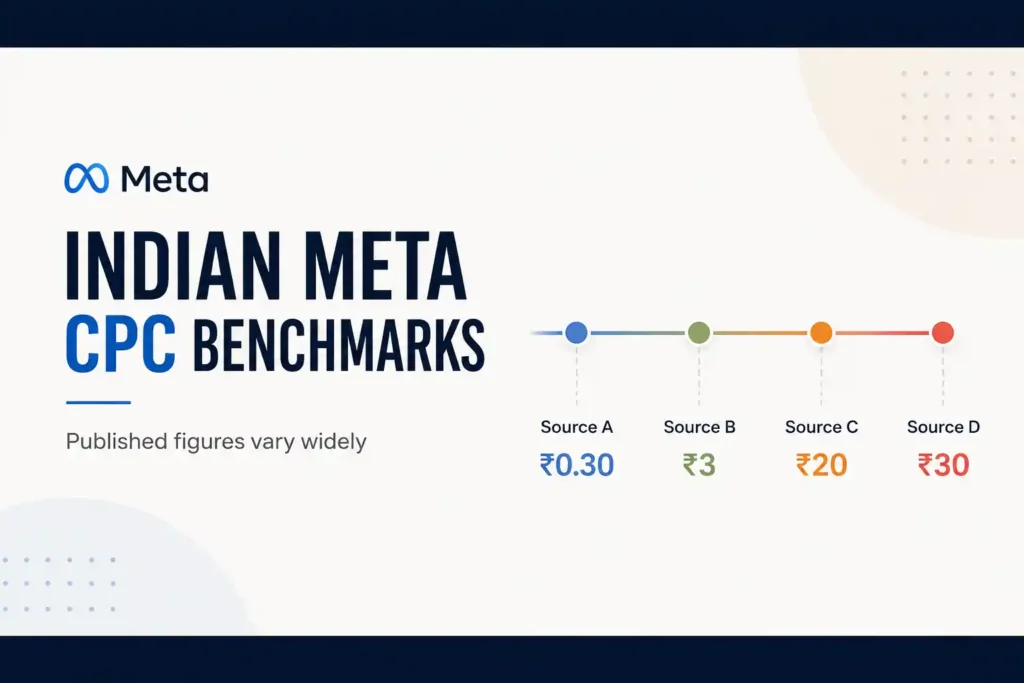
Four articles ranking for this question give four answers for Indian cost per click. ₹2 to ₹25. ₹0.50 to ₹8. ₹1 to ₹3. Somewhere above ₹6 for Instagram.
The widest of those is a fifty-fold spread, and none of them states a sample size, a date range or how the figure was calculated.
That is not sloppiness. It is a category error, and once you see it the whole question changes shape.
The short answer
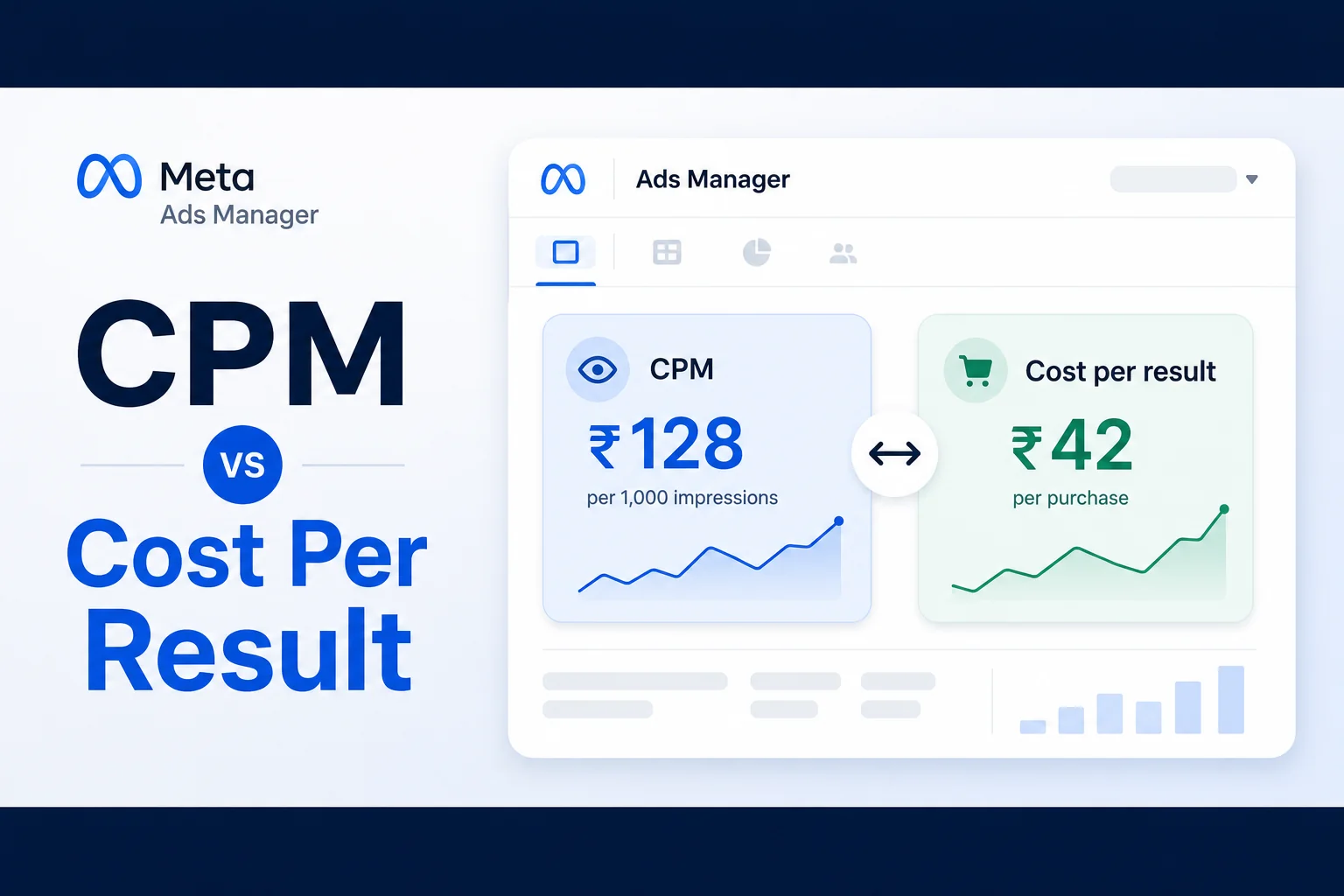
Meta prices impressions, not clicks. CPM is what the auction charges you; your cost per click is CPM divided by how many people clicked, which is a fact about your creative rather than about the market. Reported Indian CPMs cluster loosely between ₹30 and ₹400 depending on source, industry and placement. Beyond that, published cost-per-click and cost-per-lead figures describe other advertisers’ performance and cannot be used as a budget.
Key takeaways
- CPM is the price. CPC is an output. You buy impressions and receive clicks.
- Cost per result = CPM ÷ (1000 × CTR × conversion rate). Only the first term belongs to the auction.
- At a fixed CPM, doubling click-through halves cost per click. That is where the money is.
- Published Indian figures disagree by up to fifty times because they are measuring creative quality and calling it price.
- A budget too small to exit the learning phase inflates costs in a way no benchmark predicts.
What the published figures actually say
Worth putting side by side, because the disagreement is the evidence.
Cost per click. One Indian agency guide reports ₹2 to ₹25. Another reports ₹0.50 to ₹8. A third puts ecommerce at ₹1 to ₹3. Instagram is separately reported at ₹6 to ₹55.
Cost per thousand impressions. ₹50 to ₹400 on one page, ₹30 to ₹200 on another. Instagram CPM reported at ₹45 to ₹350.
Cost per lead. ₹100 to ₹2,000, with high-value categories — real estate, B2B software, premium education — reported at ₹300 to ₹1,000 and above.
Lebesgue publishes ecommerce CPM benchmarks drawn from connected advertiser accounts, which is the only figure here with a stated scope. Everything else appears without methodology.
Take the ranges as a rough sense of order of magnitude and nothing more. An Indian CPM is tens to low hundreds of rupees. That is genuinely all these figures can tell you.
The CPM Chain
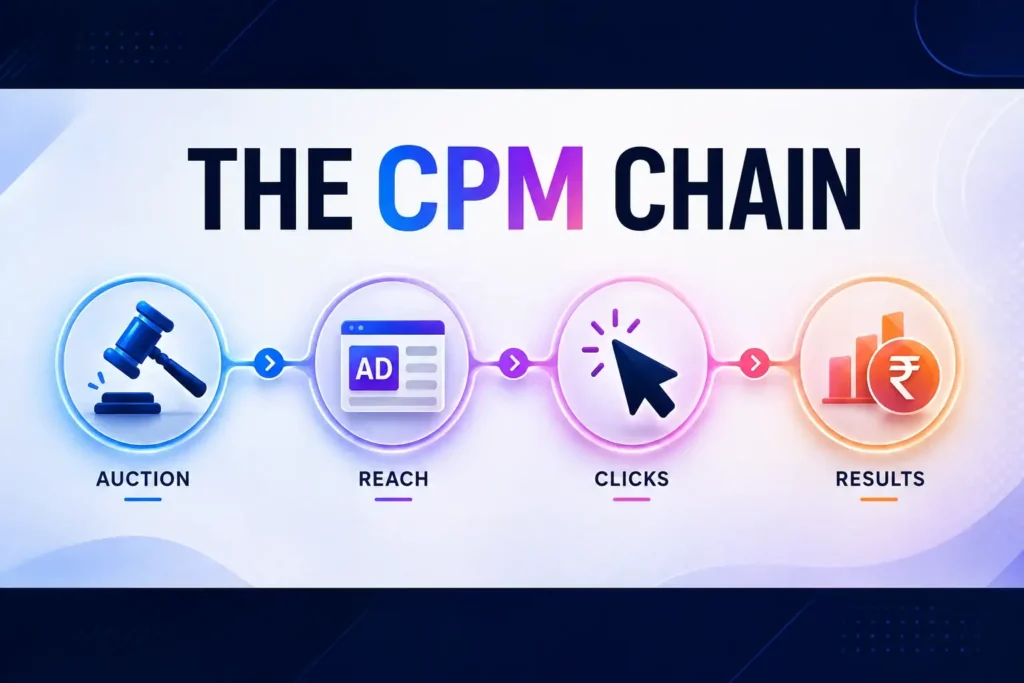
Meta sells impressions. Everything downstream of that — your cost per click, cost per lead, cost per sale — is the auction price divided by your own performance. Only one number in the chain is the market. The rest is you.
The formula, and it is short:
Cost per result = CPM ÷ (1000 × CTR × conversion rate)
Work through it once with real numbers.
CPM of ₹200 buys a thousand impressions. At a 1% click-through rate that is ten clicks, so cost per click is ₹20. If one in ten of those clicks converts, cost per result is ₹200.
Now change one thing. Hold CPM at ₹200 and lift click-through to 2%. Twenty clicks, cost per click ₹10, cost per result ₹100.
The auction charged you exactly the same amount. Your cost halved.
Lift conversion rate from 10% to 20% as well and cost per result falls to ₹50 — a quarter of where you started, with no change in what Meta charged.
This is why benchmark hunting is a waste of an afternoon. Two Indian advertisers in the same category, buying the same impressions at the same CPM, can have costs per lead four or five times apart. Both figures are real. Neither is a market rate.
What actually moves CPM
CPM is the part you do not control directly, so it is worth knowing what shifts it.
Audience size and competition. Narrow, valuable audiences cost more per impression because more advertisers want them. Broad audiences are cheaper — which, since targeting became largely advisory, is now the usual recommendation anyway.
Placement. Reels and Stories inventory is generally cheaper than feed. Reported differences vary and come from agency observation rather than published Meta data, so treat specific percentages with suspicion while accepting the direction.
Objective. Conversion campaigns cost more per impression than reach or traffic campaigns, because Meta is doing more work to find people likely to convert.
Season. Indian CPMs rise sharply during the festive period from roughly October through Diwali, and again in wedding season. If you are comparing this month against last, check whether you are comparing seasons.
Whether you are in the learning phase. An ad set that has not exited learning delivers less efficiently, and costs during that period are not representative of anything. Meta’s learning phase needs roughly 50 optimisation events per ad set within a rolling seven days. If your budget cannot produce that, you will pay learning-phase prices permanently — a structural cost that no benchmark on any of those ranking pages accounts for. Whether your budget can fund a platform properly covers the arithmetic.
What actually moves the rest of the chain
Which is where the money is.
Creative quality drives click-through, and click-through drives cost per click directly. Since Meta’s targeting changes reduced detailed targeting to a suggestion, creative has become the main instrument an advertiser still controls — why creative now does the work targeting used to covers that shift.
Creative fatigue works in reverse. The same asset shown repeatedly loses click-through, so your cost rises without the auction changing. A campaign that “got more expensive” in month three is usually a creative problem misdiagnosed as a market problem.
Landing page or form conversion rate is the second multiplier, and it is the one most advertisers never test. Halving your form abandonment does exactly as much for cost per lead as halving your CPM, and it is considerably easier.
Offer strength sits underneath both. No creative rescues a proposition nobody wants, and the cost per result will tell you so before your sales team does.
What a budget should actually be
Not “₹500 a day because someone said so.”
Work backwards from what a customer is worth. Take your average order value, apply gross margin, apply close rate. That gives you a maximum acceptable cost per lead — working out what a lead is actually worth sets out the arithmetic with a calculator.
Then check the learning threshold. Multiply your target cost per result by roughly 200. That is the monthly spend one ad set needs to produce enough events to learn from.
If your maximum acceptable cost per lead is ₹500, one ad set needs around ₹1,00,000 a month to exit learning reliably. Below that you can still advertise — you simply cannot expect stable, optimised performance, and you should not benchmark yourself against advertisers who have it.
Two things follow. Fewer ad sets, so the data concentrates. And a realistic minimum: if the arithmetic says you cannot feed one ad set, adding a second guarantees neither works.
Mistakes that cost real money
Benchmarking against a published CPC. It describes creative you have never seen.
Comparing months across a season. Festive CPMs are not a performance decline.
Reading learning-phase costs as normal costs. They are not, and they never settle if the budget cannot clear the threshold.
Blaming CPM for a creative problem. Rising cost per click with flat CPM is fatigue, not pricing.
Optimising CPM downward by broadening endlessly. Cheap impressions in front of the wrong people are still wasted, and cost per result is the only figure that matters.
Ignoring conversion rate entirely. It sits in the same formula as CPM and is usually easier to move.
When cost is the wrong thing to be looking at
When you are below the learning threshold. Fix the budget structure or reduce ad sets before analysing costs that were never going to be stable.
In the first fortnight. Early figures are learning-phase figures.
When the offer is the problem. A weak proposition produces expensive results on every platform, and no amount of optimisation reads as anything other than “the ads are not working.”
When your follow-up is slow. A ₹300 lead nobody calls for two days is more expensive than a ₹900 lead answered in ten minutes. Why frictionless forms produce unqualified leads covers the quality side of the same problem.
The cost checklist
☐ Maximum acceptable cost per lead calculated from margin and close rate
☐ Monthly spend per ad set checked against roughly 200 results
☐ Ad set count reduced to what the budget can feed
☐ Current CPM, CTR and conversion rate recorded as a baseline
☐ Cost per result recalculated using the formula rather than taken from a benchmark
☐ Creative refresh cadence agreed before fatigue sets in
☐ Landing page or form conversion rate tested at least once
☐ Seasonal comparison avoided — compare like periods
☐ Learning phase status checked before drawing conclusions
☐ Placement performance reviewed, with Reels and Stories tested against feed
☐ Cost per result, not CPM, used as the headline metric
☐ One review interval agreed, no shorter than a fortnight
Questions we get asked
How much do Facebook ads cost in India?
CPM in the tens to low hundreds of rupees, depending on audience, placement, objective and season. Beyond that, your cost per click and cost per lead depend on your creative and your conversion rate, which is why published figures vary so widely.
What is a good CPM in India?
The wrong question, mostly. A low CPM with poor click-through produces expensive results. Judge cost per outcome and treat CPM as one input.
What is the minimum budget for Meta ads?
Enough to produce roughly 200 optimisation events a month in one ad set at your expected cost per result. Multiply your target cost per lead by 200 and you have your floor.
Why did my Meta ads suddenly get more expensive?
Check three things in order: whether creative has fatigued, whether you are in a seasonal peak, and whether a recent change restarted the learning phase.
Are Instagram ads cheaper than Facebook ads?
Reported CPMs differ, but both run through the same auction and the same Ads Manager. Placement performance varies by audience and creative format, so test rather than assume.
Is Meta cheaper than Google in India?
Per impression, almost always. Per acquisition, it depends on whether your buyer is already searching. What Google Ads costs in India, and why it is priced differently covers the other side.
Three numbers, ten minutes
Open Ads Manager and note your CPM, your click-through rate and your conversion rate.
Put them through the formula. Then change one — imagine your click-through doubling — and look at what happens to cost per result.
That exercise tends to end the search for a benchmark, because it shows that the number you were hunting for would not have told you anything you could act on. Your costs are mostly a description of your own creative and your own conversion rate, priced by an auction you influence only at the edges.
If you would like the arithmetic run against your account, and an honest view of whether your budget can support what you are asking of it, you can reach out to us on whatsapp at +91 7738844851 .
More in Blog
Keep reading
All articles →


Ready to talk about your growth?
Tell us what's stuck and we'll tell you what we'd do first. Free, 30 minutes, no pitch.