
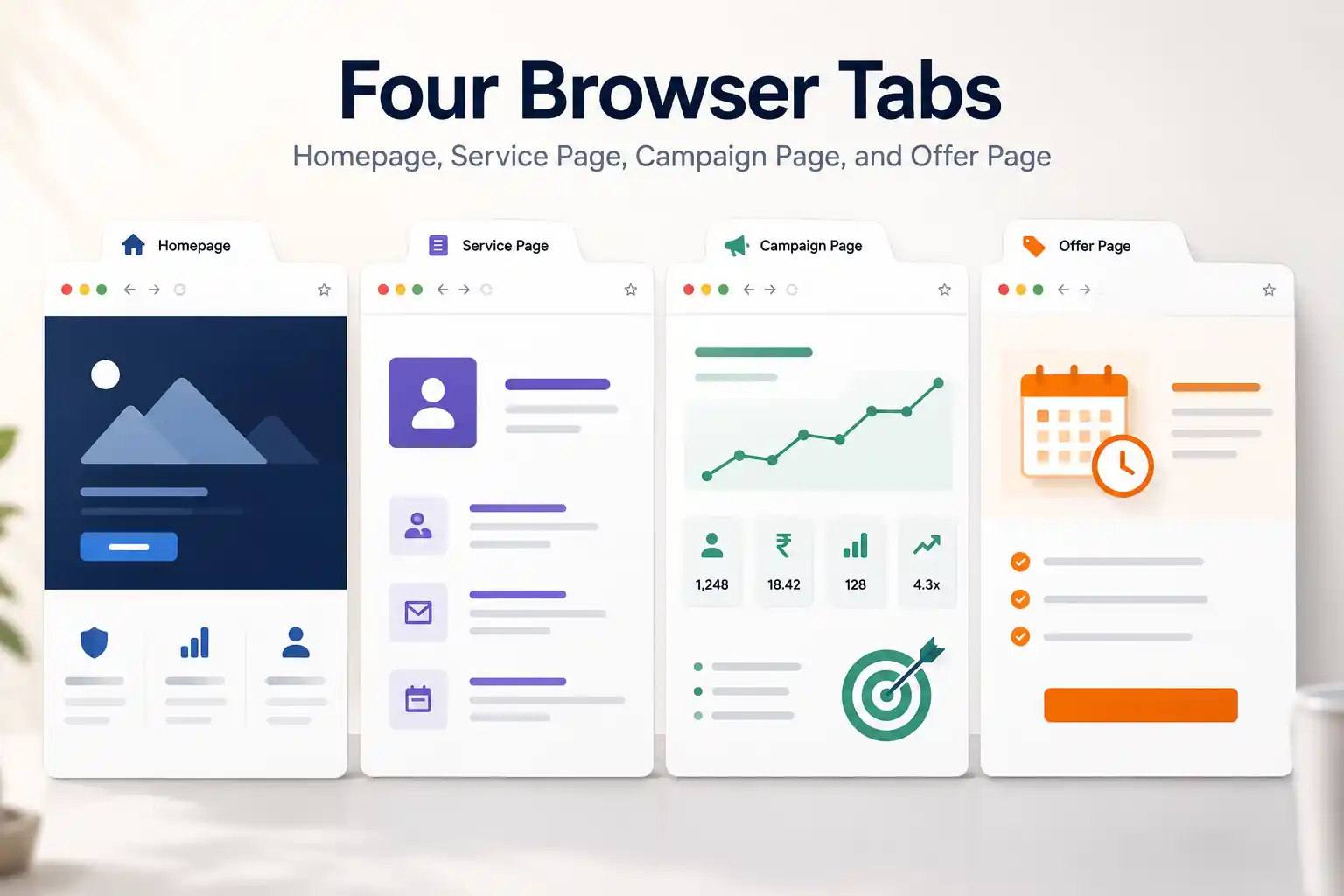
The question is usually posed as a choice between two things. It is not, and the framing is why so many businesses end up with the wrong answer.
Between your homepage and a purpose-built campaign page sit two other options, and for a lot of Indian businesses one of those middle options is the right destination — not because it converts best in theory, but because it is the one that will still be accurate in six months.
The short answer
A landing page is a single page built for one campaign with one action and usually no navigation. A website is a connected set of pages built for exploration. But the real choice has four positions: your homepage, an existing service or product page, a campaign landing page, and a dedicated offer page. Paid traffic almost never belongs on the homepage. Beyond that, the right destination depends on how specific the visitor’s next action is and, just as importantly, on what your team can keep current.
Key takeaways
- Four destinations, not two. Homepage, service page, campaign page, offer page.
- Google scores your landing page and charges you accordingly. Landing page experience is one of three documented Quality Score components.
- Paid traffic on a homepage is the most common and most expensive destination error.
- A stale landing page loses to a maintained service page. Maintenance capacity is a real input, not an excuse.
- Landing pages sit outside your site structure and contribute little to organic performance. That is a cost, not a detail.
Why the binary framing fails
Most articles on this question are published by companies that sell landing page builders. Their answer — build landing pages, they convert better — follows from what they sell, and it is not wrong so much as incomplete.
Two things go missing.
The first is that a service page and a homepage are not the same thing, and most businesses already have service pages that would do the job with minor changes. Treating “website” as a single option hides the destination that is often correct.
The second is cost after launch. A landing page is a separate artefact. It lives outside your site’s navigation, is frequently built in a different tool, and nobody’s routine work touches it. Six months later the campaign has ended, the offer has changed, the team has moved on, and the page is still live and still wrong.
That page is worse than a plain service page somebody updates. No builder will publish that sentence, and it is the most useful thing to know before commissioning one.
The Four Destinations
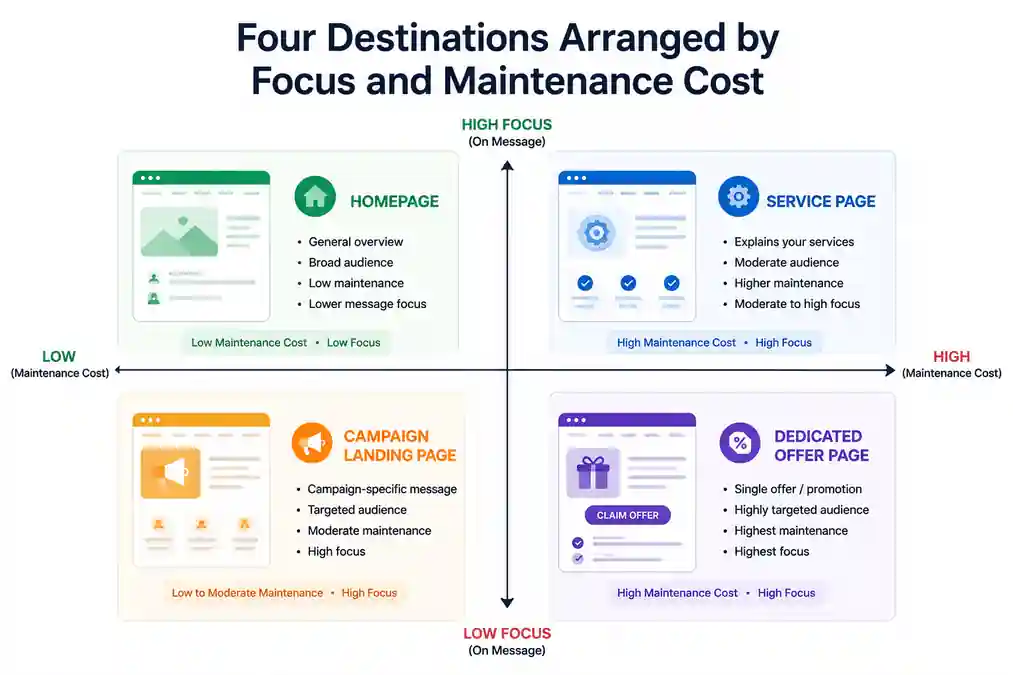
Between your homepage and a purpose-built offer page sit two other options. The right destination is the one that matches how specific the visitor’s next action is — bounded by what your team will actually keep current.
1. The homepage
What it is for. People who already know your name and typed it, or who arrived from a referral and want to work out what you do.
What belongs here. Brand searches, direct traffic, offline referrals.
What does not. Paid traffic from a specific ad. Someone who clicked an ad about industrial water chillers should not arrive at a page listing eleven services.
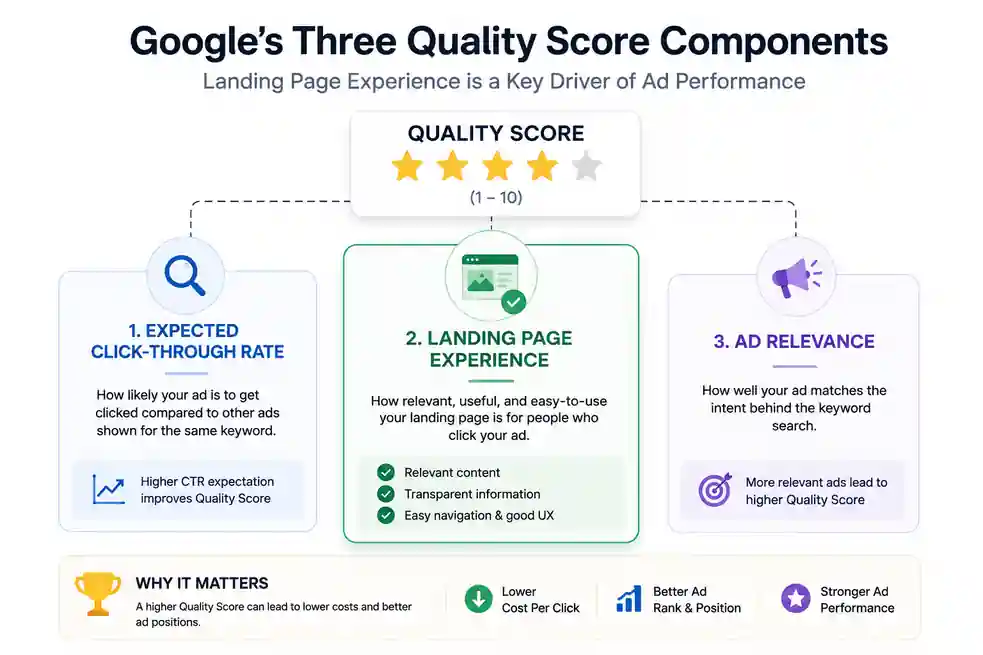
The failure mode. The visitor has to re-find what the ad promised. Most will not, and Google notices — landing page experience is one of three documented components of Quality Score, alongside expected click-through rate and ad relevance. Google assesses content relevance, page speed, mobile experience and navigability. A poor match therefore raises what you pay per click as well as lowering what you convert.
Maintenance cost. Already being maintained. That is its advantage.
2. An existing service or product page
The destination most often overlooked, and frequently the right one.
What it is for. Traffic about a specific thing you sell, where the visitor may still want to look around before acting.
What belongs here. Search traffic on service-specific keywords. Warm audiences. Anyone likely to compare you against alternatives before enquiring.
Why it is underrated. It already exists, it already ranks, it is already in your navigation, and somebody updates it because it is part of the site. The marginal work is adding a clear action and matching the headline to the ad.
The failure mode. Too many exits. A service page with navigation, a blog feed and three unrelated calls to action leaks visitors who arrived ready to act.
Maintenance cost. Low. It is maintained as part of the site.
3. A campaign landing page
What it is for. A specific campaign with a specific offer where the visitor’s next action is singular and known.
What belongs here. Cold paid traffic on a defined proposition. Seasonal promotions. A single service you are actively selling.
Why it converts better. No navigation, no competing actions, message matched to the ad, and everything on the page serving one decision.
The failure mode. It outlives the campaign. This is the most common landing page problem in practice and it is invisible until someone audits.
Maintenance cost. Real and recurring, and usually unowned. Decide who updates it and when before you build it. If the answer is nobody, choose destination two.
4. A dedicated offer page
What it is for. One offer, one audience, usually one traffic source. A webinar registration, a specific downloadable, a limited proposition.
What belongs here. Traffic from a single campaign with a genuinely singular action and a defined end date.
Why it is separate from destination three. A campaign page can serve several ad groups and outlive one promotion. An offer page exists for one thing and should be taken down or redirected when that thing ends.
The failure mode. Proliferation. Businesses accumulate dozens of these, none of them linked, none maintained, several contradicting each other on price.
Maintenance cost. Highest, and the shortest useful life. Plan the removal at the same time as the build.
What actually decides it
Four inputs, in the order they matter.
How specific is the next action? If there is exactly one thing you want the visitor to do and they need no further information to do it, move toward destinations three and four. If they need to understand or compare first, destination two.
Where is the traffic from? Paid traffic from a specific ad needs a matched destination — for the conversion and for the Quality Score. Organic and brand traffic can land on the site proper. Around 5% of B2B buyers are in market at any moment, per Ehrenberg-Bass research for the LinkedIn B2B Institute, which means most visitors are not ready to act and exploration is not always a leak.
Who will maintain it? Name the person before you build. If nobody owns it, do not create a page outside the site — the cost arrives later and quietly.
Does it need to earn organic traffic? Standalone landing pages usually sit outside your site structure, are not linked from navigation, and accumulate little authority. If you want the page to rank as well as convert, destination two is the honest answer.
The trade nobody quantifies
Landing pages convert better. Vendor-published figures put the difference substantially in their favour, though those comparisons come from companies selling the tools and rarely state what the alternative page looked like.
Take the direction as sound. A page with one action and no navigation converts better than a page with eleven links. That is not controversial.
The part that is missing is time. Compare a landing page in its first three months against a service page and the landing page wins. Compare the same two in month fourteen, when the campaign has ended and the offer has changed, and the comparison often reverses — because one of them has been updated eleven times and the other has not been touched.
For a business with a marketing team of one, which describes a great many Indian SMEs, that is the decisive consideration and it never appears in the comparison articles.
Speed and mobile apply to all four
Whatever destination you choose, two things are non-negotiable.
It must render fast on a mid-range phone on mobile data. Google’s Core Web Vitals threshold for a good Largest Contentful Paint is 2.5 seconds, and page speed is explicitly part of how landing page experience is assessed.
It must work on a phone first. Most Indian traffic is mobile, and a page designed on a laptop that happens to be responsive is not the same as a page designed for a phone.
Once the destination is chosen, how to find which problem to fix first covers diagnosing whether it actually works.
Mistakes that cost real money
Sending paid traffic to the homepage. The most common destination error, and it costs twice — in conversion and in Quality Score.
Building a landing page nobody owns. It will be wrong within a year and still receiving traffic.
Assuming you need a new page when a service page would do. Often the cheapest improvement available is adding a clear action to a page that already exists and already ranks.
Building landing pages in a tool the client cannot edit. A page that requires an agency to change is a page that will not be changed.
Accumulating offer pages without a removal plan. Twelve orphaned pages contradicting each other on price is a worse problem than any conversion rate.
Judging destination choice on conversion rate alone. Over a year, maintenance decides more than layout.
When none of this is the problem
When the traffic is wrong. A poorly converting page fed by broad, untargeted keywords is a targeting problem — what Google Ads cost in India covers the spend side.
When the offer is uncompetitive. No destination fixes a proposition the market has priced against.
When follow-up is slow. The page produces the enquiry. What happens in the next hour decides whether it was worth anything.
When you have one page and no traffic. Build the traffic first. Destination optimisation is a problem you earn.
The destination checklist
☐ Traffic source identified for each campaign — paid, organic, brand, referral
☐ Next action defined, and confirmed as singular or exploratory
☐ Existing service pages reviewed before commissioning anything new
☐ Paid traffic confirmed as not landing on the homepage
☐ Ad headline and destination headline compared side by side
☐ Named owner assigned for any page built outside the site
☐ Update schedule agreed before build, not after
☐ Removal or redirect date set for any offer page
☐ Editing access confirmed as available to the client, beyond the agency
☐ Organic value decided — does this page need to rank, or only convert
☐ Largest Contentful Paint measured against the 2.5-second threshold
☐ Page reviewed on a mid-range phone on mobile data
Questions we get asked
What is the difference between a landing page and a website?
A landing page is one page for one purpose, usually without navigation. A website is a connected set of pages built for exploration. The useful distinction is that a landing page removes choices and a website offers them.
Should I send Google Ads traffic to my homepage?
Almost never. Landing page experience is one of three components Google uses to assess Quality Score, so a mismatch costs you in what you pay as well as what you convert.
Do I need a landing page if I have a website?
Often not. A service page with a clear action and a matched headline does the job for a lot of campaigns, and it is already being maintained.
Is a landing page good for SEO?
Standalone landing pages usually sit outside your site structure and earn little organic authority. If the page needs to rank as well as convert, use a page inside the site.
How many landing pages do I need?
As many as you can keep accurate. Businesses routinely build more than they can maintain, and an out-of-date page costs more than the one you did not build.
Can I use my landing page builder for everything?
You can, and then your site lives in two systems with two designs and two update processes. That is a real cost worth weighing before starting.
Before you commission anything
Open the service page you already have for whatever you are about to advertise.
Read it beside the ad you intend to run. If the headline broadly matches and there is one obvious action, you may not need a new page — you may need twenty minutes of edits to a page that already exists, already ranks and is already somebody’s job to keep current.
If it does not match, or the action is buried among four others, then build the campaign page. And before you do, write down who updates it and on what date it comes down.
That second sentence is the one most businesses skip, and it is the one that decides whether the page is still working next year.
If you would like a view on where your campaign traffic should land, and whether your existing pages could do the job, you can reach out to us on whatsapp at +91 7738844851.
More in Blog
Keep reading
All articles →
Ready to talk about your growth?
Tell us what's stuck and we'll tell you what we'd do first. Free, 30 minutes, no pitch.