
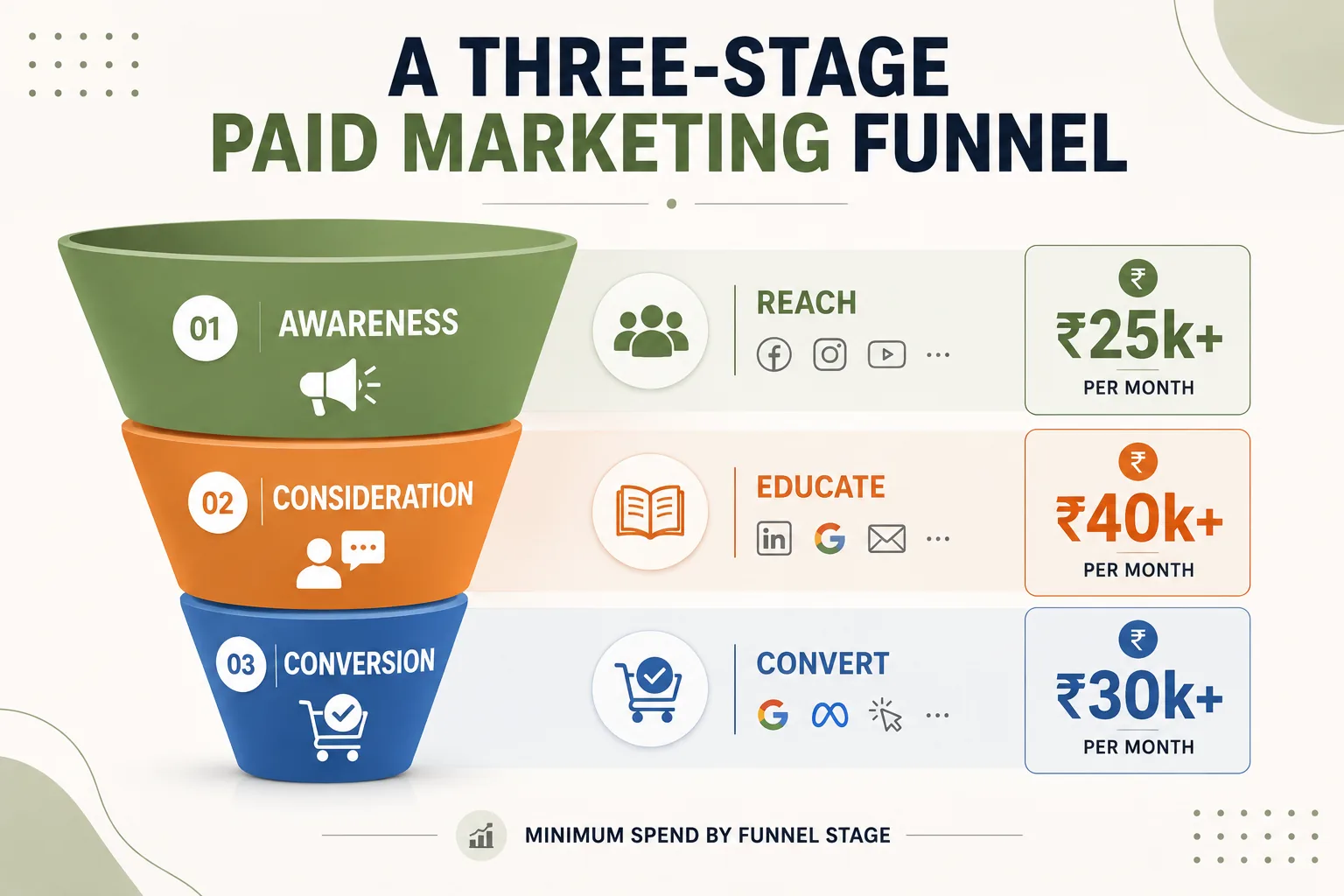
Search this topic and you will find the same article eight times. Awareness, consideration, decision. A list of tactics under each. A list of metrics under each. Occasionally a fourth stage for loyalty.
All of it correct. None of it answers the question the reader actually has, which is whether their budget can support the thing being described.
The short answer
A performance marketing funnel splits paid spend across stages of buyer readiness — reaching people who do not know you, engaging people comparing options, and converting people ready to act. Each stage has a minimum monthly spend, set by the price of the event it optimises for multiplied by the volume the platform needs to learn. Meta’s ad sets need roughly 50 optimisation events a week. Google’s automated bidding needs at least 30 conversions in 30 days. Below those numbers a stage does not learn, and adding it makes the account worse.
Key takeaways
- Every stage has a floor, and the floor is set by the optimisation event, not by the stage’s position in the funnel.
- Meta requires roughly 50 optimisation events per ad set per week — about 217 a month — before delivery stabilises.
- Google’s Target CPA needs at least 30 conversions in 30 days; Target ROAS needs 50.
- The same three stages can cost ₹1.75 lakh or ₹4.56 lakh a month on identical media rates, depending only on which event each stage optimises for.
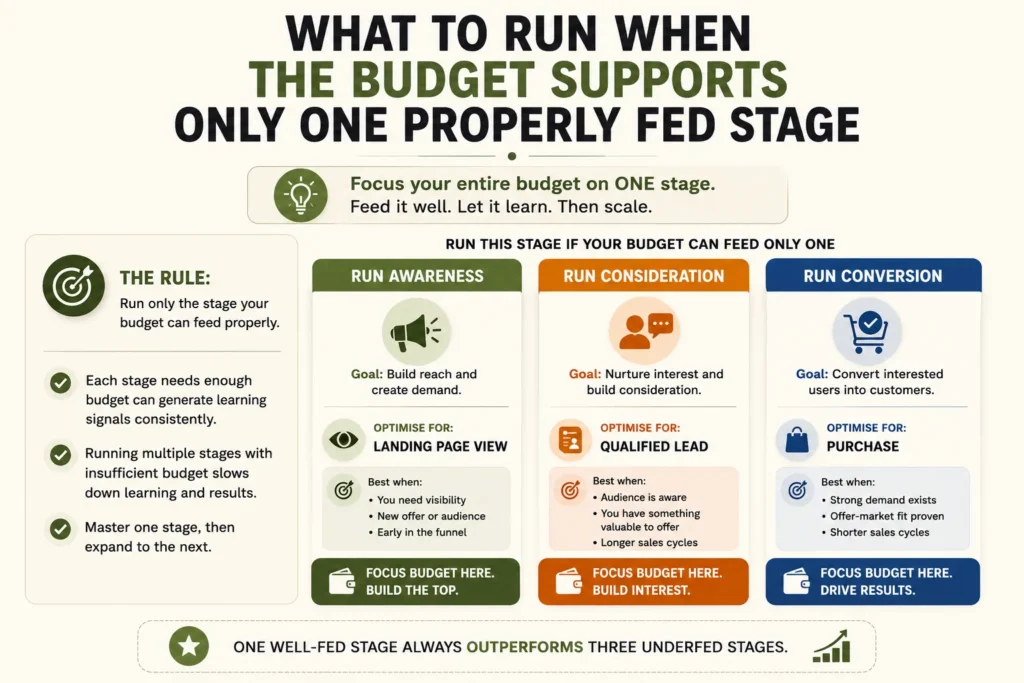
- Below the floor, one well-fed stage beats three starved ones. Every time.
- The performance claims circulating on this topic have no sources. We have not used them and neither should you.
What the guides get wrong before they start
The stage catalogue assumes the structure is free. It is not.
Every campaign, ad set and bid strategy you add divides the same conversion volume into smaller pieces. Platforms do not optimise on strategy. They optimise on data, and data arrives one conversion at a time.
Split a small budget across three stages and you get three campaigns that never leave the learning phase. Delivery stays erratic, costs stay high, and the reports stay unreadable because no cell in the table has enough events to mean anything.
The funnel is not wrong. It is priced, and nobody prices it.
The Stage Floor
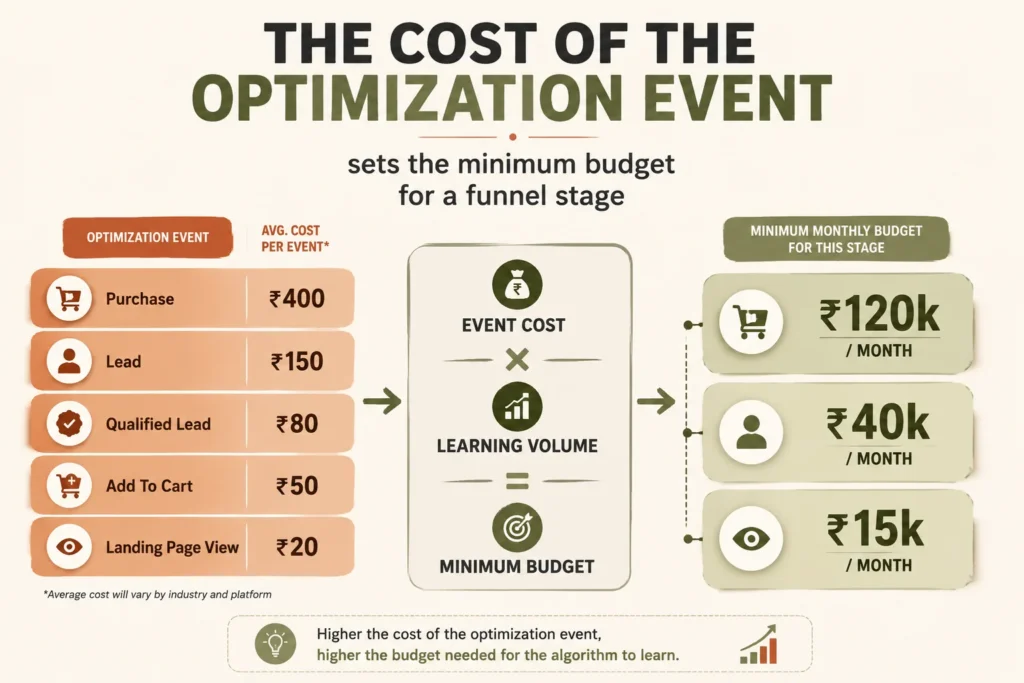
Every funnel stage costs the price of its optimisation event multiplied by the volume the platform needs to learn. Choose the event and you have chosen the floor.
Two published numbers set the multiplier.
Meta. An ad set needs approximately 50 optimisation events per week to exit the learning phase and deliver stably. Over a month that is around 217 events.
Google. Target CPA needs at least 30 conversions in 30 days. Target ROAS needs 50. Below those, automated bidding is guessing with your money.
Multiply either by what one event costs you and you have that stage’s minimum monthly spend. Not a recommendation — a floor. Spend less and the stage cannot function regardless of how good the creative is.
The part almost nobody says out loud: the price of an event is a choice. A landing page view and a qualified lead are both optimisation events. They differ in cost by a factor of forty.
Top of funnel — reaching people who do not know you
The job. Put your offer in front of people with the relevant problem who have never heard of you. Nothing more.
What to run. Video and image ads on Meta, YouTube and Discovery placements, broad-interest and lookalike audiences, Demand Gen campaigns. Content that answers the question before the product exists in the reader’s mind.
The optimisation event. Landing page views, ThruPlays, or content views. Not leads. Not purchases.
The floor. At ₹15 per landing page view, 217 events cost about ₹3,255 a month. At ₹35 in a competitive category, roughly ₹7,595.
Which is affordable for almost anyone — and it is the reason top-of-funnel is the cheapest stage to feed, not the most expensive. Set the same ad set to optimise for leads at ₹700 and the floor jumps to ₹1,51,900 for exactly the same audience and creative.
What goes wrong here. Judging this stage on cost per lead. It has no leads to give you. Judge it on reach, cost per landing page view, and whether your retargeting pool is growing month on month. If that pool is flat, the stage is not working, and no ROAS figure will tell you that.
Middle of funnel — engaging people who are comparing
The job. Move people who know you exist toward believing you can solve the problem. They are comparing you against two or three alternatives and a decision to do nothing.
What to run. Retargeting against site visitors and video viewers, case studies, comparison content, calculators and tools, webinars, email capture against something genuinely worth an email address.
The optimisation event. Something cheap and frequent — add to cart, content view, tool completion, a light-friction form. Around ₹90 per event is realistic for a well-built asset.
The floor. 217 events at ₹90 is roughly ₹19,530 a month on Meta. Push the event up to a ₹400 lead and the same stage needs ₹86,800.
The audience-size constraint. Retargeting pools are capped by top-of-funnel volume. If 4,000 people visited the site last month, the pool cannot be larger than 4,000 no matter what you spend, and past a point you are simply showing the same people the same ad more often. That is the stage where frequency starts working against you.
What goes wrong here. Running middle-funnel ads to an audience too small to sustain them, and blaming the creative.
Bottom of funnel — converting people ready to act
The job. Capture demand that already exists and remove the last obstacles.
What to run. Search campaigns on high-intent and category terms, brand-term defence, retargeting to people who reached a pricing or contact page, and offer-led creative.
The optimisation event. The real one — a qualified lead or a purchase. This is the stage where expensive events are appropriate, because the event is the outcome you are paying for.
The floor. At ₹700 per qualified lead: ₹21,000 a month on a single Google campaign using Target CPA, and about ₹1,51,900 for one Meta ad set. At a ₹1,200 purchase event, Meta’s floor is ₹2,60,400.
Note the gap between the two platforms. Google’s threshold is 30 conversions a month; Meta’s is roughly 217. The same stage costs seven times more to feed on Meta than on Google. That single fact should shape where a small budget starts, and it appears on none of the ranking pages.
What goes wrong here. Spending the entire budget here and wondering why volume plateaus. Bottom-of-funnel campaigns harvest existing demand. When the demand runs out, cost per acquisition climbs and no amount of bidding fixes it.
What this means for a real budget
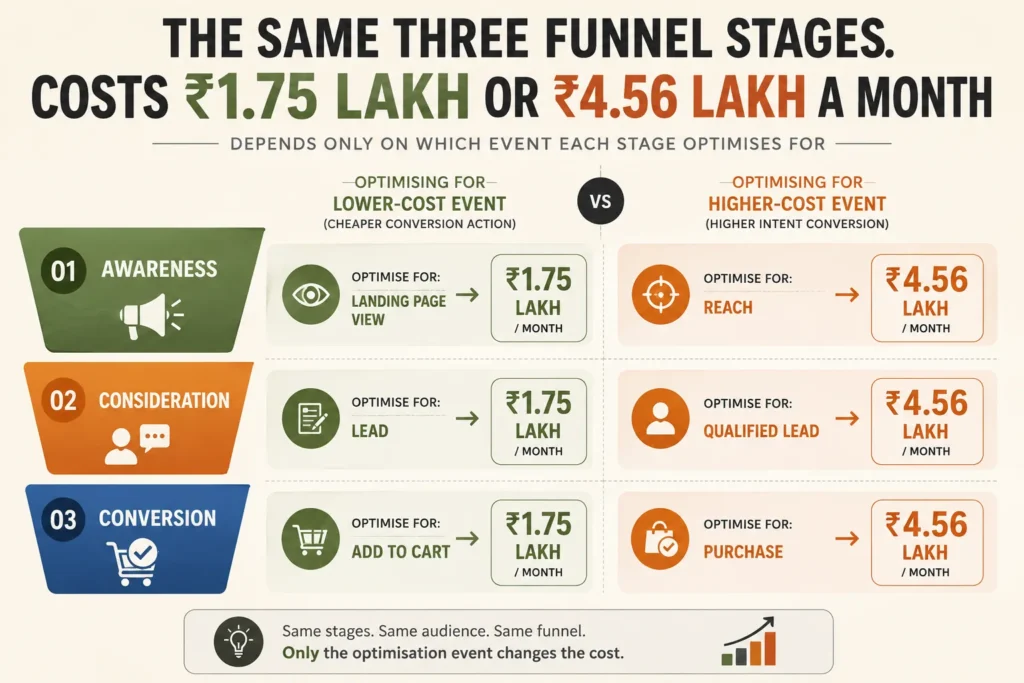
Same three stages. Same media rates. One variable — which event each stage optimises for.
Event-matched. Top of funnel on landing page views at ₹15, middle on a ₹90 engagement, bottom on a ₹700 lead. Meta floors add up to about ₹1,74,685 a month.
All three optimising for the lead. The same structure costs about ₹4,55,700 a month.
A difference of ₹2.81 lakh — 2.6 times — from one decision that most accounts make by accident, usually by duplicating a working bottom-funnel ad set upward and leaving the event unchanged.
Which produces a rough guide, using those illustrative costs:
Under about ₹75,000 a month. One stage. Bottom of funnel, on Google, using Target CPA or manual bidding until you have 30 conversions. Any funnel you build at this level will starve.
Around ₹1.5 to ₹2 lakh a month. Two stages. Bottom on Google, a cheap-event top or middle stage on Meta to build the pool. Do not run a Meta lead-optimised ad set as your only Meta activity at this budget — one ad set will consume three-quarters of it.
Above ₹3 lakh a month. Three stages, event-matched, with enough left over to test creative rather than merely sustain delivery.
Run this with your own numbers, not ours. The cost per event is the input that matters and it varies by category, city and quality of landing page. The method is what transfers.
About the statistics on this topic
Search this keyword and you will meet these figures within two clicks: full-funnel marketing raises conversion rates by 91%, improves ROI threefold, cuts acquisition costs by 25–40%.
We could not trace any of them to a source. No study named, no year, no sample size, no link — on pages that carefully cite HubSpot for a definition of attribution and cite nothing at all for their headline claims.
They may be true. There is no way to check, which is the same problem.
So this article uses two numbers only, both published by the platforms whose behaviour they describe: Meta’s roughly 50 events per ad set per week, and Google’s 30-conversion minimum for Target CPA. Everything else here is arithmetic you can reproduce.
If a page selling you a funnel cannot source the number justifying the funnel, treat the rest of the page accordingly.
Mistakes worth the money they cost
Duplicating a bottom-funnel ad set upward without changing the event. The commonest and most expensive error in this article. It multiplies your floor without changing your creative.
Building three stages on a one-stage budget. Three starved campaigns underperform one fed campaign, reliably.
Judging every stage by cost per acquisition. Upper stages do not produce acquisitions. Measuring them that way guarantees you switch off the thing feeding the stage you like.
Adding stages faster than the audiences can support them. A retargeting pool of 800 people cannot sustain a dedicated ad set.
Summing platform-reported conversions across stages. Every platform claims the same sale — why platforms count the same sale twice covers the reconciliation.
Restructuring monthly. Every structural change resets learning. A funnel rebuilt every six weeks never leaves the learning phase in any stage.
When a funnel is the wrong structure
When existing demand is unexhausted. If your brand and category search terms are not fully covered, capture that first. It is cheaper than creating demand and it converts faster.
When the budget supports one stage. Covered above, and it is the most common situation among businesses of the size we work with in Mumbai.
When the sales cycle is long and the CRM is not connected. You will build stages you cannot measure, then argue about which one worked.
When the offer is not converting. A funnel moves more people to a page that does not convert. Fix the page — making the bottom of the funnel convert — before widening the top.
When “funnel” is being used to mean pipeline. Sales-stage progression is a different subject with different mechanics; the B2B pipeline, which is a different thing covers it separately.
Before you build one
☐ Cost per event calculated for each candidate optimisation event, from your own account
☐ Meta floor calculated — cost per event × 217
☐ Google floor calculated — cost per conversion × 30
☐ Total floor compared honestly against monthly budget
☐ Number of affordable stages decided from that comparison, not from a template
☐ A distinct optimisation event assigned to each stage, cheapest at the top
☐ Retargeting pool size checked against the audience each middle-funnel ad set needs
☐ Stage-appropriate metrics agreed in advance, so upper stages are not judged on CPA
☐ Conversion tracking verified against the CRM before any of it goes live
☐ Structure frozen for at least six weeks after launch
☐ Existing demand confirmed as fully covered before any awareness spend
☐ Reporting reconciled across platforms rather than summed
Questions we get asked
What are the stages of a performance marketing funnel?
Awareness, consideration and decision, with retention often added. The names matter less than the job each stage does and the optimisation event you assign to it.
What is the difference between a marketing funnel and a sales funnel?
A marketing funnel describes paid and organic activity moving people toward an enquiry. A sales funnel describes what happens to that enquiry inside your pipeline. They connect at the handover and are managed by different people with different tools.
Do I need a full-funnel strategy?
Only if your budget clears the combined floor of the stages you want to run. Below that, a single well-fed stage produces more customers.
What budget do you need for full-funnel marketing?
Calculate it rather than accept a figure. Cost per event × 217 for each Meta ad set, cost per conversion × 30 for each Google campaign, added up. On the illustrative costs in this article that lands near ₹1.75 lakh a month for three event-matched stages.
Which metrics belong to which funnel stage?
Reach, cost per landing page view and retargeting pool growth at the top. Engagement rate, cost per engagement and pool progression in the middle. Cost per acquisition and return at the bottom. Which metric should govern your decisions covers how they interact.
Can I run a funnel on Meta alone?
You can, and it is the most expensive way to do it. Meta’s learning requirement is roughly seven times Google’s on the same event. Small budgets should generally start on search.
The decision this actually comes down to
Take the cost of one conversion in your account. Multiply by 30 for a Google campaign, by 217 for a Meta ad set. That is what one stage costs to keep alive for a month.
Then count how many of those your monthly budget covers. That number — not a diagram, not a stage list — is how many stages you can run.
If the answer is one, run one properly. It will outperform the three-stage version of itself, and you can add the second stage the month the first one has more demand than budget.
If you want the floors calculated against your own account and an honest view of how many stages your spend supports, you can reach out to us on whatsapp at +91 7738844851 .
More in Blog
Keep reading
All articles →


Ready to talk about your growth?
Tell us what's stuck and we'll tell you what we'd do first. Free, 30 minutes, no pitch.