

A link is a mention with an attribute attached, and current evidence suggests the mention is doing most of the work for AI citation. That lowers the bar considerably: a link must be granted by somebody with editorial access, while a mention only requires that a writer knows your name. It also introduces a condition nobody states — a business trading under a generic descriptive name cannot accumulate mentions, because the string is indistinguishable from a category description.
Take a link apart and there are two things in it. Your name, written by somebody else, on their page. And an attribute making that name clickable.
Everything difficult about link building attaches to the second part. Getting somebody into their content management system. Negotiating where it points. Arguing about anchor text. Following up three times.
Our pillar on AI search reports that the mention — the first part, on its own — appears to do more work than the link for citation in AI answers.
If that holds, a lot of effort has been going into the wrong half of the object.
What this actually lowers
The practical consequence is about who can compete.
A link has to be granted. Somebody with editorial access has to decide to give you one, which is why link building is slow, why it is sold in packages, and why the packages are usually against Google’s policies — as our article on the spam policy sets out.
A mention requires only that somebody writing about your subject knows your name and uses it.
That is a much lower bar, and it is available to a firm with a five-page website and no domain history. It is one of the few things in search where the small business is not structurally behind.
The problem with being called Digital Growth Solutions
Now the uncomfortable part, and it applies to a great many Indian companies.
A mention only accumulates if your name functions as a name.
If your business trades as Digital Growth Solutions, or Premier Business Services, or Reliable Tech Consultants, then a sentence containing those words is indistinguishable from a description of a category. A person cannot tell it refers to a specific company. Neither can anything else.
You can be mentioned a hundred times and accumulate nothing, because there is no string to accumulate against.
This is not a small edge case in India. A large share of SME names in this market were chosen to sound established and descriptive, which was reasonable advice for a signboard and is a real cost online.
We are not going to tell you to rebrand. That is a serious decision with serious costs and a marketing article is not the place it should be made. What we will say is that if your name is generic, the mention route is largely closed to you until it changes, and you should know that when you are deciding where to spend.
There is a partial workaround worth knowing. A distinctive product name, a named methodology, a published index or a founder’s own name can carry the attribution the company name cannot. Firms with generic names that have built recognition almost always did it through one of those.
Use one version of your name

Smaller, free, and almost universally ignored.
Most businesses appear across the web under several strings. The full legal name with the private limited suffix. The short trading name. The name with the city attached. An abbreviation somebody used once.
Each variant accumulates its own partial record. Nothing consolidates them for you.
Decide on one form, write it down, and use it everywhere — your site, your profiles, your invoices, your email signatures, your speaker bios, your directory entries, and every press mention you have any influence over. Where the legal form is required, keep it to the pages where it is legally required.
It costs an afternoon and it is the closest thing to free progress in this article.
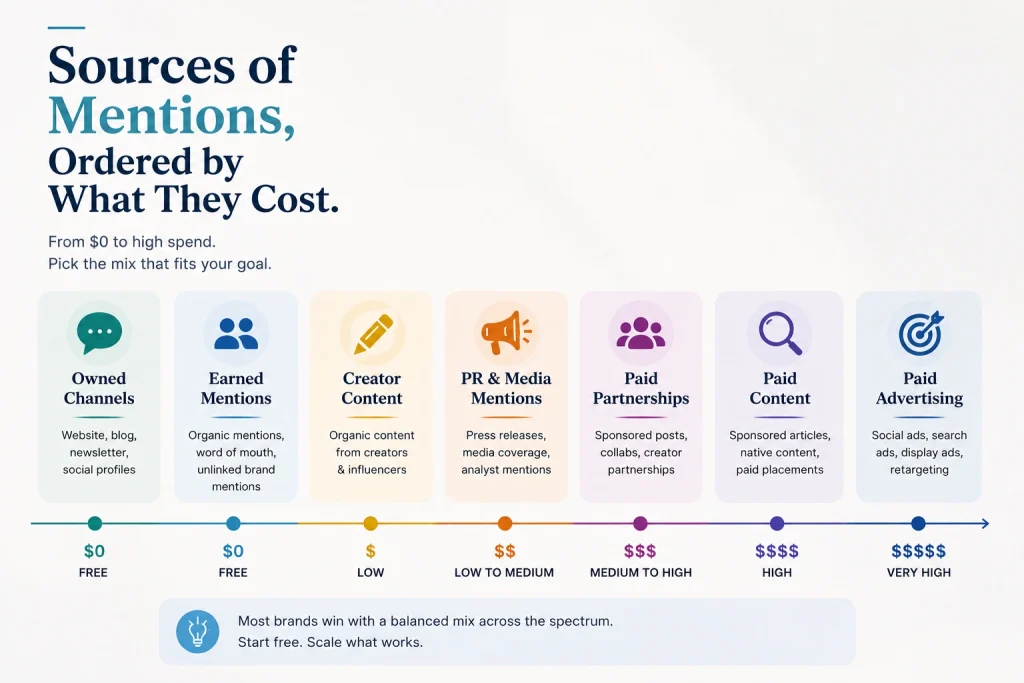
Where mentions actually come from
Ordered roughly by what they cost you.
Your customers and partners. The cheapest source in existence and the least asked. Businesses you work with write about their year, their suppliers, their projects. Almost none of them name you, because nobody asked and they assumed you would rather have a testimonial.
Your own people. Every employee’s professional profile, every speaker biography at every event, every conference programme, every panel listing. These are mentions, they already exist, and most firms have never checked that the name is spelled consistently across them.
Job listings and hiring pages. An underrated one. Recruitment content names the employer repeatedly, sits on third-party sites, and is written anyway.
Being quoted. The slower route, covered in what to send a journalist — and worth noting that on this evidence a quote without a link is now most of the prize rather than a disappointment.
Community threads and video. Where the concentration sits, as our article on citation sources reports.
Industry lists, awards programmes and association directories. Genuine ones. The paid variety carries the same problem as paid links and produces mentions in places nothing reads.
Find the ones you already have

Before generating any, count what exists. It takes twenty minutes and most businesses are surprised.
Search your exact name in quotation marks, excluding your own domain. Do it for each name variant. Do it for your founder’s name. Then set a standing alert on the same terms so new ones surface.
You will typically find three categories.
Mentions you knew about and never used — a quote in a trade publication two years ago, a panel listing, a customer case study.
Mentions you did not know existed. Directory entries, forum threads, a supplier’s blog post, an old event programme.
And mentions with the wrong details. An old address, a misspelled name, a former employee described as current. Those are worth correcting first, because they are actively supplying wrong information about you.
The advice this reverses
Standard practice on finding an unlinked mention is to email the publisher and ask them to add a link. Link reclamation, it is called, and it is a staple of every SEO retainer.
On the current evidence, the mention is already doing most of what you wanted.
Which changes the calculation on the ask. It is now optional rather than the point, and worth making only where it is easy and the relationship survives it. Our digital PR article sets out how to ask well when you decide to.
What is worth more than the ask is the follow-up that produces the next mention. Thank the person, offer something specific for their next piece on the subject, and be available. One relationship producing four mentions over two years beats forty emails asking for anchor text.
Whose name accumulates: the founder question
In a great many Indian SMEs, the founder is more mentionable than the firm.
They speak at things, they are quoted, they answer questions in public, and their name is distinctive in a way that a services company name usually is not. So mentions attach to the person while the company stays invisible.
That is worth being deliberate about rather than letting it happen by default, because it is a real trade with real costs on both sides.
Building on the founder’s name is faster. People quote people, panels invite people, and a person can hold an opinion in a way an organisation cannot. For a firm with a generic name it may be the only route open.
The cost is concentration. Everything accumulates against an individual who might leave, retire, fall out with a partner or sell the business — and none of it transfers. Firms that discover this at the point of an exit discover it expensively.
The workable middle is to pair them consistently. The person is named, the firm is named beside them, every time, in the same form. A bio line that reads as a person at a named company rather than a person in isolation. It costs nothing at the point of writing and it is nearly impossible to retrofit.
What to do when you get one
The instinct on receiving a mention is to screenshot it and put it on your own website.
That does very little for the purpose described here. The value of the mention is that it exists on somebody else’s page, written by somebody else. A copy of it on your own site is you saying it about yourself, which is the thing that carries no weight anywhere.
Use it for the things it is actually good for. Send it to the people in your pipeline. Put it in the proposal. Tell your team. If you republish anything, republish a link to the original rather than an image of it.
And then do the thing that produces the next one, which is to go back to whoever wrote it with something useful for their next piece.
Why you cannot buy this
Predictably, a market will appear. Some of it already has.
It fails for two reasons and the second is the interesting one.
The first is the same reasoning that applies to purchased links: paid placement sits inside the policies, and paying for a mention on a site that will publish anything is buying a mention on a site nothing draws from.
The second is that a mention only has value if something encounters it. A mention in content nobody reads, on a domain nothing cites, in a paragraph assembled to hold it, is a string on a page. The asset here is being talked about, and being talked about is not a thing that can be purchased into existence — which is precisely why it works as a signal.
What we cannot tell you
We cannot tell you that mentions cause citation. The published work is correlational, produced by vendors, and reported by us as direction rather than magnitude for the reasons the pillar gives.
It is entirely possible that mentions are a symptom rather than a cause — that the businesses being mentioned are also the businesses doing everything else well, and the mention is the visible part.
We would note that this does not change the recommendation much. Whether being talked about causes citation or merely accompanies it, being talked about is what you want.
And we cannot tell you a target. There is no threshold, no benchmark, and nobody has published one worth the name.
Final thoughts
Stop treating an unlinked mention as an unfinished link. It is most of the thing you were trying to get.
Pick one version of your name. Fix the mentions that are wrong. Ask your customers and partners to name you. Count what you already have and stop losing the next one.
And if your business is called something nobody could attribute a sentence to, that is worth an honest conversation before you spend anything on this at all.
You can reach out to us on whatsapp at +91 7738844851.
More in Blog
Keep reading
All articles →

Ready to talk about your growth?
Tell us what's stuck and we'll tell you what we'd do first. Free, 30 minutes, no pitch.