
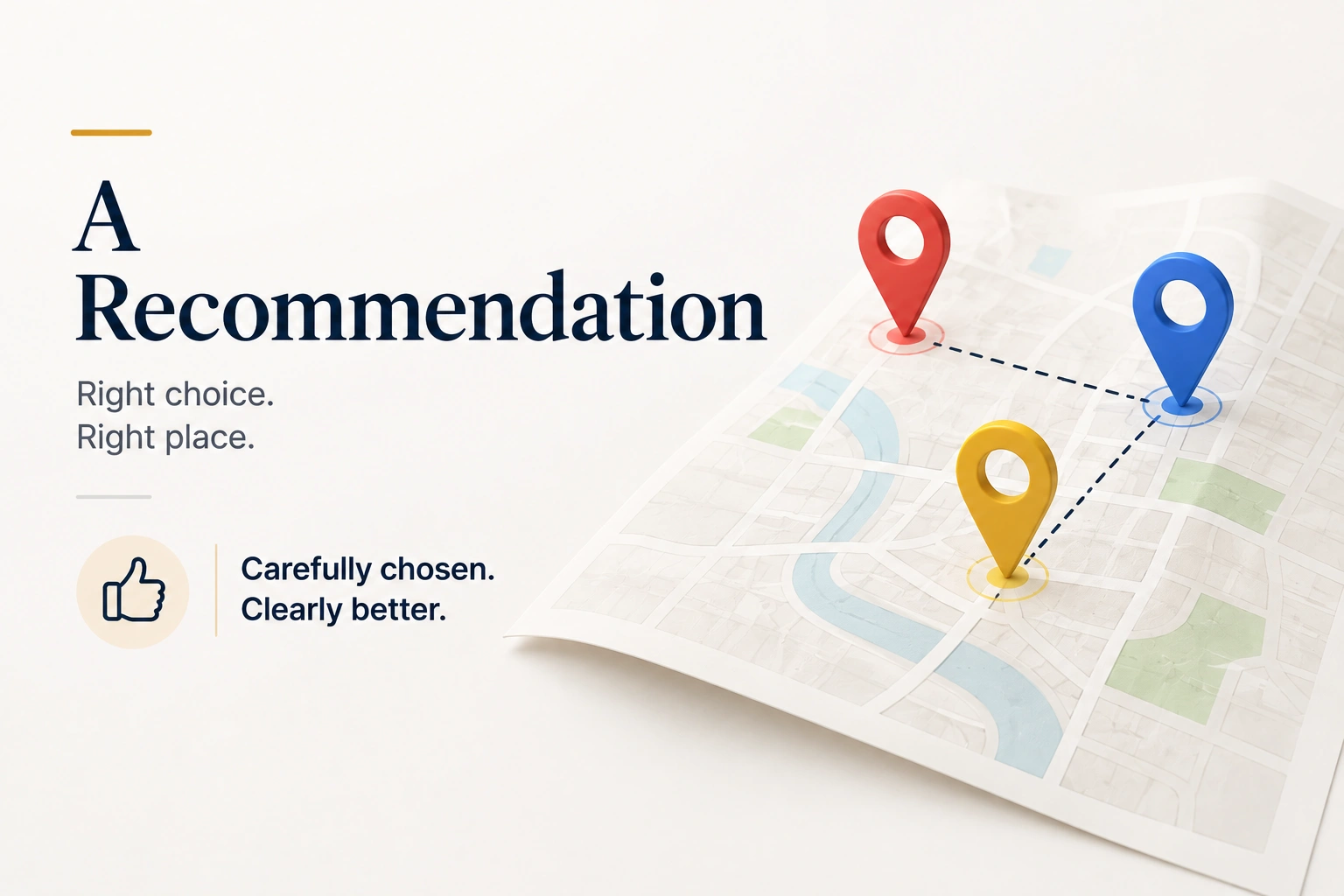
The map pack ranks Business Profiles with proximity as a heavy input, while an AI answer to a local question is assembled from reviews, directories, community threads and articles and returns a recommendation instead. So a business written about in its city can surface where the map pack would never have shown it. That opening is real for considered purchases and not for immediate ones, since anybody needing something tonight still takes the nearest acceptable option.
Our article on local search makes an unwelcome argument: the three results beside the map are ranked partly on how far you are from the person searching, and no amount of marketing changes an address.
That is still true of the map pack. It is much less true of an AI answer, and the difference is the best news a locked-out local business has had in some time.
Two systems, two sets of inputs
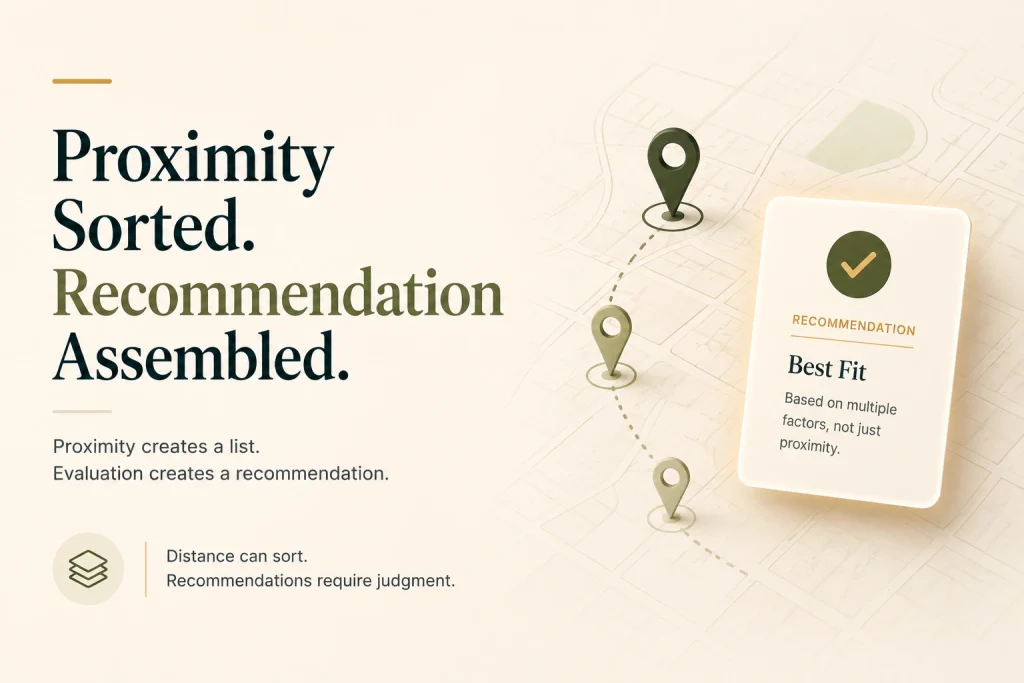
The map pack ranks business profiles. Entities with addresses, categories, hours and ratings, sorted with proximity as a heavy input.
An AI answer to a local question is assembled. It draws on reviews, directory entries, community threads, local publications and any article that addresses the question, and it returns a recommendation with reasoning attached.
Those two processes have almost nothing in common except the subject.
Which is why the businesses named in local AI answers are frequently not the three in the map pack. A firm that has been written about, discussed and reviewed in detail can appear in an answer for an area where the pack would never have shown it.
How large that opening actually is
We want to be careful here, because it would be easy to oversell.
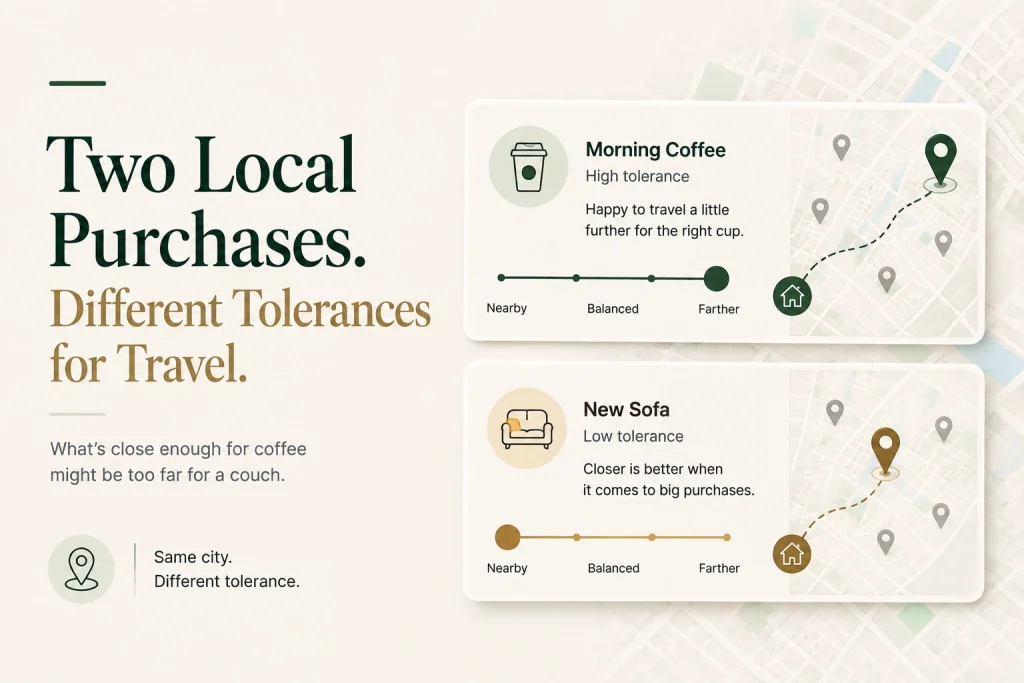
For immediate purchases, distance still decides everything. A blocked drain at nine at night, a chemist, a restaurant tonight, a phone repair before a flight. The buyer will take the nearest acceptable option, whatever any system says, and a recommendation two suburbs away is useless to them.
For considered purchases, the door is genuinely open. A dentist for ongoing work. An architect. A tuition centre for a child. A specialist clinic. A wedding photographer. These buyers will travel, and they are asking which is best rather than which is nearest.
That is the distinction that decides whether the rest of this article applies to you. If your customers arrive within ten minutes of deciding, the map pack is still your battlefield and the profile work in our other article is still the job.
If your customers spend a week choosing, you are in a different game and you have been treating it as the same one.
The blocker is that you have nothing to draw on
Here is the actual problem for most Indian local businesses, and it is not technical.
A profile with photographs. A five-page website with a services list, an about page and a contact form. That is the standard presence, and it has been sufficient for a decade.
There is nothing in it. No material, no specifics, no observations, nothing anything could quote.
Which is why local AI answers name aggregators, directories and forum threads instead. Those sources at least contain sentences about what the experience of using a local business is like. The business’s own site contains a services list.
Our article on reviews covers one half of this — that what customers wrote about you is being read rather than counted. The other half is that you have written nothing yourself.
The thing only you can supply
The good news is that a local business holds something no aggregator has, and almost none of them publish it.
Local specificity. Not “the best dentist in Bandra”, which is a claim nobody can verify. The things you know because you work there.
What a procedure actually costs in this city, and why it varies. What the waiting times are like locally and at which times of year. Which local conditions affect the work — the water, the traffic, the building stock, the weather, the local regulations. What the alternatives in the area are and when somebody should choose them instead. What people in this neighbourhood most commonly get wrong.
Any of that, written plainly, is more useful to a person choosing than everything currently on a typical local business website combined. It is also the only material in this article that a competitor cannot copy, because it comes from doing the work in that place.
Five such pages, written by the person who does the job rather than by an agency writer, would put most Indian local businesses ahead of everybody in their category locally.
The reason nobody does it is not cost. It is that it does not feel like marketing.
What those five pages actually look like

Abstract advice about local specificity is easy to nod at, so here it is made concrete for two categories.
A dental clinic in a Mumbai suburb might publish: what a root canal costs here and what makes the range vary; how long the waiting list runs at different times of year; which treatments genuinely need a specialist referral and where those are locally; what the water and diet in the area do to enamel, if anything real can be said; and what patients most often delay until it becomes expensive.
An architect practising in the same city might publish: what municipal approvals actually take in that ward and what delays them; what a redevelopment costs per square foot locally and why the range is wide; which building types in the neighbourhood carry known structural constraints; when a client should hire a contractor directly instead of an architect; and what people underestimate about living through a renovation.
Read those and notice two things. Every item is answering a question somebody actually asks. And none of them could be written by an agency copywriter who has never worked in that city — which is exactly the property that makes them worth writing.
The failure version is a page titled “Why Choose Us for Dental Care in Bandra”. That answers nothing and could sit on any clinic’s site anywhere.
If you have several branches
Chains and multi-branch businesses have a specific version of this problem, and the fix looks dangerously like a mistake we have written about elsewhere.
The standard arrangement: each branch has its own profile, and all the content is centralised. One services page, one about page, one blog, written at the company level. So a question about the branch in a particular suburb has nothing branch-specific to draw on, and the answer names an aggregator instead.
The obvious response is a page per location, and that is where it goes wrong. Our article on indexation sets out why eleven of twelve near-identical location pages are read, recognised as saying nothing new, and left out.
The distinction is whether each page contains something only true of that branch. The team there, named. What that branch does that the others do not. Local conditions that genuinely differ. Photographs of the actual place. Cases handled there.
Three branch pages with real content beat fifteen with a city name swapped, and the fifteen were never going to be indexed anyway.
For most Indian multi-branch businesses this is a staffing question rather than a content question. Somebody at each branch has to supply the material, and nobody has asked them.
Getting the operational facts right everywhere
A smaller and more urgent point.
Hours, holiday closures, whether you take walk-ins, which payments you accept, whether you deliver, and how much things cost. These change, and they are recorded in a dozen places you have not looked at in two years.
When a system answers a question about you, it draws on those records. A customer told you close at eight when you now close at six is a customer you lose without ever knowing they existed.
Our article on incorrect information covers the general fix. The local version is narrower and worth doing this week: check every listing, every directory entry, every profile and your own site, and make the operational facts agree.
Festival and holiday hours are the specific Indian failure. Almost nobody updates them anywhere, and the periods when they matter most are the periods with the most demand.
Nobody clicks, which matters more locally
One consequence from our article on AI Mode lands harder on local businesses than anywhere else.
Most interactions end without a website visit. For a local business that was already half true — people called the number or took directions without visiting the site at all.
What changes is that the recommendation now happens before either of those. Somebody asks which is best, receives three names with reasons, and only then looks one of them up.
So the objective is to be one of the three named, which is decided by what exists about you rather than by anything on your website. Your site’s job shifts toward confirming the recommendation for somebody who has already been told about you — which means the operational facts and the local specifics matter more, and the homepage banner matters less.
What we cannot tell you
We cannot tell you how these systems handle Indian local queries specifically. The published work is global and largely American, and Indian local search involves language mixing, informal addressing and a directory ecosystem that does not exist elsewhere.
We cannot tell you the balance between the map pack and the AI answer for any given category. It will differ by how considered the purchase is, and nobody has measured it here.
And we cannot tell you that the distance relaxation is permanent. It follows from how these answers are currently assembled, and that could change.
Final thoughts
Work out first whether your customers travel. If they do not, the map pack is your battlefield and this article is not for you.
If they do, you have an opening that geography previously closed — and the way through it is to write down five things you know about doing your work in your city, which nobody in your category has done.
If you want help deciding which five, you can reach out to us on whatsapp at +91 7738844851.
More in Blog
Keep reading
All articles →
Ready to talk about your growth?
Tell us what's stuck and we'll tell you what we'd do first. Free, 30 minutes, no pitch.