ROI Full Form: Return on Investment (and Rate of Interest) Explained
ROI full form is return on investment (in banking, rate of interest). Learn the ROI formula, a marketing example, and how ROI differs from ROAS.

The short answer
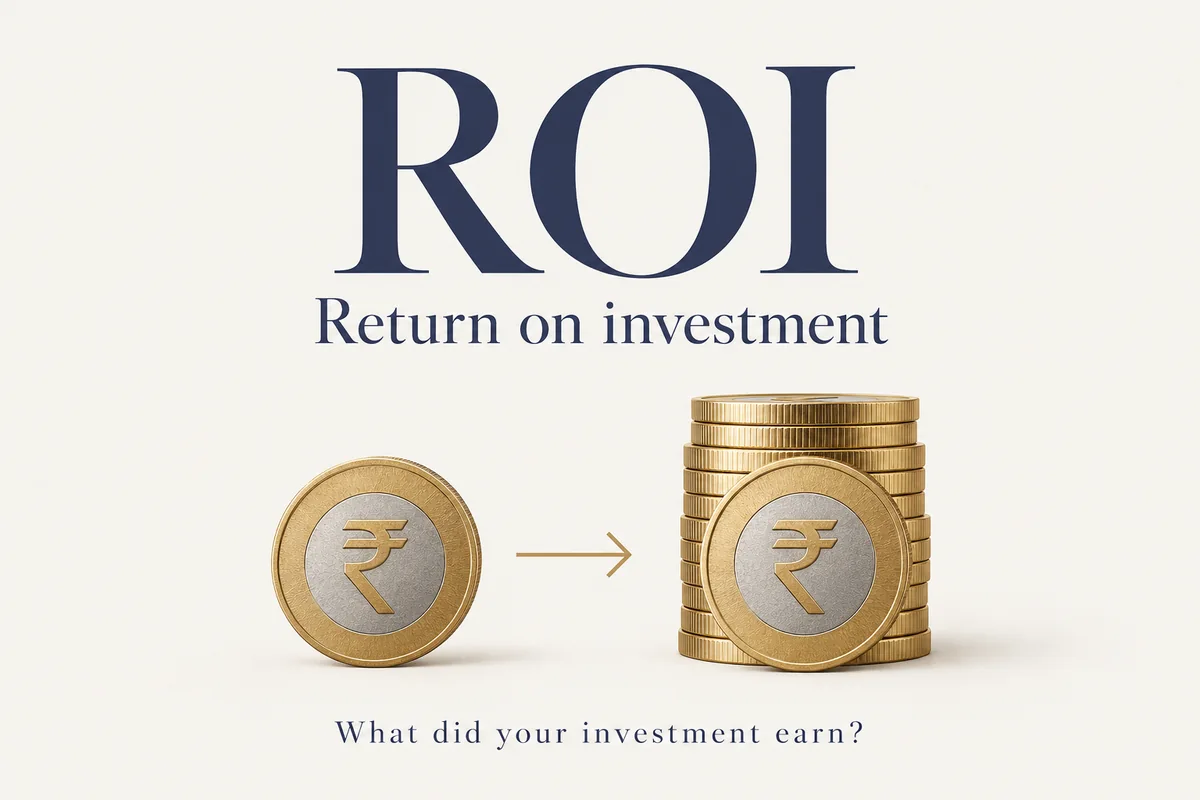
The full form of ROI is return on investment. It shows how much profit you made compared with what you spent: ROI = (gain − cost) ÷ cost × 100. If you spend ₹1,00,000 and get back ₹1,50,000, your ROI is 50%. In Indian banking, though, ROI usually means rate of interest, the percentage a bank charges on a loan or pays on a deposit. So check the context. In marketing and business, ROI means return on investment, and it should be calculated on profit, not revenue. That’s the main difference between ROI and ROAS.
The two meanings of ROI
Return on investment. Used in business, finance, marketing and investing. It’s a ratio of profit to cost.
Rate of interest. Used on loan documents, bank websites and deposit rate cards in India. “ROI 9.5% p.a.” on a home loan means the interest rate.
The rest of this article covers return on investment. The banking meaning is explained briefly below.
The ROI formula
ROI = (gain from investment − cost of investment) ÷ cost of investment × 100
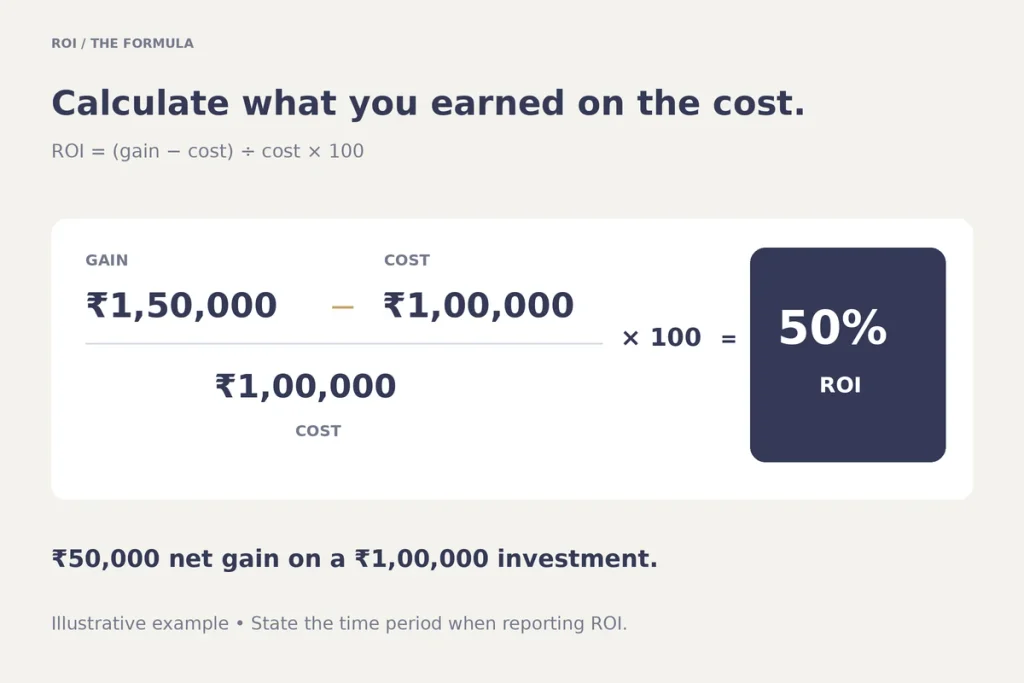
Example: you buy equipment for ₹1,00,000 and it earns ₹1,50,000 in extra profit over a year.
(₹1,50,000 − ₹1,00,000) ÷ ₹1,00,000 × 100 = 50%
A negative ROI means you lost money. An ROI of 0% means you broke even.
ROI in marketing
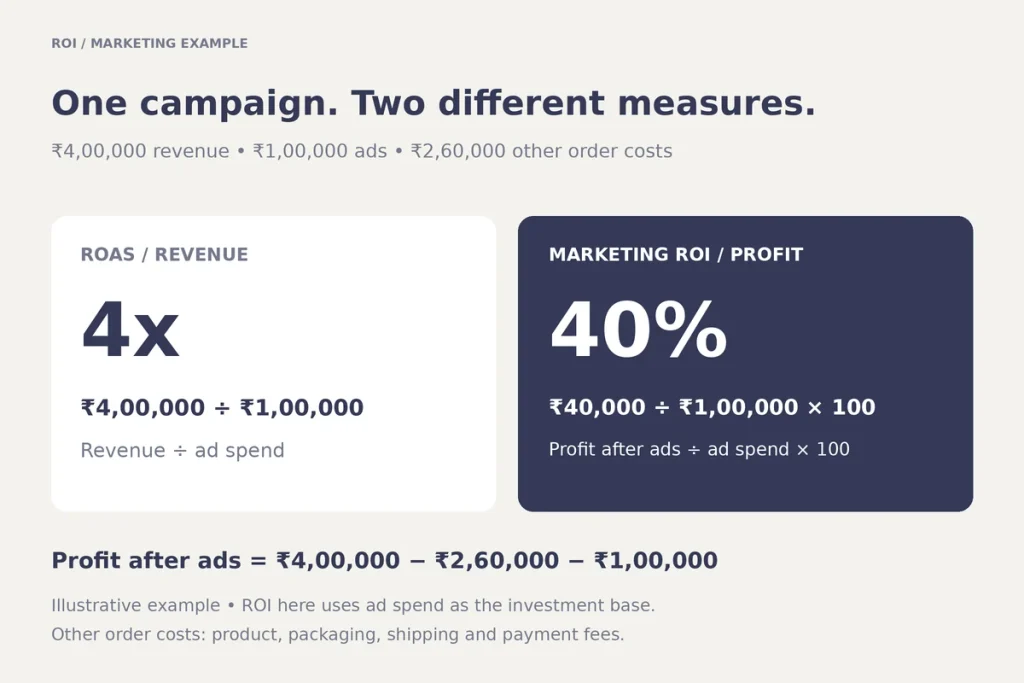
Marketing ROI is where most confusion starts. Many reports show revenue from ads divided by ad spend and call it ROI. That number is actually ROAS (return on ad spend).
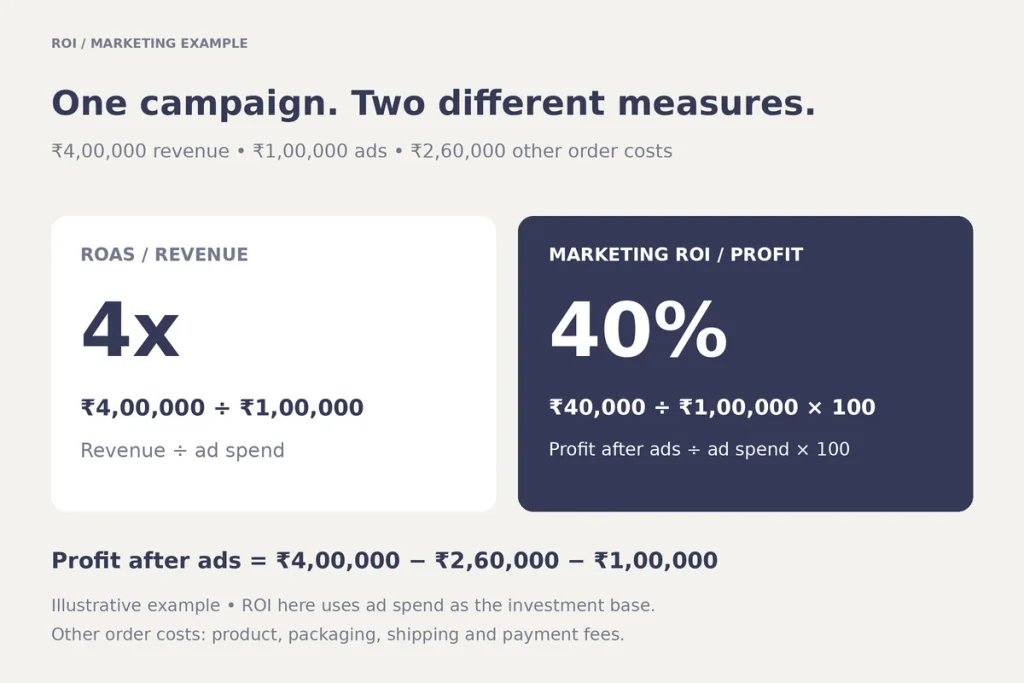
Here’s an illustrative example:
- Ad spend: ₹1,00,000
- Revenue from the ads: ₹4,00,000
- Product, packaging, shipping and payment costs on those orders: ₹2,60,000
ROAS = ₹4,00,000 ÷ ₹1,00,000 = 4x
Profit before ads = ₹4,00,000 − ₹2,60,000 = ₹1,40,000
Marketing ROI = (₹1,40,000 − ₹1,00,000) ÷ ₹1,00,000 × 100 = 40%
A 4x ROAS sounds excellent. A 40% ROI is good but far less dramatic. Both are true; they answer different questions. Google Ads itself defines target ROAS as conversion value divided by ad spend, which is revenue-based.
For deeper guides, see performance marketing ROI and Google Ads ROI.
ROI in banking: rate of interest
On a loan offer, ROI is the yearly interest rate.
Example (illustrative): a ₹10 lakh personal loan at an ROI of 11% per year. Your EMI depends on this rate and the loan period. When comparing loans, also check processing fees, which the ROI figure doesn’t include.
What is a good ROI?
There’s no single number. It depends on risk, time and what else you could do with the money. For marketing, a practical test is whether ROI stays positive after all costs, and whether it improves over time as customers reorder. That’s why CAC and customer lifetime value matter alongside ROI.
Mistakes to avoid
Using revenue instead of profit. That’s ROAS, not ROI.
Ignoring time. A 30% ROI in three months is better than 30% in three years.
Leaving out costs. Agency fees, tools, discounts and returns all count.
Mixing meanings. In a loan document, ROI is the interest rate.
Checklist
- Context checked: return on investment or rate of interest
- ROI calculated on profit, not revenue
- All costs included (ads, fees, tools, discounts, returns)
- Time period stated
- ROAS and ROI reported separately
- ROI listed among your KPIs only if profit data is available
Questions we get asked
What is ROI full form in banking?
Rate of interest.
Is ROI a percentage?
Usually, yes. It can also be written as a ratio, such as 0.5.
Can ROI be more than 100%?
Yes. An ROI of 200% means you made twice your investment back as profit.
Final thoughts
ROI tells you whether spending made money. Calculate it on profit, state the period, and don’t confuse it with ROAS. More in our guide to digital marketing terms.
Want to know the real ROI of your ad spend? Book a consultation.You can reach out to us on whatsapp at +91 7738844851 .
More in Blog
Keep reading
All articles →
Ready to talk about your growth?
Tell us what's stuck and we'll tell you what we'd do first. Free, 30 minutes, no pitch.