USP Meaning: What a Unique Selling Proposition Is and How to Write Yours
USP meaning: a unique selling proposition is the one benefit you offer that rivals don't. See the three-part test, famous USP examples, and how to write yours.

The short answer
USP means unique selling proposition: the one specific benefit your product offers that competitors don’t, stated clearly enough to make people choose you. The term came from Rosser Reeves, an advertising executive at Ted Bates & Company, during campaigns in the early 1940s. His test had three parts: the claim must be a specific benefit, it must be something competitors can’t or don’t offer, and it must be strong enough to move customers. “Premium quality” fails all three. A classic example that passes: M&M’s “melts in your mouth, not in your hand”.
What USP means in business
Every business needs an answer to one question: why should I buy from you instead of the others? The USP is that answer, in one line.
It is not a slogan, a logo or a mission statement. It’s a promise of a benefit.
Your USP shapes your ads, landing pages, packaging and sales conversations. When it’s clear, your ad creative and ad copy almost write themselves.
The three-part USP test
Rosser Reeves set out three conditions, summarised on Wikipedia’s page on the term. A real USP must pass all three.
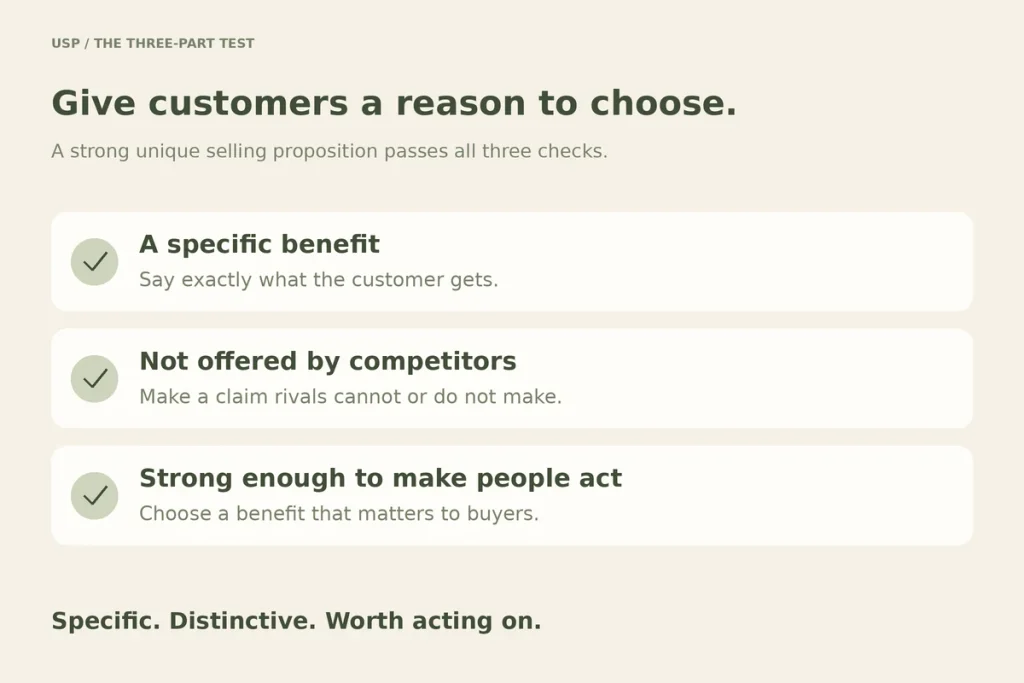
- A specific benefit. “Buy this, and you get this.” Not vague praise
- Unique. Competitors can’t or don’t make the same claim
- Strong enough to act on. It matters enough to win new customers
Most “USPs” fail the second test. “Fast delivery” is not unique if everyone delivers in two days.
USP examples
Well-known examples cited in marketing texts:
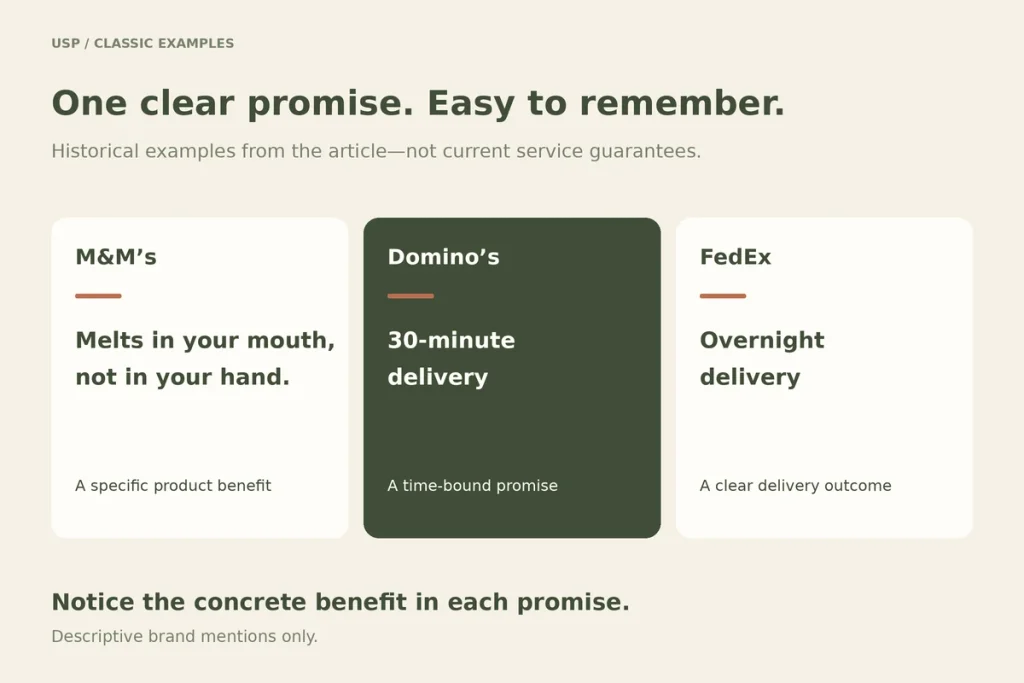
- M&M’s: “Melts in your mouth, not in your hand.” A specific, provable benefit from the sugar shell
- Domino’s (its earlier promise): delivery within 30 minutes
- FedEx (early positioning): overnight delivery
- Head & Shoulders: clinically proven to reduce dandruff
Illustrative examples for Indian small businesses:
- A tiffin service: “Home-style meals delivered hot by 1 pm, or lunch is free”
- A B2B IT firm: “Your server issue picked up by an engineer within 15 minutes, 24×7”
- A coaching centre: “Batches capped at 12 students, with a weekly one-to-one review”
Each one is specific, and each would be hard for a competitor to copy overnight.
How to write a USP in five steps
1. List every benefit you offer. Speed, price, quality, service, range, guarantee, expertise.
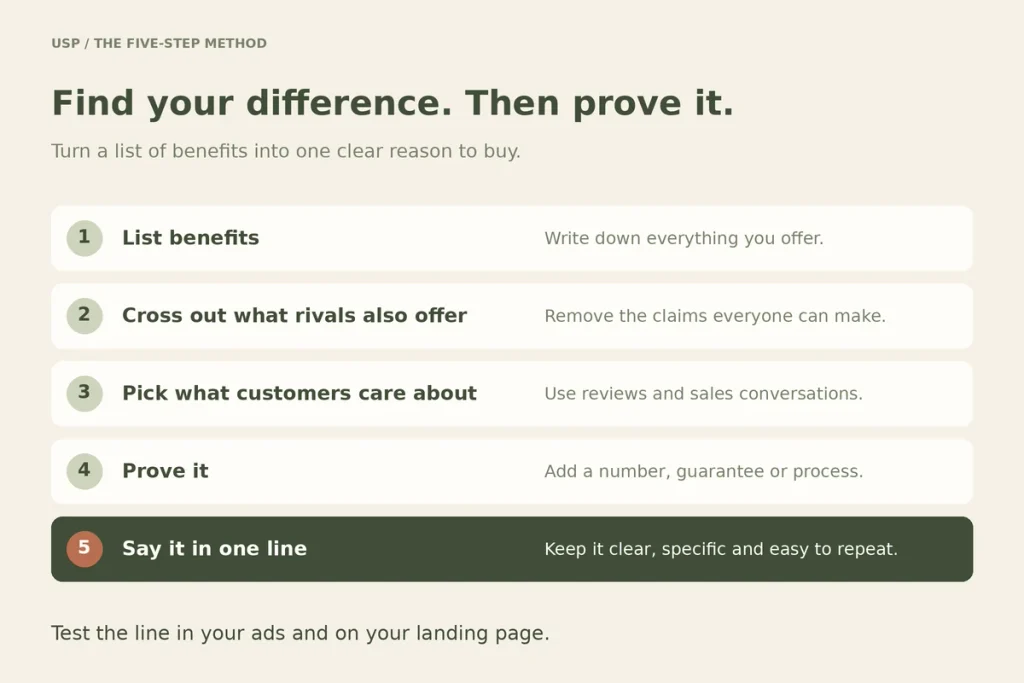
2. Cross out what competitors also offer. Check their websites, ads and reviews.
3. Pick what customers care about most. Read your reviews and sales calls. What do people praise or complain about?
4. Add proof. A number, a guarantee, a process, a certification.
5. Say it in one line. Aim for under 15 words. Then test it in ads and on your landing page, with a clear CTA.
USP vs tagline vs value proposition
USP: the one benefit that sets you apart.
Value proposition: the full set of benefits and why they matter; usually longer.
Tagline: a short, memorable phrase for the brand. It may or may not state the USP.
Mistakes to avoid
Claiming “best quality” or “best price”. Everyone says it, so nobody believes it.
Too many USPs. If you have five, you have none.
No proof. A claim without evidence reads as puffery.
A USP customers don’t care about. Unique isn’t enough if it doesn’t matter to them.
Checklist
- Benefit is specific and measurable
- Competitors checked; they don’t make the same claim
- Customers care about it (from reviews or sales calls)
- Proof included: number, guarantee or process
- Written in one line, under 15 words
- Used consistently in ads, landing pages and sales pitches
Questions we get asked
What is the full form of USP?
Unique selling proposition. Some sources say unique selling point; the meaning is the same.
What is the USP of a product?
The specific benefit that product offers and similar products don’t.
Can a service business have a USP?
Yes. Speed of response, guarantees, specialisation and process are common service USPs.
Final thoughts
A USP answers “why you?” in one line. Make it specific, make it yours, and prove it. The AIDA model shows where it fits in an ad. More terms in our guide to digital marketing terms.
Want help sharpening your USP for ads? Book a consultation.You can reach out to us on whatsapp at +91 7738844851.
More in Blog
Keep reading
All articles →
Ready to talk about your growth?
Tell us what's stuck and we'll tell you what we'd do first. Free, 30 minutes, no pitch.