
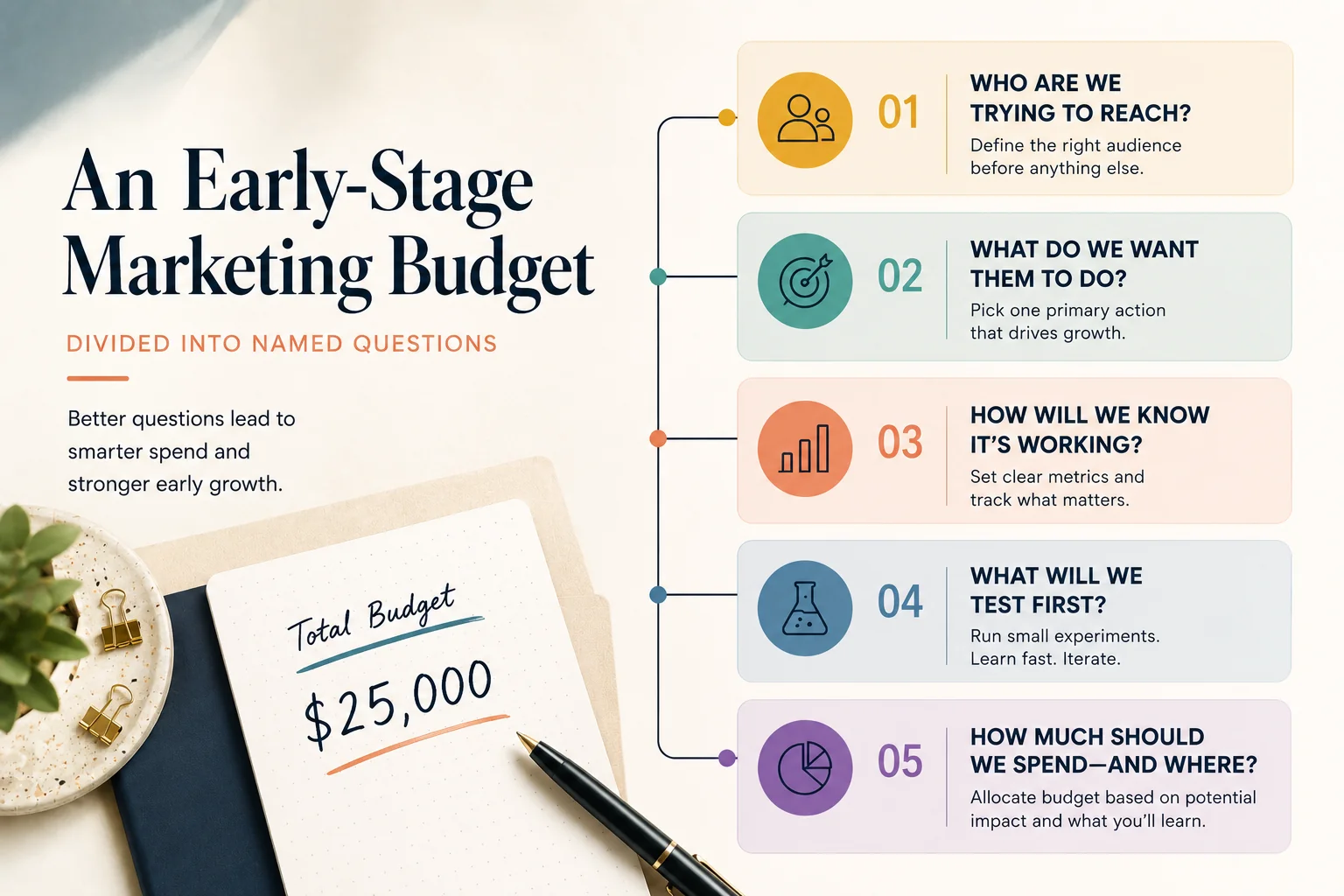
The guides written for founders on this subject describe dynamic remarketing, visual search, retail media networks and social commerce.
Delete the word “startup” from any of them and nothing changes. They are channel catalogues written for advertisers who already know what they sell, to whom, and at what price.
A startup, by definition, does not know any of those things yet. That single fact should change everything about how the first budget is spent — and on none of those pages does it change anything at all.
The short answer
Before product-market fit, paid media is a research instrument. Its job is to answer questions — who responds, at what price, to which promise — faster than any other method available. Budget it in answers rather than in months, attach a written question to every campaign, and understand that a startup-scale budget can only detect large differences. At 8,000 visitors a month against a 3% conversion rate, the smallest improvement you can reliably see is about 39%. Test things that could differ by that much. Test small variations later, when you have volume.
Key takeaways
- CB Insights puts “no market need” at 42% of startup failures, against 29% for running out of cash. Their 2024 update across 431 shutdowns found 43% failed on poor product-market fit.
- Early spend should be budgeted in questions, each with a price and a written answer condition.
- Small budgets cannot detect small differences. At 4,000 visitors per variant on a 3% base rate, the minimum detectable improvement is about 39%.
- So test large things — different audiences, different promises, different prices. Not button colours.
- Three conditions gate the switch to scaling spend: a repeatable buyer, a price that holds, and demand that is not exhausted.
- Paid media cannot create product-market fit. It can tell you quickly and cheaply that you do not have it.
What a startup is actually buying
An established advertiser spends money to acquire customers at a known cost. That is a purchase.
An early-stage company spends money to find out whether customers exist at any acceptable cost. That is research, and it should be planned, priced and reported as research.
The distinction is not academic. It changes what you run, how long you run it, what you report, and what counts as a good outcome. A campaign that spends ₹40,000 and produces four customers looks like a failure by acquisition standards. If it establishes that a segment you had written off converts at twice the rate of your assumed core market, it was one of the cheapest research projects your company will ever run.
The failure data supports treating it this way. CB Insights’ post-mortems put no market need at 42% of startup failures, well ahead of running out of cash at 29%. Their 2024 analysis of 431 venture-backed companies that shut down since 2023 found 43% failed on poor product-market fit. Founders often record the cause as running out of money, which is usually the downstream symptom — a product nobody wanted did not generate revenue, and the cash ran out on schedule.
Advertising is the fastest instrument available for testing whether anyone wants the thing. It works in days, at a price a seed-stage company can pay, against real strangers rather than friendly interviewees.
The Answer Budget
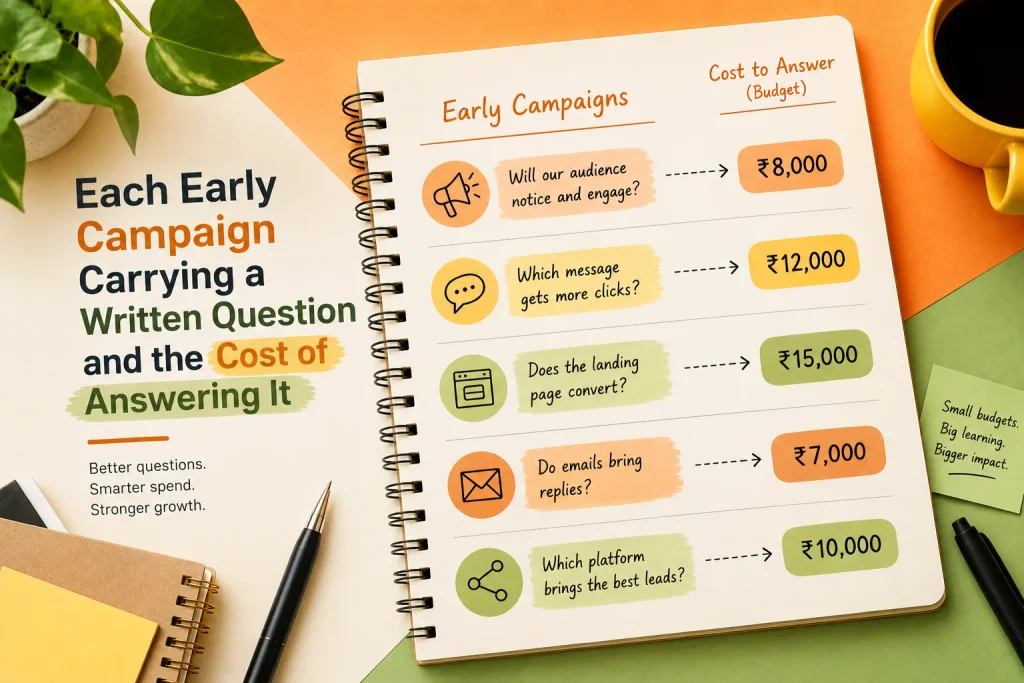
Every early campaign carries a written question and the price of answering it. You are not buying customers yet. You are buying the removal of a specific uncertainty, and the budget should be stated in answers rather than in months.
In practice this means each campaign gets three lines written before it launches.
The question. Specific and falsifiable. Not “does Meta work for us” but “will operations managers at 50–200 person manufacturers give us an email address for a downtime calculator?”
The answer condition. What result would settle it, decided in advance. “Thirty leads at under ₹800 from this segment within four weeks” is a condition. “Good performance” is not.
The price. What you are willing to spend to find out, and the point at which you stop whether or not you have your answer.
Three or four questions is a research programme. Twelve is a wish list you will run out of money halfway through.
Why the questions must be written down. Without a stated answer condition, every result becomes arguable. A campaign that produced eleven leads at ₹1,400 is either encouraging or damning, depending on who is presenting it, and the argument consumes more time than the test did.
What your budget can actually detect
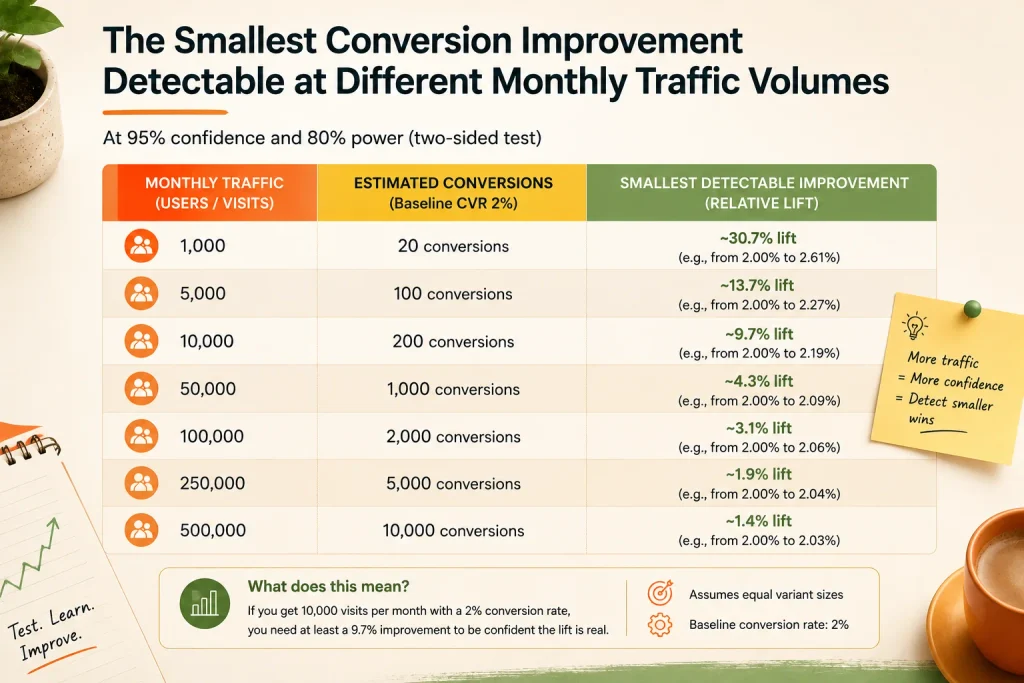
This is the section that changes behaviour, and no guide written for founders includes it.
Statistical testing has a floor. To be reasonably confident a difference is real rather than noise, you need enough conversions on both sides. At a 3% conversion rate, using standard 95% confidence and 80% power:
- Detecting a 10% improvement needs about 53,000 visitors per variant
- A 20% improvement needs about 13,900 per variant
- A 50% improvement needs about 2,500
- Doubling needs about 745
Read that in reverse and it becomes useful. With 4,000 visitors per variant — a reasonable early month — the smallest difference you can reliably detect is around 39%. At 10,000 per variant, around 24%.
Which means the test most startups run is impossible. Two headlines that differ by 15% will look identical in your data for months. You will pick one on instinct, call it a win, and have learned nothing.
The instruction that follows is unusually clear. Test things capable of differing by 40% or more:
- A different audience entirely — a segment you have not tried, not a narrower slice of the one you have
- A different promise — outcome-led against feature-led, not two versions of the same sentence
- A different price or offer structure — a trial against a demo, ₹4,999 against ₹9,999
- A different acquisition mechanic — a form against a call booking against a purchase
Small refinements are worth making. Later, at volume — the arithmetic behind that is at how many visitors a test actually needs. Early on, they are noise wearing a lab coat.
Questions worth buying answers to
In rough order of how much they change what you build next.
Which segment responds at all? Run the same offer to three genuinely different audiences. You are looking for a segment that responds two or three times better, not marginally better — and if none of them do, that is also an answer.
Which promise moves people? Same audience, three different framings of what the product does. Founders are usually wrong about this, and the wrongness is expensive because it propagates into the website, the deck and the sales script.
Does the price hold? Point ads at two price presentations. Cheap to test, and it changes your entire model.
Where does interest die? Impressions, clicks, page arrival, form start, form completion. A collapse between two of those stages is more informative than the final conversion number.
Is anyone searching for this? Search volume for the problem you solve is a direct read on whether the market has named its own pain yet. If nobody searches for it, your costs will be structurally higher, because you must create demand rather than capture it. In B2B this is normal — roughly 5% of buyers are in-market at any time, per Ehrenberg-Bass research for the LinkedIn B2B Institute — but it should be a decision rather than a surprise.
The Evidence Gate
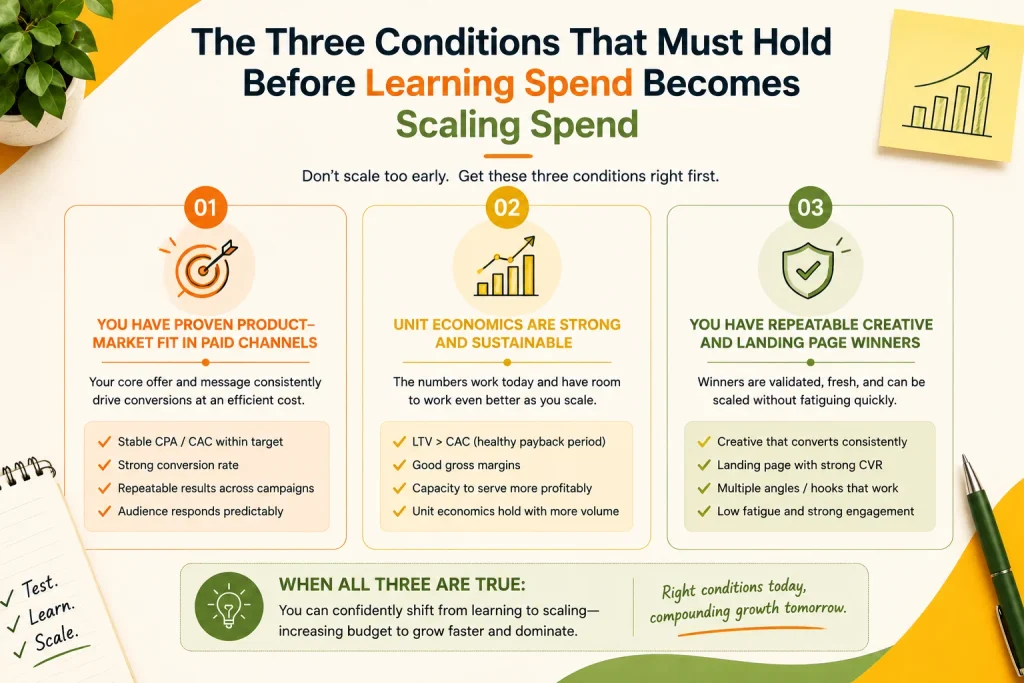
Three conditions. All three, not two.
One — a repeatable buyer. One audience-and-message combination has produced enough conversions to be non-random. The platforms give you the threshold: Google’s Target CPA wants at least 30 conversions in 30 days, Meta’s ad sets around 50 optimisation events a week. Below those numbers you have anecdotes.
Two — a price that holds without hand-holding. Founder-led sales close deals that normal sales processes do not. If the acquisition cost only works while the founder personally calls every lead, you have found a founder, not a channel.
Three — demand that is not exhausted. Double the spend for a month. If cost per acquisition stays roughly flat, there is room. If it climbs steeply, you have harvested a small pool of existing demand and the next stage of growth costs a different kind of money.
Until all three hold, keep spending on answers. Once they hold, the questions change to structure and allocation — what each funnel stage costs to run and how to split a budget across stages take over from here, and this article stops being the relevant one.
Mistakes that cost startups their runway
Scaling on a good week. Two strong weeks is variance. Scaling on it converts a small loss into a large one.
Running four channels at once on a budget for one. Nothing gets enough data to say anything, and the conclusion is always “none of it worked.”
Testing differences too small to see. Covered above, and it is the single most common waste of early budget.
Optimising for the cheapest lead. Cheap leads are easy to buy and usually worthless. Track what happens to them, or you are optimising for volume of disappointment.
Reporting spend instead of learning. A monthly report listing impressions and clicks tells an investor nothing. A report saying “we established that segment B converts at 2.4x segment A, and we were wrong about the price” is worth the money you spent.
Rebuilding the account every fortnight. Every structural change resets platform learning. Nothing stabilises, so nothing can be measured.
When paid media is the wrong first move
When you have not spoken to twenty potential customers. Conversations are cheaper and faster at this stage, and ads will only tell you that a message you have not yet found does not work.
When you cannot service the demand. Generating enquiries you answer four days later wastes the budget entirely.
When the total budget is under about ₹30,000. That is below the point where any platform can learn anything. Spend it on conversations, a working landing page and one search campaign on your clearest intent term.
When the product is not usable yet. Advertising an unfinished product buys you a permanently negative reputation among exactly the people you most needed.
When existing demand is unexhausted. If people are already searching for what you sell and you are not appearing, capture that before creating anything.
The first ninety days, in order
☐ Twenty customer conversations completed before any spend
☐ Three or four questions written down, each with an answer condition and a price
☐ Conversion tracking installed and verified against your own records
☐ One landing page per question, each with a single clear action
☐ Budget floor checked — cost per conversion × 30 for Google, × 217 for Meta
☐ One channel chosen to start, matched to whether demand already exists
☐ Test differences sized at 40% or more, never small variations
☐ Structure frozen for six weeks minimum
☐ Weekly review of learning, monthly review of spend — in that order
☐ Lead quality tracked to a real outcome, not to form submission
☐ Evidence Gate assessed honestly at day 90
☐ Findings written up as answers, not as a performance report
Questions we get asked
How much should a startup spend on performance marketing?
Enough to clear the platform learning floors on one channel, which typically starts near ₹30,000–₹50,000 a month in India depending on your cost per conversion. Below that you are buying noise. Calculate it from your own cost per conversion rather than accepting a figure.
When should a startup start running paid ads?
Once you can service the demand, your tracking works, and you have questions specific enough to be answered. Not before, and not after you have spent a year on content hoping the problem solves itself.
What is the best marketing channel for a startup?
The one where demand already exists, if it exists. If people search for your category, start on search — it is cheaper to capture demand than create it, and Google’s learning threshold is far lower than Meta’s.
How do you measure marketing before product-market fit?
By questions answered, not by return on ad spend. ROAS on a hundred conversions is a number with error bars wider than the number itself.
Should a startup hire an agency or do it in-house?
At research stage, whoever is closest to the customer should be reading the data — usually a founder. Bring in help when the questions turn structural. How to choose an agency without being sold to covers what to ask.
Can paid ads create product-market fit?
No. They can tell you within six weeks and for under ₹1 lakh that you do not have it, which is the most valuable thing they will do for you in the first year.
What to do on Monday
Write down the three things you are least certain about in your business. Not marketing questions — business questions. Who this is for, what they will pay, and what promise makes them act.
Then work out what it would cost to answer each one with strangers instead of opinions.
That number is your first performance marketing budget. It buys evidence, and evidence at this stage is worth more than the customers it happens to bring along.
If you would like the questions framed and priced against your own numbers, you can reach out to us on whatsapp at +91 7738844851 .
More in Blog
Keep reading
All articles →
Ready to talk about your growth?
Tell us what's stuck and we'll tell you what we'd do first. Free, 30 minutes, no pitch.