
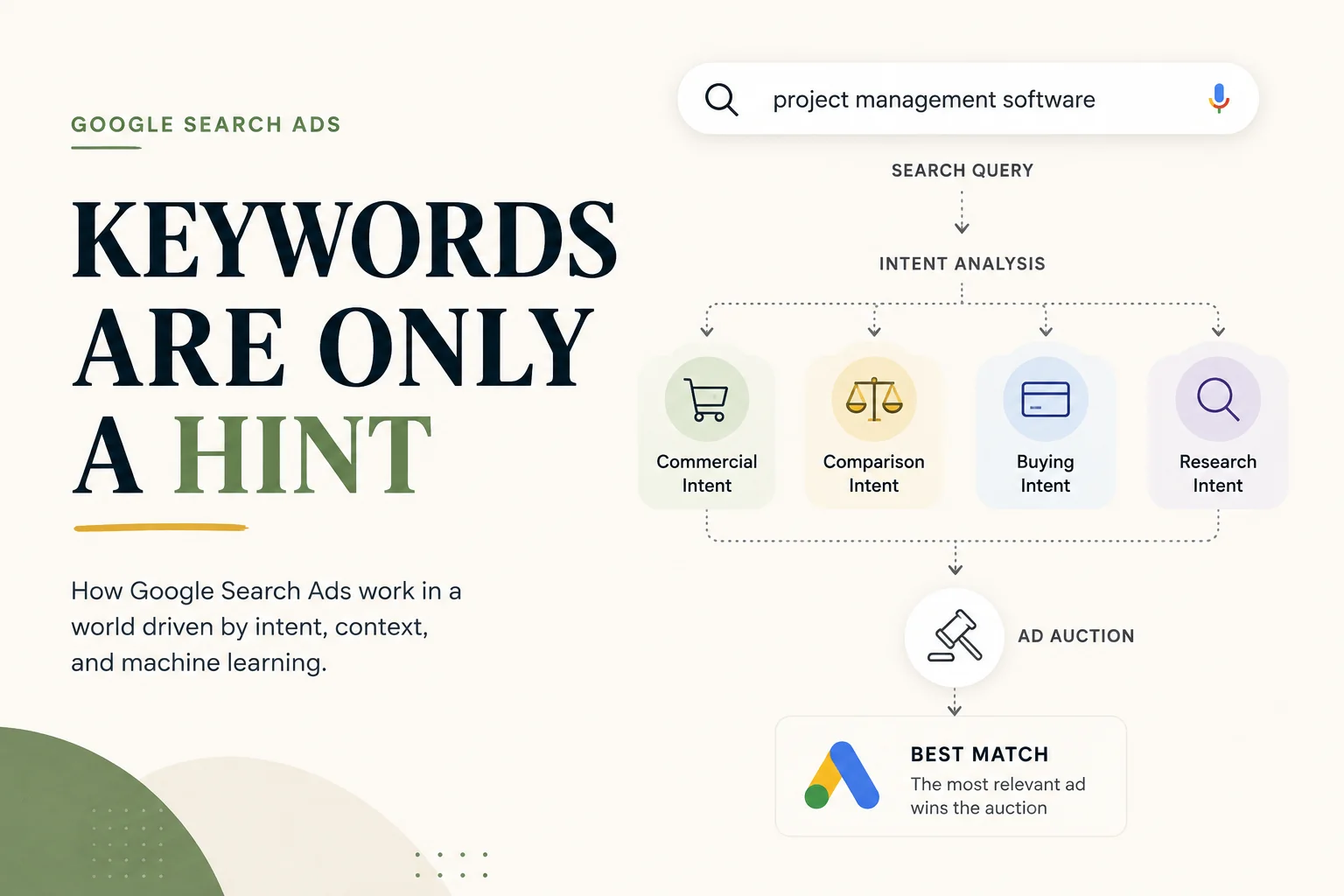
A Google Search ad is a text ad that appears above or below the organic results when someone searches. You pay when they click. That part has not changed since 2000 and probably will not.
What has changed is the bit everyone thinks they understand: the keyword.
For twenty years, a search campaign was a control system. You chose keywords, assigned match types, and Google broadly obeyed. Exact match meant exact. That model is being retired, and most of what you will read about search ads still describes it as though it were intact.
The short answer
Google Search Ads are keyword-triggered text ads on the search results page, priced by auction and charged per click. You still choose keywords, but they now function as strong hints rather than instructions — under AI Max for Search, keywords are treated as broad match regardless of the match type assigned. From 1 September 2026, campaigns using the campaign-level broad match setting or automatically created assets are auto-upgraded. What steers a campaign now is negatives, landing pages, conversion signals and assets.
Key takeaways
- Search ads capture existing demand. Someone types what they want; you appear. That is the entire proposition and it is why search converts better than most channels.
- Match types are becoming approximations. AI Max treats keywords as broad match whatever you assigned them.
- Doing nothing is a decision. Campaigns on campaign-level broad match or automatically created assets migrate automatically from 1 September 2026. Migrate voluntarily and you choose your settings; wait and you inherit Google’s.
- Four inputs still steer a campaign — negative keywords, landing pages, conversion signals and assets. Most advertisers have neglected all four because match types felt sufficient.
- This direction is not arbitrary. About 15% of Google searches each day have never been searched before, which is a problem no keyword list can solve.
How a search ad actually gets shown
Worth being precise, because the mechanism explains everything that follows.
Someone searches. Google assembles the advertisers whose keywords are considered relevant to that query, then ranks them — not by bid alone, but by Ad Rank, which combines your bid, ad quality, the competitiveness of the auction, context and the expected effect of your assets. A higher-quality ad can outrank a higher bid, which is the single most useful fact about the system.
You are then charged no more than needed to hold your position, which is why your actual cost per click is usually below your maximum bid.
Two things are worth pulling out of that.
You are bidding on a query you did not write. You bid on a keyword; the auction runs on a query. The distance between those two has always existed and is now widening deliberately.
Quality is a discount. Relevance between query, ad and landing page lowers what you pay for the same position. It is the closest thing to free money in the platform.
Why Google moved away from keyword control
Not a conspiracy, and worth understanding rather than resenting.
Roughly 15% of the searches Google sees each day have never been searched before. That figure was 25% in 2007, settled at 15% around 2013, and Google has reaffirmed it since — including in the context of AI-driven search. At Google’s volume, that is over a billion genuinely novel queries every day.
No keyword list can cover that. Every advertiser using only exact match is, by definition, invisible to the newest 15% of demand — including the long, conversational queries people increasingly type.
So Google’s system moved from matching strings to inferring intent, using your keywords, your landing pages and your assets as evidence of what you sell. Whether that serves you or serves Google’s revenue is a fair argument, and both can be true.
The Steering Set
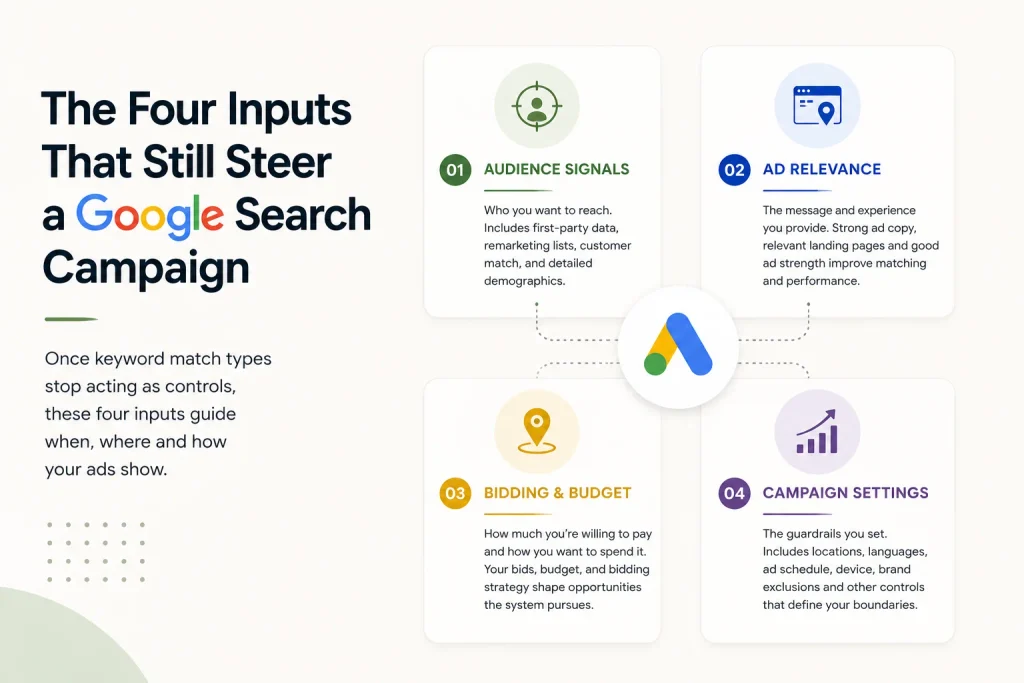
When match types stop being controls, four inputs still steer a search campaign: what you exclude, where you send traffic, what you count as success, and what the system is allowed to say. Advertisers who neglected these because keywords felt sufficient will feel the change hardest.
1. Negative keywords — the only hard constraint left
Negatives still mean what they say. In a system where everything else is inference, an explicit exclusion is the one instruction reliably obeyed.
This inverts old practice. The negative list used to be housekeeping. It is now the primary targeting control, and it should be reviewed weekly against the search terms report rather than quarterly.
Watch the breadth. A single-word negative applied campaign-wide can silently remove traffic you want, and nobody notices because absence generates no report.
2. Landing pages — now a targeting input
This is the change most advertisers miss. Where final URL expansion is active, Google reads your landing pages to decide which queries you are relevant to and which page to send each searcher to.
Your website has quietly become part of your targeting. A thin services page, a page describing products you no longer sell, an old campaign page still indexed — each is now a signal telling Google what to match you against.
Before enabling anything that expands URLs, audit what is actually on the site and exclude pages you do not want used.
3. Conversion signals — what the system optimises toward
Automated bidding optimises toward whatever you count. Count badly and it will efficiently find you more of the wrong thing.
If every form fill counts equally, the system learns to find form-fillers, not buyers. Our guide on which conversions are worth optimising toward covers how to separate the two.
The system also needs enough signal to work with. Google recommends at least 30 conversions in the past 30 days for Target CPA bidding to perform reliably — which is also why splitting thin conversion data across too many campaigns hurts, as why fewer campaigns usually perform better sets out.
4. Assets — what it is allowed to say
Headlines, descriptions and sitelinks — renamed from “ad extensions” to “assets” back in 2022, though half the internet still uses the old term.
Where text customisation is enabled, the system can generate copy tailored to individual searches. Pinning still works: pinned assets in responsive search ads continue to be respected after the AI Max upgrade, which matters if you have legal or brand language that cannot vary.
Weak assets used to mean a weak ad. They now mean weak evidence about what you sell, which affects what you get matched to in the first place.
The September 2026 change, and what to do about it
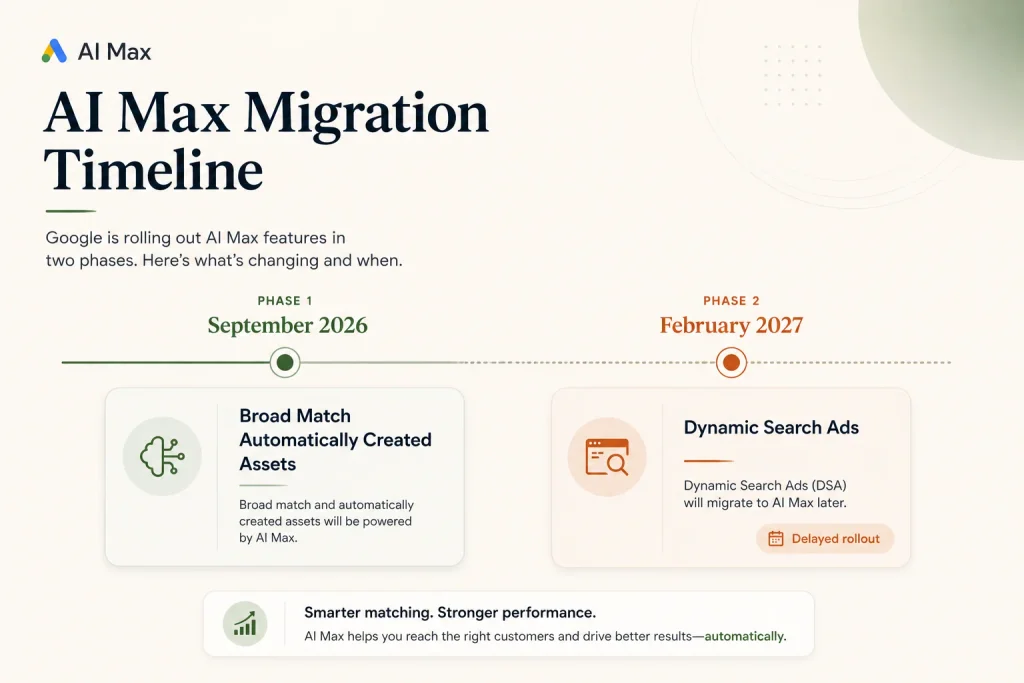
Concrete dates, because this is the part with a deadline attached.
Google emailed advertisers on 5 August 2026. From 1 September 2026, campaigns using the campaign-level broad match setting or automatically created assets are being converted to AI Max for Search, with eligible upgrades expected to conclude by the end of September.
Campaigns in the broad match group receive search term matching only by default. Because final URL expansion requires text customisation to be active, landing page rerouting and generated copy do not apply to that group automatically.
Dynamic Search Ads are on a separate timetable. That migration was postponed from September 2026 to February 2027, announced on 11 June 2026.
The Default Trap. Doing nothing does not mean avoiding the change. It means accepting Google’s configuration of it. Voluntary migration tools are available, and migrating on your own schedule lets you choose your feature settings rather than inheriting assigned defaults.
Three things worth doing before the window closes.
Find out whether you are affected. Check whether any campaign uses the campaign-level broad match setting or automatically created assets. Many advertisers have these switched on without knowing.
Clean the negative list first. If matching is about to widen, the exclusions had better be right beforehand.
Audit the landing pages you would not want used. Thin pages, outdated pages, pages for discontinued products.
What search ads cost
There is no list price. You are in an auction, and what you pay depends on the competitiveness of your keyword, your Quality Score and what your competitors bid.
India’s paid search market reached ₹16,581 crore in 2025 — about 23% of a ₹71,621 crore digital advertising market, according to dentsu India. That is a large and competitive auction, and rising.
Rather than trusting a published average cost per click, use Keyword Planner for your terms in your geography, then work backwards from what a customer is worth. Our guide to what Google Ads actually costs in India covers that arithmetic, including why most of the CPC figures circulating online have no traceable source.
Mistakes that cost real money
Treating exact match as a guarantee. It has been an approximation for years and is becoming more so.
Ignoring the search terms report. It was always the most valuable report in the account. It is now the only reliable window into what you are actually buying.
Sending all traffic to the homepage. Weak relevance, weak Quality Score, and now weak evidence about what you sell.
Counting every form fill as a conversion. The system will optimise toward exactly what you count.
Judging a campaign in its first fortnight. Automated bidding needs a learning period, and early data is noise.
Assuming ads help organic rankings. They do not. Google has been consistent on this for years. They can both appear on the same page and that is the whole relationship.
Leaving Search Partners and Display on by default. Fine if chosen deliberately. Expensive if not, and it is switched on unless you turn it off.
When search ads are the wrong channel
Nobody is searching for what you sell. The clearest disqualifier. If Keyword Planner shows negligible volume for the phrases your buyers would use, there is no demand to capture and a demand-creation channel is where you should be — our comparison of Google and Meta covers how to decide.
You cannot reach the data thresholds. Automated bidding needs volume. Below it, results are unstable regardless of how well the account is built.
Your follow-up is slow. Search ads deliver people at the moment of intent. That advantage evaporates over a two-day response time.
You need results with no budget. Search advertising is fast, not cheap, and it stops the day you stop paying.
Search ads checklist
☐ Keyword Planner checked for real volume on your buyer’s actual phrases
☐ Search Partners and Display Network deliberately switched on or off
☐ Conversion tracking installed and verified as firing
☐ Only meaningful actions counted as conversions
☐ Negative keyword list built before launch, reviewed weekly after
☐ Landing page matched to the query, not the homepage
☐ Every responsive search ad asset slot filled
☐ Brand-critical or legally required copy pinned
☐ Campaigns checked for the campaign-level broad match setting or automatically created assets
☐ Migration decision made deliberately rather than by default
☐ Landing pages audited for anything you would not want used as a targeting signal
☐ One metric agreed as the campaign’s measure for the quarter
Questions we get asked
What is the difference between search ads and display ads?
Search ads are text and appear when someone searches. Display ads are visual and appear on websites and apps while people do something else. Search captures demand; display creates or reminds.
Are search ads better than SEO?
Different instruments. Search ads are immediate, controllable and stop when you stop paying. SEO is slow, cheaper over time and compounds. Most businesses eventually want both, and the honest answer about which to start with depends on how fast you need results and how long you can wait.
Do Google Ads improve my organic rankings?
No. Google has stated repeatedly that paid spend does not influence organic ranking.
What are keyword match types, and do they still matter?
Broad, phrase and exact, in decreasing order of breadth. They still shape behaviour but no longer determine it, and under AI Max keywords are treated as broad match regardless of assignment. Think of them as a stated preference.
How long before search ads work?
Traffic arrives within hours. Reliable performance takes longer — expect a learning period after launch and after any significant change, and give a campaign a quarter before concluding anything.
Should I run search ads myself or hire someone?
Below a modest spend, most agency fees outweigh what better management recovers. Above it, the maths usually turns. How to choose a Google Ads agency in India covers what to ask.
What to do this week
Two checks, twenty minutes.
Open your campaign settings and look for the campaign-level broad match setting and automatically created assets. If either is on, you are in the September migration and the decision is whether you make it deliberately or have it made for you.
Then open the search terms report and read what you are actually buying. In a system where keywords are hints, that report is no longer a diagnostic — it is the account’s only honest mirror.
If you would like someone to look at what your account is about to become, you can reach out to us on whatsapp at +91 7738844851 .
More in Blog
Keep reading
All articles →

Ready to talk about your growth?
Tell us what's stuck and we'll tell you what we'd do first. Free, 30 minutes, no pitch.